On this page
If you are studying haloarenes for CBSE boards or JEE Main, Fittig's name turns up twice in one short section: the Wurtz-Fittig reaction and the Fittig reaction. Both sit under "Reaction with metals" in Unit 6, Haloalkanes and Haloarenes, of the NCERT Class 12 Chemistry textbook (page 186 of the 2026-27 reprint). Here is who Fittig was, what each reaction does, and a worked example of the side products examiners like to ask about.
Who was Rudolph Fittig?
Rudolph Fittig was a German organic chemist, born in Hamburg on 6 December 1835 and died in Strasbourg on 19 November 1910, according to the Deutsche Biographie. He turned fully to chemistry at Göttingen in 1857 on Friedrich Wöhler's advice and took his doctorate under Heinrich Limpricht in 1858. He became a full professor at Tübingen in 1870 and in 1876 moved to Strasbourg, succeeding Adolf von Baeyer (same source).
The benzene reactions are only part of his work. The Deutsche Biographie credits him with discovering lactones, the cyclic esters of hydroxy acids, and with finding phenanthrene among the products of coal tar. The American chemist Ira Remsen was one of his doctoral students, as Wikipedia's biography of Fittig notes.
What is the Wurtz-Fittig reaction?
The story starts with Wurtz. In 1855 Charles-Adolphe Wurtz reported that sodium joins two alkyl groups, 2 R-X + 2 Na → R-R + 2 NaX, as the Wurtz reaction page records with his original papers. Our profile of Charles-Adolphe Wurtz and the reaction he found in 1855 tells that half of the story.
Fittig's step was to bring a benzene ring into it. In 1864 he and Bernhard Tollens published "Ueber die Synthese der Kohlenwasserstoffe der Benzolreihe" (On the synthesis of hydrocarbons of the benzene series) in Justus Liebigs Annalen der Chemie (DOI 10.1002/jlac.18641310307). A follow-up with Joseph König in 1867 dealt with ethylbenzene and diethylbenzene (DOI 10.1002/jlac.18671440308). The Deutsche Biographie calls this "Fittig synthesis" the analogue of Wurtz's: halogen derivatives of benzene react with alkyl halides to give benzene homologues.
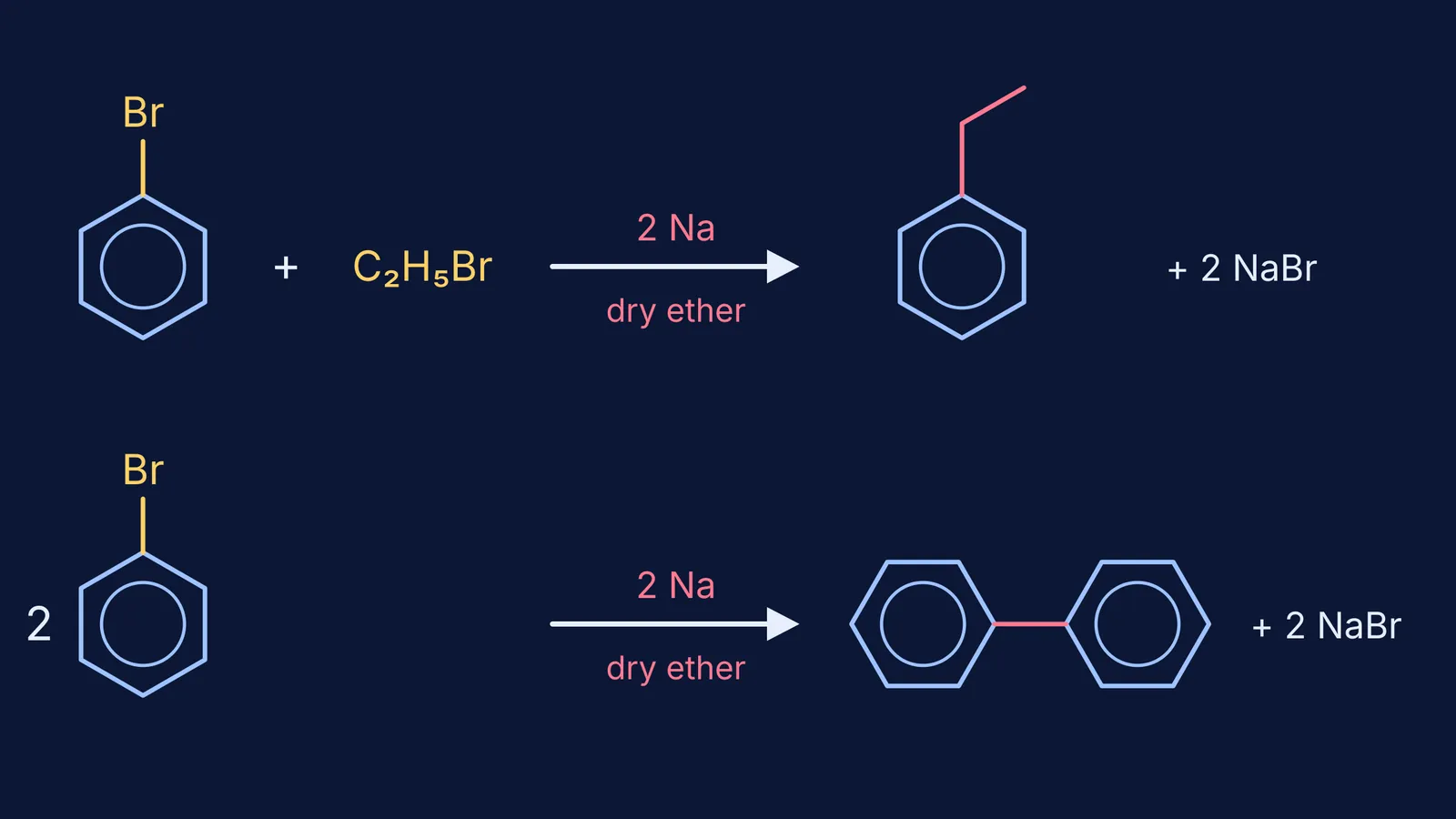
NCERT's definition is the one to learn: "A mixture of an alkyl halide and aryl halide gives an alkylarene when treated with sodium in dry ether and is called Wurtz-Fittig reaction" (NCERT Class 12 Chemistry, Unit 6). Balanced, it reads Ar-X + R-X + 2 Na → Ar-R + 2 NaX.
What is the Fittig reaction, and how is it different?
In the Fittig reaction, aryl halides treated with sodium in dry ether join two aryl groups together, and NCERT's example is 2 C6H5X + 2 Na → C6H5-C6H5 (diphenyl) + 2 NaX (NCERT Class 12 Chemistry, Unit 6). So the difference is only in what the sodium joins.
Worked example: what forms from bromobenzene, bromoethane and sodium?
The expected answer is ethylbenzene, C6H5-CH2CH3, the alkylarene. But sodium does not pair the groups selectively, so a mixture of the two halides can give three products:
Phenyl + ethyl gives ethylbenzene (the Wurtz-Fittig product you want).
Ethyl + ethyl gives butane, CH3CH2CH2CH3 (a Wurtz coupling).
Phenyl + phenyl gives biphenyl, C6H5-C6H5 (a Fittig coupling).
This is the same counting you do for a Wurtz reaction with two different alkyl halides, which we work through in what forms when Wurtz uses two different halides. Chemists do steer it: the Wurtz-Fittig reaction page notes the reaction works best for the cross product when the two halides differ in reactivity, and that the method is troubled by side reactions such as rearrangements and eliminations.
Now try one yourself before reading the answer: chlorobenzene, chloromethane and sodium in dry ether. The intended product is toluene (methylbenzene). The side products are ethane, from two methyl groups, and biphenyl, from two phenyl groups.
How do you keep these reactions straight in an exam?
Use this four-step check on any sodium question:
Circle each halide and mark it alkyl (halogen on an sp3 carbon) or aryl (halogen on a ring carbon).
Name the reaction from the mix: alkyl + alkyl, alkyl + aryl, or aryl + aryl.
Write the main product by joining the two groups where the halogens were.
If two different halides are present, list every pairing as a possible product, then give the cross product as the intended main product.
If you keep landing on the wrong product, the Fermi Problem Library has worked problems with a step-by-step solver that explains the reasoning rather than printing an answer. If the gap is earlier, in why a halogen on a ring behaves so differently from one on a chain, the Fermi Concept Library gives each concept its own lesson.
For the other side of haloarene chemistry, read why ortho and para nitro groups make chlorobenzene reactive.