On this page
If you have met the line "alkyl halide + sodium in dry ether gives a higher alkane" in your organic chemistry notes, you have met the work of one person. Charles-Adolphe Wurtz, a chemist from Strasbourg working in Paris, published the method in 1855.
Who discovered the Wurtz reaction?
The Wurtz reaction is named after Charles-Adolphe Wurtz, who discovered it in 1855 (Wikipedia: Wurtz reaction).
Wurtz was born in Strasbourg on 26 November 1817, the first child of a Lutheran pastor, according to a 2021 biography by Aleksander Sztejnberg in Revista CENIC Ciencias Químicas. He began his chemical career as an assistant to the French chemist Jean-Baptiste Dumas, as an 1882 profile in Popular Science Monthly records.
The 1911 Encyclopædia Britannica lists the rest of his career: the chair of organic and mineral chemistry at the Paris faculty of medicine from 1853, dean of the faculty of medicine from 1866 to 1875, and first holder of the chair of organic chemistry at the Sorbonne from 1875. The same entry credits him with methylamine in 1849, glycols in 1856 and aldol in 1872.
What did Wurtz actually do in 1855?
In the 1850s, chemists used the word "radicals" for groups such as ethyl or butyl that seemed to pass unchanged through reactions. The 1882 Popular Science Monthly profile says his 1855 investigation confirmed the theory of Laurent, Gerhardt and Hofmann that these alcohol radicals have a "double nature".
His answer appeared in German as "Ueber eine neue Klasse organischer Radicale" (On a new class of organic radicals) in Justus Liebigs Annalen der Chemie, volume 96, pages 364–375 (Crossref record, DOI 10.1002/jlac.18550960310). The fuller French version, "Sur une nouvelle classe de radicaux organiques", ran in the Annales de chimie et de physique, volume 44, pages 275–312 (Wikipedia: Wurtz reaction).
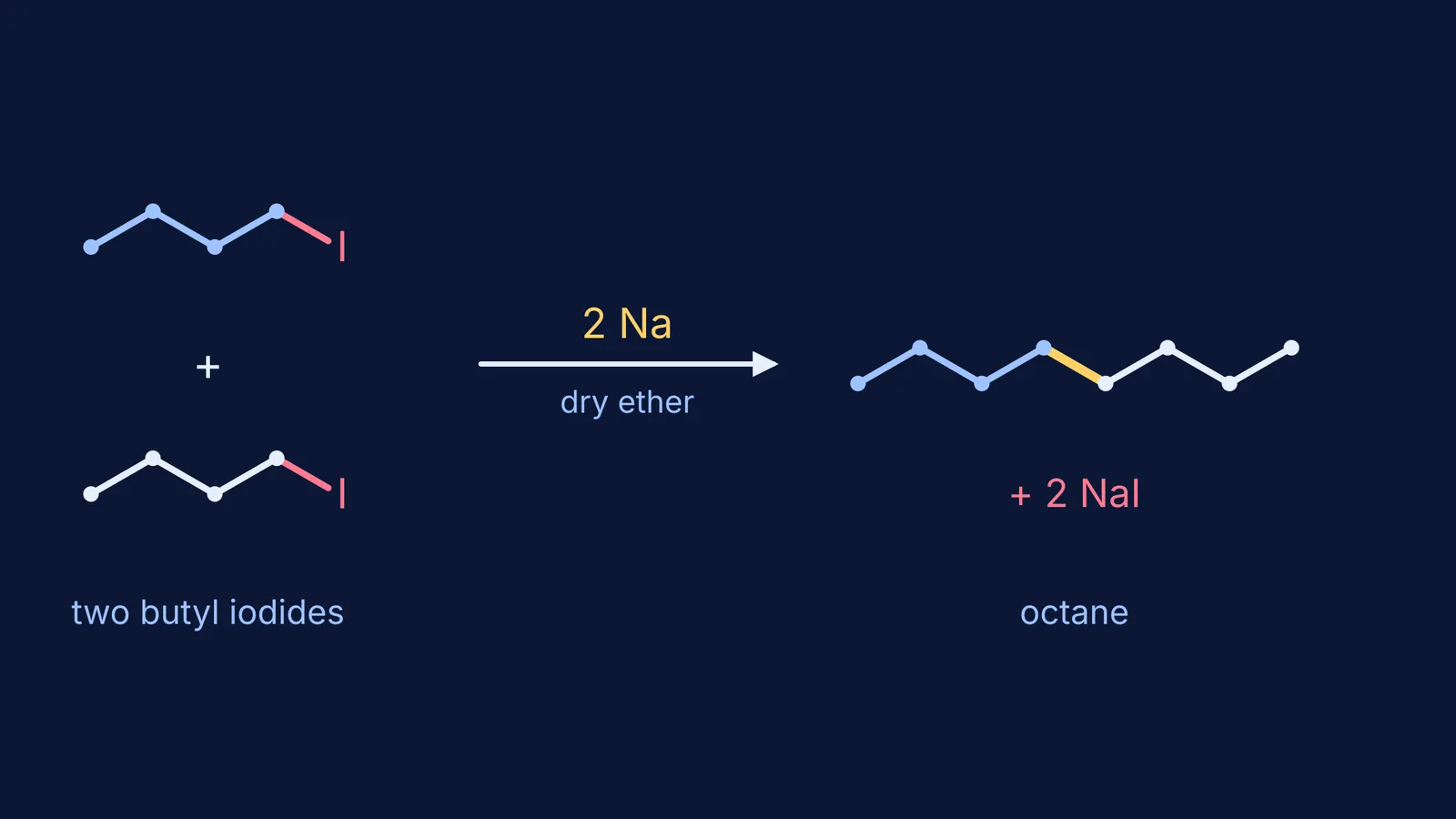
Sztejnberg's biography describes the key experiments. Butyl iodide with sodium gave octane. A mixture of butyl and ethyl iodides with sodium gave hexane. In modern terms, what looked like a free radical was a doubled molecule: two alkyl groups joined by a new carbon–carbon bond.
How does the Wurtz reaction work?
The general equation is 2R–X + 2Na → R–R + 2NaX, where R is an alkyl group and X is a halogen (LibreTexts: Wurtz reaction).
The same LibreTexts page gives the usual teaching mechanism:
Sodium gives one electron to the halide, forming sodium halide and an alkyl radical.
The radical takes a second electron from another sodium atom and becomes an alkyl anion.
That anion attacks a second alkyl halide in an SN2 step, forming the new C–C bond.
The solvent must be dry ether because sodium reacts with water. Even then, the method has weak points: yields are low, and warm sodium attacks many common functional groups (Wikipedia: Wurtz reaction). For another metal that joins carbon chains, read how Victor Grignard used magnesium.
How do you predict the product of a Wurtz reaction?
Use this three-step check on any exam question.
Write the alkyl group from each halide. Ignore the halogen and the sodium.
Join the groups at the carbons that held the halogens. If there is only one halide, join the group to a copy of itself.
If two different halides are mixed, write all three pairings: R–R, R'–R' and R–R'.
Worked example 1: ethyl bromide (CH3CH2Br) with sodium. The group is ethyl, two carbons. Ethyl joined to ethyl gives CH3CH2CH2CH3, butane.
Worked example 2: 2-bromopropane with sodium. The halogen sits on the middle carbon, so the two middle carbons bond. The product is (CH3)2CH–CH(CH3)2, which is 2,3-dimethylbutane, not hexane. Students who join the chains end to end lose this mark.
Worked example 3: methyl bromide and ethyl bromide together. Methyl–methyl gives ethane, ethyl–ethyl gives butane and methyl–ethyl gives propane. You get a mixture. Our post on the Wurtz reaction with two different alkyl halides works through more of these.
Two quick checks follow from step 2. The product always has at least two carbons, so methane cannot be made this way. And a single halide always gives an even number of carbons.
If you keep picking the wrong joining carbon, the Fermi Problem Library has worked problems with a step-by-step solver that explains the reasoning rather than printing an answer.
Why does the Wurtz reaction still matter?
Wurtz's 1855 idea, that a metal can pull halogens away and let two carbon groups bond, carries on in related reactions. The same sodium coupling, applied to aryl halides, appears in our explainer on Wurtz-Fittig and Fittig reactions.
For your revision, link the name to the date and the result: Wurtz, 1855, sodium joins two alkyl halides into one longer alkane. If radicals, carbanions or SN2 steps still feel shaky, the Fermi Concept Library gives each chemistry concept its own lesson and shows where it sits in the map.