

On this page
In 1899, a young chemist in Lyon took a suggestion from his supervisor and started working with magnesium. Within a year he had a method that organic chemists still use to join one carbon chain to another. If you are learning how alcohols are made from carbonyl compounds, you are learning Victor Grignard's chemistry.
Who was Victor Grignard?
François Auguste Victor Grignard was born in Cherbourg, France, on 6 May 1871, according to his Nobel Prize biography. He failed the licentiate examination in mathematics at the University of Lyon, left for military service in 1892, and came back to finish his mathematics degree in 1894.
In December 1894 he took a junior post in the science faculty at Lyon, first working with the chemist Louis Bouveault. After a promotion he began a long association with Philippe Barbier, the chemist who would point him towards magnesium.
How did Grignard discover his reagent in 1900?
In 1899 Barbier had published the first known study of organomagnesium compounds reacting with carbonyl compounds, but the reaction often gave low yields and was hard to reproduce, as the history of Barbier's work records. He asked Grignard, his graduate student, to improve the conditions.
Grignard changed the order of events. He first treated magnesium turnings with methyl iodide in anhydrous ether at room temperature, making the organomagnesium compound on its own. Only then did he add an aldehyde or ketone, and finally dilute acid, giving secondary or tertiary alcohols in much better yields than Barbier had obtained, as a description of the original 1900 paper explains.
The result was first communicated to the Académie des Sciences by Henri Moissan on 11 May 1900, according to the Nobel biography. The paper appeared in the Comptes rendus, volume 130, page 1322, as cited in a 2009 history of Grignard reagents in Organometallics. Grignard wrote his doctoral thesis on these compounds in 1901.
By the time Grignard died in 1935, there were over 6,000 references to his reagents in the chemical literature, says the Nobel biography.
What does a Grignard reagent actually do?
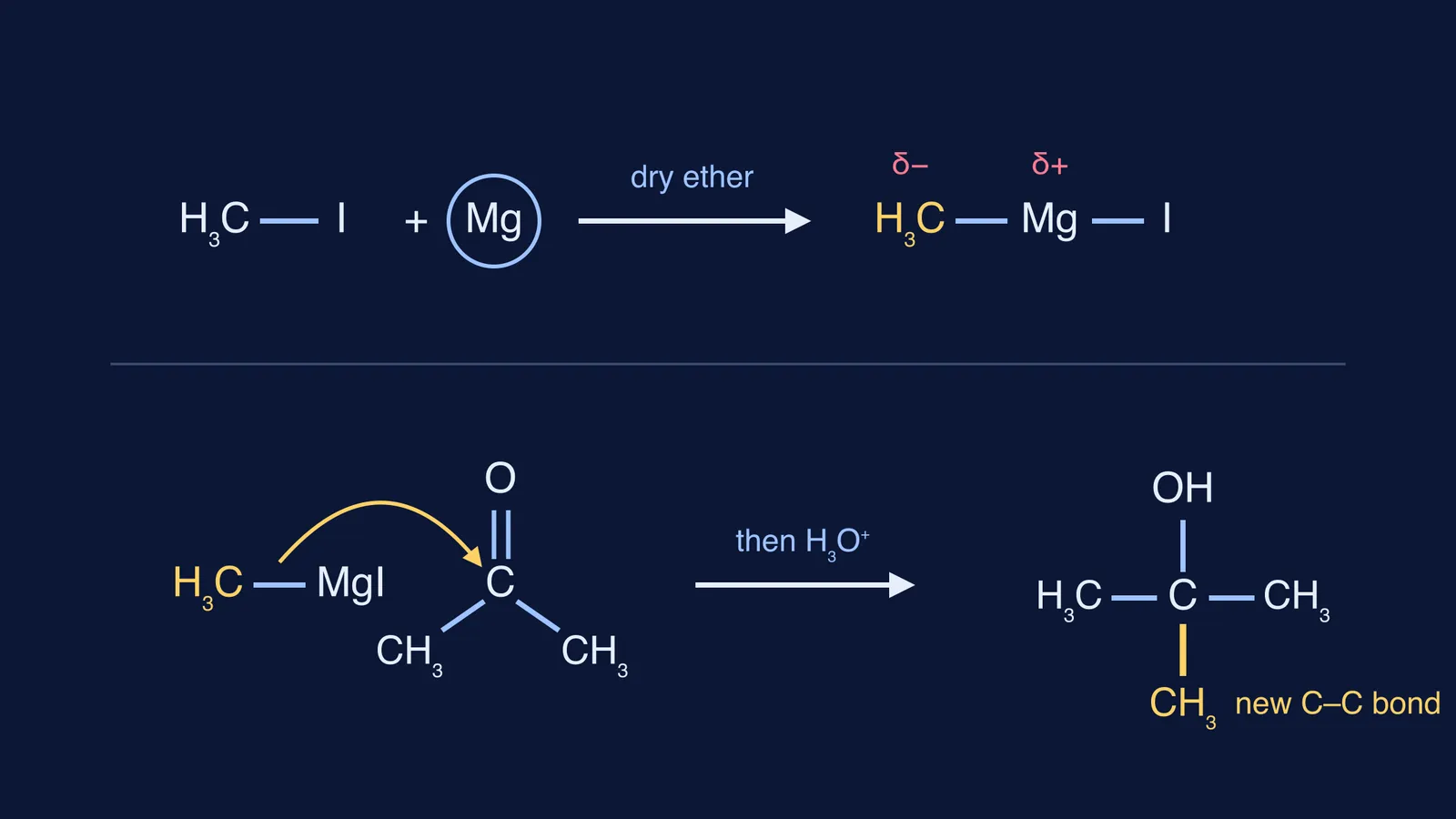
A Grignard reagent has the general formula RMgX, where R is an organic group and X is a halogen, and it is normally handled as a solution in diethyl ether or tetrahydrofuran (Grignard reagent overview). The carbon-magnesium bond is polar, with extra negative charge on carbon, so that carbon behaves as a nucleophile and attacks electron-poor carbon atoms.
The most useful target is the carbon of a C=O group. Formaldehyde gives a primary alcohol, other aldehydes give secondary alcohols and ketones give tertiary alcohols (Grignard reaction overview).
Worked example: methylmagnesium iodide plus acetone.
Make the reagent: CH3I + Mg in dry ether gives CH3MgI.
Add acetone, (CH3)2C=O. The CH3 carbon bonds to the carbonyl carbon, and oxygen ends up attached to MgI.
Add dilute acid. The O-MgI becomes O-H.
Count the carbons: 1 from the reagent plus 3 from acetone gives 4. The product is 2-methylpropan-2-ol, a tertiary alcohol, because a ketone was used.
Why did Grignard win the 1912 Nobel Prize?
The Nobel committee gave Grignard half of the 1912 chemistry prize "for the discovery of the so-called Grignard reagent, which in recent years has greatly advanced the progress of organic chemistry" (Nobel Prize 1912 summary). The other half went to Paul Sabatier for hydrogenating organic compounds with finely divided metals; you can read his story in our post on Paul Sabatier and catalytic hydrogenation.
Grignard himself used the reagents to prepare and study alcohols, ketones, keto-esters, nitriles and terpene compounds, the Nobel biography notes.
How do you use Grignard reactions in exam problems?
Most questions give you a target alcohol and ask what to start from. Work backwards with this four-step check:
Find the carbon carrying the OH group.
Count how many carbon groups are attached to it: one means primary, two secondary, three tertiary.
Cut one C-C bond to that carbon. The piece you cut off becomes R in RMgX; the rest, with C=O in place of C-OH, is your carbonyl compound.
Check the carbonyl type matches: formaldehyde for primary, another aldehyde for secondary, a ketone for tertiary.
Try it on 2-methylbutan-2-ol, CH3CH2C(OH)(CH3)2. Cut off the ethyl group and you need ethylmagnesium bromide plus acetone. Cut off a methyl group instead and you need methylmagnesium iodide plus butanone. Both routes are correct.
For more practice, see our guides to choosing the right carbonyl in Grignard retrosynthesis and why a Grignard reagent must be made in dry ether.
If you keep picking the wrong carbonyl partner, the Fermi Problem Library has worked problems with a step-by-step solver that explains the reasoning rather than printing an answer. If the idea of a polar carbon-metal bond still feels shaky, the Fermi Concept Library gives each chemistry concept its own lesson.
Next time you see RMgX on a page, count the carbons before and after. That count is the whole point of what Grignard found.


