On this page
About a hundred years ago, in a hill town in the Nilgiris, Dr Robert McCarrison gave young rats the everyday food of different Indian communities and watched how they grew. The experiment's message, that variety matters, still holds. It is also a good lesson in reading an old study without swallowing all of it.
What did McCarrison do at Coonoor?
McCarrison set up a one-room Beri-Beri Enquiry Unit at the Pasteur Institute in Coonoor in 1918, according to a history by ICMR-National Institute of Nutrition scientists. It became the Deficiency Disease Inquiry in 1925 and the Nutrition Research Laboratories in 1929, with McCarrison as first director. That lab is the ancestor of today's ICMR-NIN in Hyderabad.
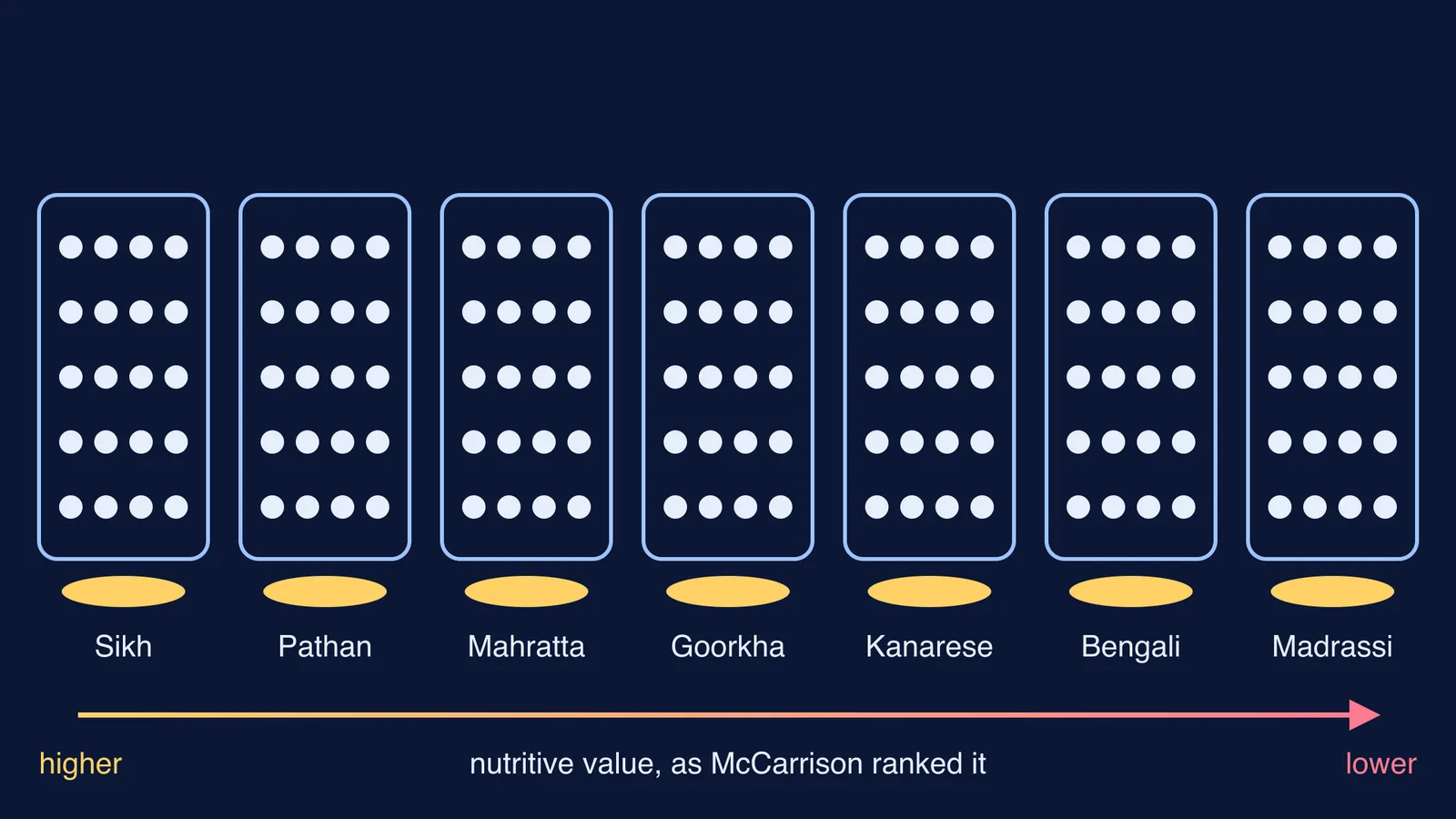
He described the experiment in his 1936 Cantor Lectures, reprinted in Nutrition and National Health. Seven groups of 20 young rats, of the same age, sex mix and body weight, lived in roomy cages "under precisely similar conditions of life." Each group got the diet of one community, "as prepared and cooked" by them: Sikh, Pathan, Mahratta, Goorkha, Kanarese, Bengali and Madrassi. The trial ran for 140 days, which he equated to nearly twelve years of a human life. His paper on these diets was given at a 1927 Far Eastern tropical medicine congress.
Cages, care and starting rats were the same, so diet was the one thing that changed. If you have read about why experiments need a control group, you will see the same logic.
What did the rats' growth show?
McCarrison reported that the diets fell into this descending order of nutritive value: Sikh, Pathan, Mahratta, Goorkha, Kanarese, Bengali and Madrassi. At the end of 140 days he weighed each group and took an average.
The top diet, as he described the food of northern India, was built on chapattis of freshly ground whole wheat, then milk and milk products, dhal, and vegetables and fruit, with meat for some. The bottom diet, the Madrassi one, was in his words "excessively rich in carbohydrates, and deficient in suitable protein, mineral salts and vitamins." A diet can fill the stomach and still fall short.
In a second test, he set rats on the Sikh-style diet against rats on a diet of the poorer classes in England: white bread, margarine, over-sweetened tea, tinned meat and cheap jam. The second group grew stunted, and by the sixtieth day began to kill and eat the weaker ones.
How should you read McCarrison's results critically?
Ask these five questions of this study, and of any diet headline.
Are the subjects people? No. Writing about his rat work, McCarrison said it was "not unreasonable" to expect that "other things being equal, similar results will arise in man." That is an assumption, and so is his 140-days-to-twelve-years conversion.
Who built the diets? One lab cooked one version of each community's food. Real homes differed by income, season and village.
What labels were used, and why? The historian David Arnold, in Medical History in 2010, shows that McCarrison, like the earlier researcher McCay, used the colonial "martial races" stereotypes, setting the wheat and dairy diets of Sikhs, Pathans and other northwestern "martial races" against the "poor rice" diets of Bengalis, Biharis and Madrasis. He adds that McCarrison's successor W R Aykroyd and Indian co-workers carried the research on without those stereotypes.
What was measured? Mainly the average weight of each group after 140 days. That tells you about growth, not about how long a rat or a person lives.
Has anyone tested it another way? One lab, 20 rats per group. Look for work that tests the idea differently, as Joseph Goldberger did for pellagra and Takaki Kanehiro did for beriberi in the navy.
What does a balanced diet look like today?
The modern answer comes from the lab McCarrison founded. ICMR-NIN's Dietary Guidelines for Indians open with "Eat a variety of foods to ensure a balanced diet." The booklet says combining cereals with pulses in a 3:1 ratio improves the quality of protein in a meal. It also advises at least 400 g of vegetables a day, and adequate milk or curd for children and adolescents.
Here is a worked example. Say a weekday lunch is a big plate of rice, rasam and pickle: filling, but heavy on one cereal.
Keep the rice, and add a katori of dal or sambar so roughly one part pulse goes with three parts cereal.
Add a vegetable: a poriyal, a salad or greens cooked into the dal.
Finish with curd or buttermilk.
On some days, swap white rice for millets or another whole grain, as the guidelines suggest.
These are everyday habits, not a treatment plan. For anaemia, a growth worry or any medical condition, talk to a doctor or a registered dietitian.
If terms like essential amino acids or micronutrients are fuzzy in your biology chapter, the Fermi Concept Library gives each concept its own lesson, so you can check the idea behind the rule.
Next time you see "this diet is best", ask two questions: what exactly changed, and who decided what counts as normal?