On this page
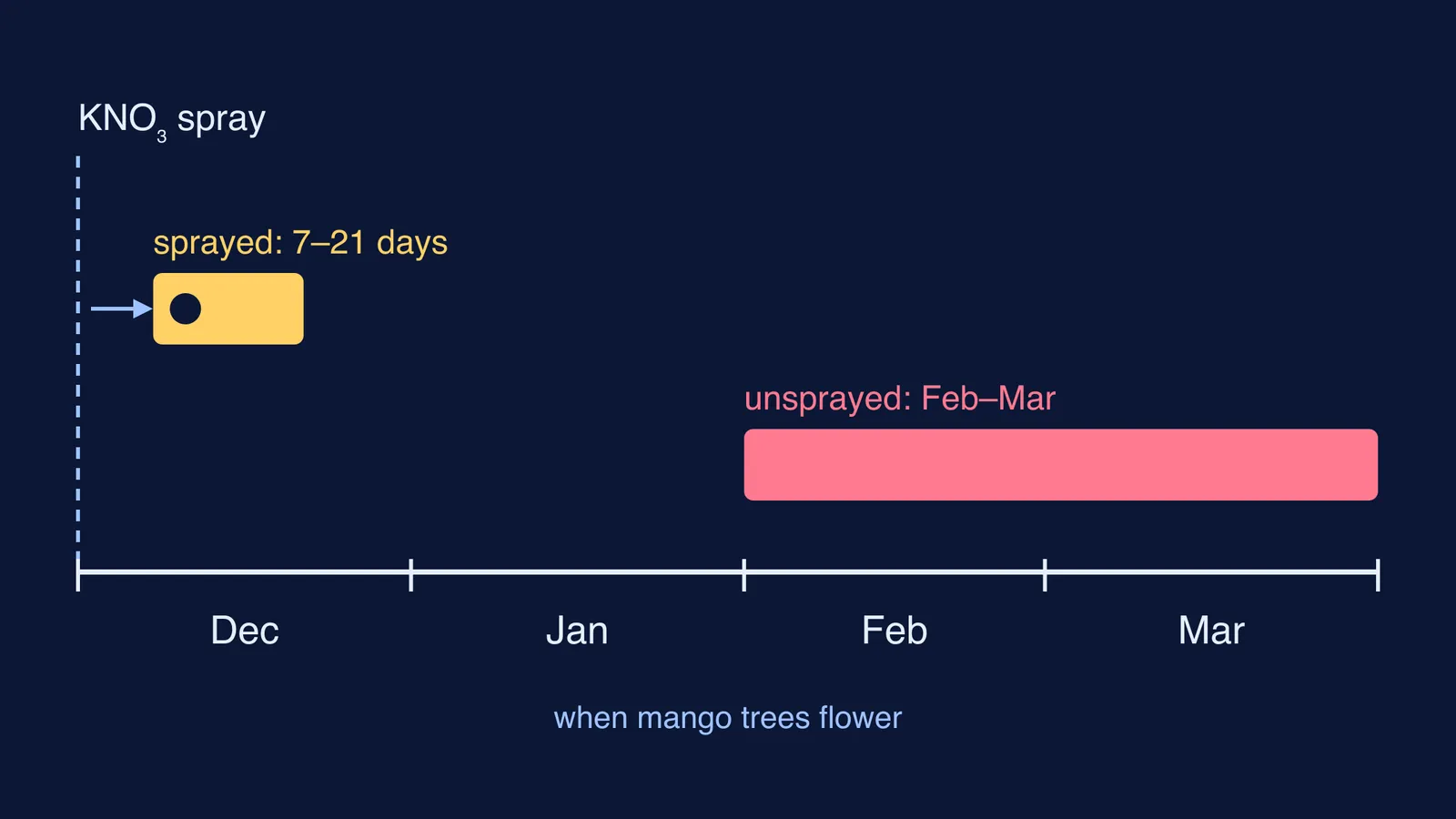
In July 1974, Ramon C. Barba, a plant physiologist at the University of the Philippines Los Baños (UPLB), first filed for a patent on a simple idea: wet a mango tree's leaves with dilute potassium nitrate, and it flowers out of season instead of waiting for its usual months. His US patent, US 4,001,002 on promoting flowering in fruit plants, reports that 0.25 to 2.0 percent potassium nitrate sprayed on mature, dormant trees in December brought flowers within 7 to 21 days, usually within 10. That spray helped make Philippine mangoes a fruit you could buy for much of the year.
Who was Ramon Barba?
Barba was born in 1939 in San Nicolas, Ilocos Norte, and earned a PhD at the University of Hawaii in 1967 (biography). The University of the Philippines says he joined UPLB as an assistant professor in 1969 and developed the flowering method soon after. He was named a National Scientist of the Philippines on 6 June 2014 by Proclamation No. 783, the National Academy of Science and Technology records. He died on 10 October 2021, aged 82, according to the Department of Science and Technology.
Why was mango flowering a problem?
Mango trees in the Philippines flowered only from December to March, and the old way to push them, smudging (smoking the trees), was "costly, laborious and unreliable", Barba's patent states. A separate 1976 patent by Restituto Bugante, for a different spray mixture, gives a sense of the labour: 15 workers spraying made 2,900 trees flower, where smudging them would have needed 415 workers for 14 days (US 3,997,320).
How does potassium nitrate make mango trees flower?
Barba's patent is careful about the conditions. The trees had to be mature, with dormant leaves and buds. Sprayed in December, they flowered within 7 to 21 days; untreated trees did not flower until the following February or March, and the result held on a larger trial of 100 trees. Other nitrates worked too, though somewhat less well, and the patent also covers thiocyanates and thiourea.
Why does a salt do this? A 2007 review by Thomas Davenport in the Brazilian Journal of Plant Physiology splits mango flowering into two events. Initiation is a dormant bud starting to grow, governed by a balance of hormones, thought to be auxin from the leaves and cytokinins from the roots. Induction decides what that new shoot becomes: a flower or more leaves, depending on a temperature-regulated flowering promoter and an age-regulated leafy promoter. Davenport writes that tropical growers manage off-season flowering by using tip pruning and nitrate sprays to synchronise shoot initiation, and by managing stem age.
Can farmers spray too often?
Yes. In 2001 The Philippine Star reported a warning from Barba and Rolando Bugayong, a former president of the Philippine Fruit Association, that farmers forcing trees to bear three times a year were seeing yields fall. Barba's research had found that trees sprayed with 1 percent potassium nitrate every year for five years made fewer new shoots and smaller leaves, and their fruit was smaller. The report's rules of thumb work as a checklist:
Is the shoot mature? It is ready to flower eight to ten months after flushing.
Is the weather dry? Trees respond to the spray in the dry season and are hard to induce in the rains.
Is the strength right? About 1 percent in the regular season and 2 to 2.5 percent off-season.
Has the tree rested? Aim for two crops in three years.
Worked example: read "1 percent" as weight per volume, so 1 g of potassium nitrate per 100 mL, or 10 g per litre. With a molar mass of 39.1 + 14.0 + 3 × 16.0 = 101.1 g/mol, 10 g per litre is about 0.1 mol/L.
Why did Barba refuse royalties?
The method was patented in the Philippines, the USA, England, Australia and New Zealand. Barba "did not collect any royalty from the patent so that ordinary farmers can freely use the technology", the NAST citation says. It credits his work with spreading flowering across several months, giving the Philippines a supply of fresh mangoes throughout the year. He went on to develop micropropagation methods for more than 40 species, including banana and sugar cane.
What can you learn from Barba's experiment?
Look at how the patent argues: sprayed trees against unsprayed controls, stated conditions (mature, dormant, December), several related chemicals, then a repeat on 100 trees. Borrow that pattern for any school investigation.
If you are studying plant hormones, read how night length decides when short-day and long-day plants flower, how ethylene and ethephon drive ripening and flowering, and why grafted mango trees fruit years before seedlings. If auxin, cytokinins and florigen still blur together, the Fermi Concept Library gives each concept in biology and chemistry its own lesson and its place in the map.
Next time you see mangoes on sale outside their usual months, think of a December spray and a ten-day wait.