On this page
In 1980 the ecologist Raman Sukumar began his work on wild elephants in south India (TWAS profile). He earned his doctorate at the Indian Institute of Science (IISc) in Bengaluru, where he later became a professor of ecology (St. Olaf College). His question: why do elephants leave the forest to eat crops, and why do some cause far more trouble than others?
What did Raman Sukumar discover about Asian elephants?
Between 1981 and 1983 he studied an elephant population across 1,130 km² of southern India, from dry thorn forest to evergreen shola forest and grassland (Sukumar 1989, Journal of Tropical Ecology).
Some of the elephants he identified had home ranges of 105 to 320 km², and he defined five clans of 50 to 200 animals each, with overlapping home ranges. Their movements followed food and water. In the dry months of January to April, elephants gathered in river valleys at up to five per km², eating browse plants that held more protein than the coarse grass on the hill slopes. When the first rains came, they spread out into tall-grass forest to eat fresh grass (Sukumar 1989).
He also used nineteenth-century records to show that the basic movement pattern in the region had not changed in more than a century (Sukumar 1989). The elephants were walking old routes. What had changed was the land along them.
Why do elephants raid crops?
His second paper looked at what elephants eat (Sukumar 1990, Journal of Tropical Ecology). They ate at least 112 plant species, but about 85% of their diet came from just 25 of them.
Crop raiding was sporadic in the dry season, rose as more land was planted after the rains, and peaked from October to December, when most farmers grew finger millet (ragi). In that season some villages were raided almost every night (Sukumar 1990).
Cultivated cereal and millet crops gave significantly more protein, calcium and sodium than wild grasses. His conclusion was that crop raiding "can be thought of as an extension of the elephant's optimal foraging strategy" (Sukumar 1990). Put simply, a ragi field is a very rich patch of food, and an elephant that eats it is doing what natural selection shaped it to do.
When he started, the usual view was that elephants ate crops mainly because they had lost their habitat. His work showed that this was not the whole picture, though fragmentation still matters: where forests break into patches, elephants have to cross farms to get from one patch of trees to the next (TWAS profile).
Why do male elephants raid more crops?
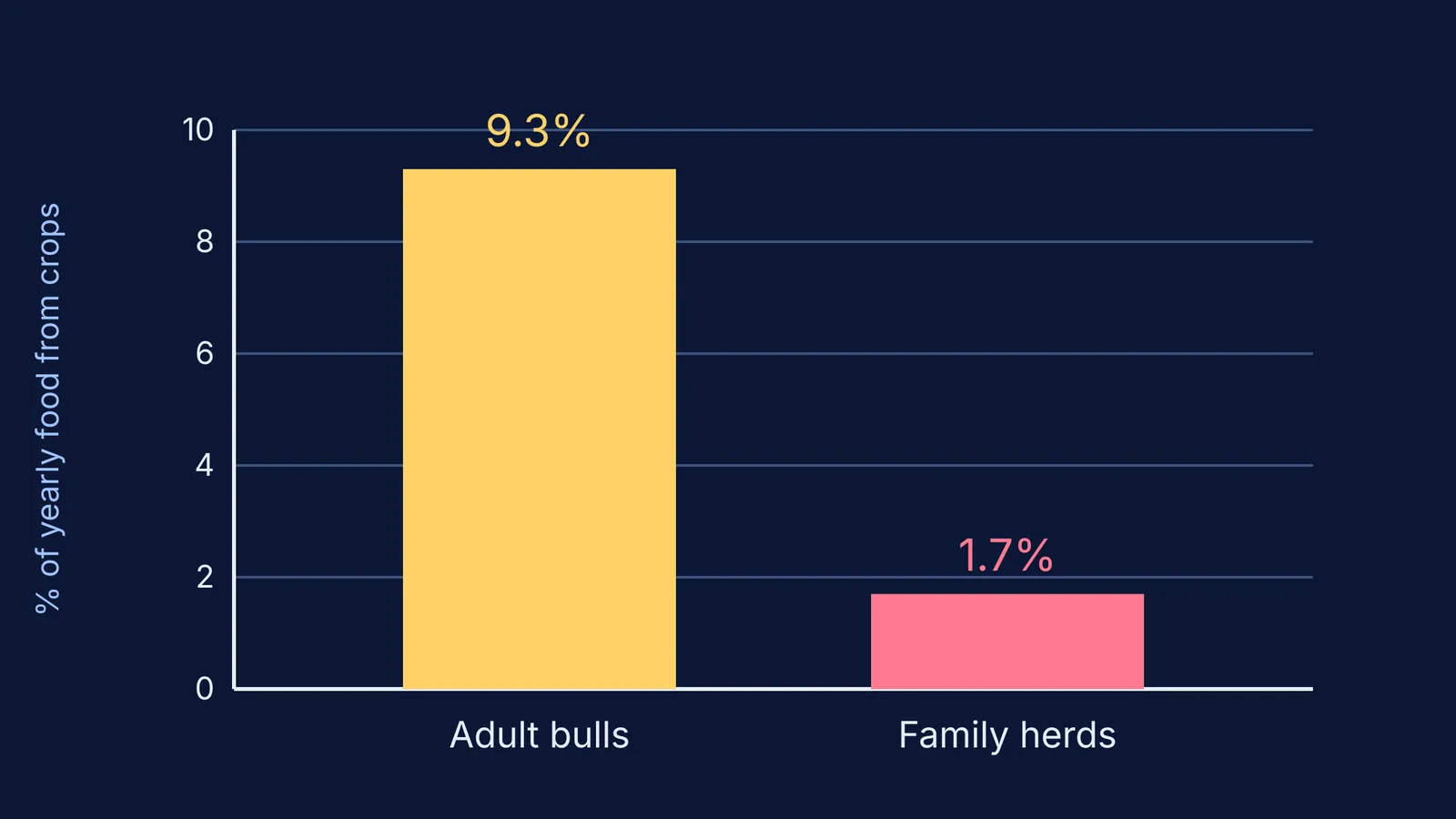
Adult bull elephants got an estimated 9.3% of their yearly food from cultivated land, while family herds got 1.7% (Sukumar 1990). The TWAS profile reports his finding that males raid crops five times as often as females, and links this to musth: to mate successfully, a bull must be healthy enough to enter this intensely hormonal state (TWAS profile).
In 1991 he took the idea further in a paper on managing large mammals in relation to male strategies and conflict with people (Sukumar 1991, Biological Conservation90007-v)).
How serious is human-elephant conflict in India today?
In a written reply in the Lok Sabha in July 2024, the environment ministry listed 606 human deaths caused by elephants in 2023-24, up from 583 in 2022-23; these state totals leave out Kerala, which reported its figures separately (PIB, Ministry of Environment, Forest and Climate Change). The same reply says ex-gratia relief for a death from a wild animal attack was raised from Rs 5 lakh to Rs 10 lakh in December 2023.
How to think about it like an ecologist: a worked example
Use his 1990 figures to practise the reasoning that ecology questions reward (Sukumar 1990).
Turn percentages into something you can picture. 9.3% of a year's food is about 34 days' worth from farms for a bull. 1.7% is about 6 days' worth for a family herd.
Compare the groups. 9.3 divided by 1.7 is about 5.5. That is close to the "five times as often" raiding figure in the TWAS profile, though that counts raids, not food.
Look at timing. Raids peak from October to December, so a farmer's risk is packed into the ragi season, not spread across the year.
Name the interaction. The elephant gains and the farmer loses, a (+, -) relationship you can place in the table of population interaction signs.
Ask what shifts the trade-off. Anything that makes a field less rewarding, or a raid riskier, changes the bull's choice: a hypothesis to test.
Measure first, then explain with evolution: that was Sukumar's method. His work also connects to Class 12 topics such as protecting animals in their own habitat; see our guide to in situ vs ex situ conservation. For another Indian scientist who shaped wildlife protection, read about Kailash Sankhala and the launch of Project Tiger.
If terms like home range, optimal foraging or musth are new to you, the Fermi Concept Library covers every concept in biology, each with its own lesson and its place in the map, so you can see how the ideas connect.