On this page
On a small paper nest, only one wasp lays eggs. The rest feed and guard larvae that are not theirs. Over nearly four decades, Raghavendra Gadagkar and his research group at the Centre for Ecological Sciences, Indian Institute of Science, Bengaluru, have watched these wasps to answer an old question in evolution: why would an animal give up having its own young to help someone else's?
Who is Raghavendra Gadagkar and why study Ropalidia wasps?
Gadagkar is an evolutionary biologist at the Centre for Ecological Sciences, IISc, and an International Honorary Member of the American Academy of Arts and Sciences, elected in 2017. His model animal is Ropalidia marginata, which he describes in a 2016 review in Philosophical Transactions of the Royal Society B as "a primitively eusocial wasp widely distributed in peninsular India."
In such a species workers can potentially switch to the queen role, so you can fairly ask why so many of them help instead.
Why do some female wasps work for others?
The standard answer is kin selection. W.D. Hamilton showed that a gene for helping can spread if the help goes to relatives who carry the same gene. Gadagkar's review states the condition as b.r > c: a benefit, weighted by relatedness, must outweigh the cost to the helper (Gadagkar 2016). For background, see our explainer on W.D. Hamilton's rule of kin selection.
In wasps, bees and ants, males come from unfertilised eggs, so sisters can share more genes with each other than with their own daughters. Our post on how haplodiploidy works in honey bees explains the arithmetic.
What did Gadagkar's field test of kin selection find?
Gadagkar split Hamilton's rule into three measurable factors: productivity, relatedness and survival. The figures below come from his 2016 review.
Group living is the norm: in a long-term study of 145 newly founded (pre-emergence) nests, 92.5 to 95.4% of wasps nested in groups and only 4.6 to 7.5% nested alone.
Queens mate with one to three males, so their daughters are related to each other by an average of 0.53, not the 0.75 the haplodiploidy story needs.
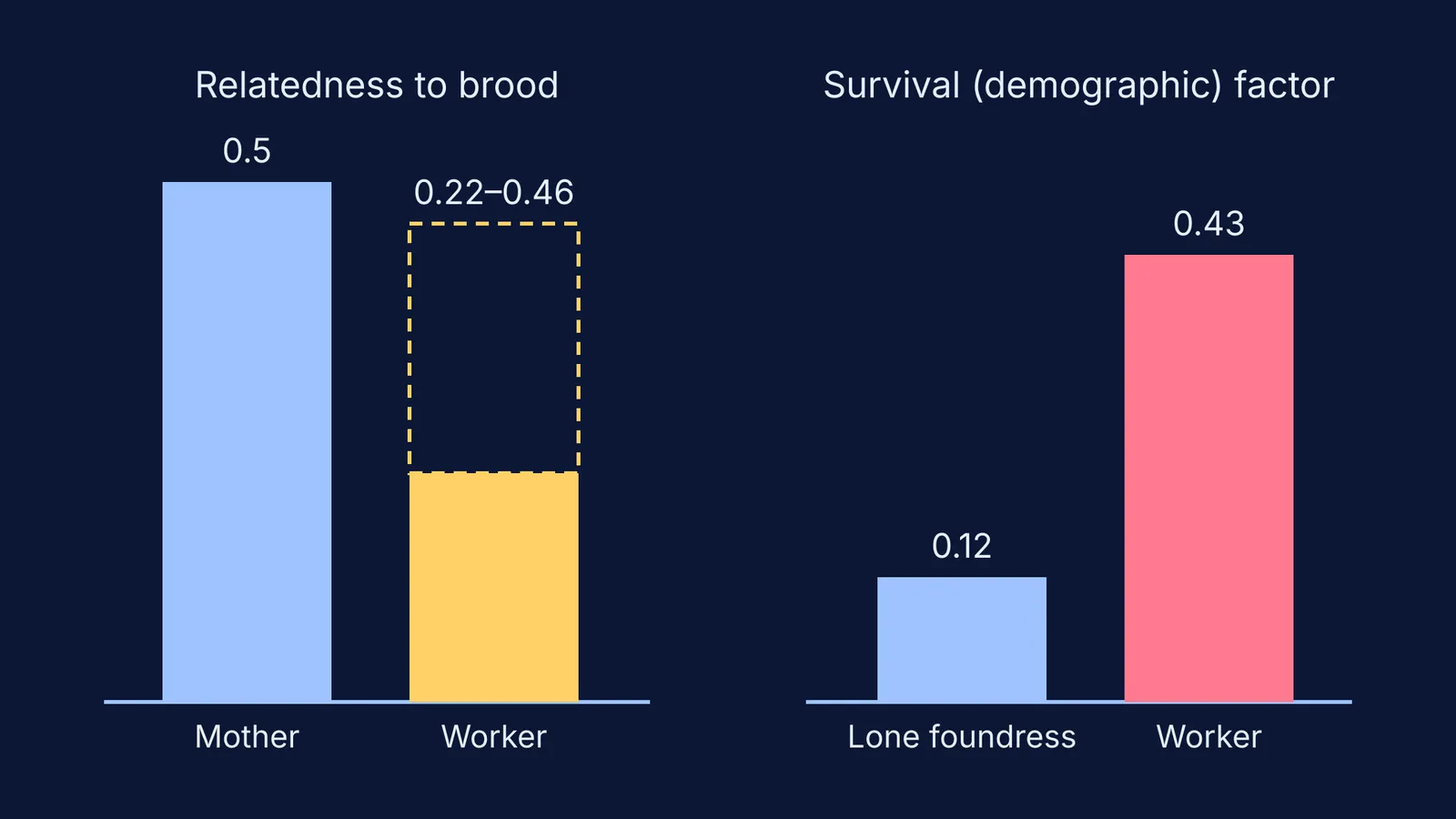
Across four colonies, worker-brood relatedness ranged from 0.22 to 0.46, below the 0.5 a lone foundress shares with her own offspring.
Newcomers join in: of 676 wasps recorded, 217 (32.1%) were joiners, wasps not marked on the nest where they turned up.
Workers make poor lone founders: when workers were forced to nest alone, they raised significantly less brood than wasps that chose to nest alone. So workers give up little.
On relatedness alone, working looks like a bad deal. Productivity helps, and survival matters even more. A lone foundress must stay alive for the 62 days her brood takes on average to develop, and Gadagkar estimated the chance of a wasp surviving that long at 0.12. If a worker dies, others finish raising the brood. Gadagkar calls this "assured fitness returns", and for workers he put the matching factor at 0.43.
Combining the three factors, Gadagkar calculated that nesting alone is favoured in only 5.1% of the parameter space, even under assumptions most generous to lone nesting, close to the minority that nest alone in the field.
Do we need to look beyond kin selection?
That is the title question of Gadagkar's paper. Hamilton's rule holds, but here survival and ecology, not high relatedness, do most of the work. He concludes that understanding R. marginata society "will require consideration of several kinds of evolutionary forces, including individual, kin and group selection" (Gadagkar 2016). For another insect story where cooperation has its own logic, see how fig and wasp mutualism works.
How do you use Hamilton's rule in a worked example?
Gadagkar's version compares a worker with a lone foundress. Working is favoured when σ/s is greater than rb/ρβ. Here σ and s are the survival factors, r and ρ are relatedness to brood, and b and β are productivity (Gadagkar 2016).
Survival ratio from the paper: σ/s = 0.43 / 0.12 = about 3.6.
Relatedness from the paper: take r = 0.5 for the lone foundress and ρ = 0.3, a value inside the measured 0.22 to 0.46 range.
Productivity, a made-up harsh value (the paper found workers ahead here): suppose a lone foundress raises 1.5 times a worker's brood, so b/β = 1.5.
Right side: rb/ρβ = (0.5 × 1.5) / 0.3 = 2.5.
Compare: 3.6 is greater than 2.5, so working still wins. Now try: how high would b/β have to climb before nesting alone wins?
If the symbols in Hamilton's rule still feel slippery, the Fermi Concept Library gives each idea its own lesson. To check your working on problems like this, the Fermi Problem Library has a step-by-step solver that explains the reasoning rather than printing an answer.
Next time you see a paper wasp nest, count the wasps. Most of them are betting on the group.