

On this page
In 1859, Charles Darwin admitted a problem that he thought was "insuperable, and actually fatal" to his theory of natural selection. If natural selection relies on individuals surviving to pass their advantageous traits to their offspring, how can a species evolve a caste of entirely sterile workers, like those found in bee and ant colonies? Since a sterile worker never reproduces, it cannot pass on the instincts that make it such a good worker.
He called this "one special difficulty" in On the Origin of Species, correctly guessing that selection could apply to the family unit. The exact proof arrived a century later, in a mathematical inequality formulated by the British evolutionary biologist W.D. Hamilton in 1964.
What is Hamilton's rule?
In his landmark paper, The Genetical Evolution of Social Behaviour90038-4), Hamilton shifted the focus from the individual to the gene. He introduced the concept of inclusive fitness, which states that an organism's genetic success is not just about its own direct offspring. An organism can also pass on its genes indirectly by helping its relatives, who carry copies of those same genes, to survive and reproduce.
Hamilton proved that an "altruistic" or self-sacrificing behaviour will evolve if the genetic payoff outweighs the cost. The condition for this is known as Hamilton's rule:
rB > C
r (Relatedness): The genetic relatedness between the altruist and the recipient. It represents the probability that they share a specific gene by common descent.
B (Benefit): The reproductive benefit gained by the recipient of the help.
C (Cost): The reproductive cost incurred by the individual performing the act.
In short, a trait that causes you to sacrifice your own offspring (C) will still spread through the population if it allows your relatives to produce enough extra offspring (B) to compensate, weighted by how closely related they are to you (r).
Would you save two brothers or eight cousins?
A few years before Hamilton published his rule, the biologist J.B.S. Haldane reportedly joked about the exact mathematics of this idea while drinking in a London pub. When asked if he would give up his life to save a drowning brother, Haldane calculated the odds and replied that he would lay down his life for two brothers or eight cousins.
Haldane's math was exactly right for a diploid organism like a human. As John Maynard Smith explained in the 1964 Nature paper that coined the term kin selection, you share, on average, 50% of your genes with a full sibling, meaning r = 0.5. Saving two brothers (2 × 0.5 = 1.0) is genetically equivalent to saving one "self".
By the same logic, you share 12.5% of your genes with a first cousin (r = 0.125). To break even genetically, you would need to save eight of them (8 × 0.125 = 1.0). (To see how other early biologists shaped our view of populations, read about Theodosius Dobzhansky and evolution seen through genetics or Sewall Wright and genetic drift: why small populations wander.)
Why do worker bees help their sisters?
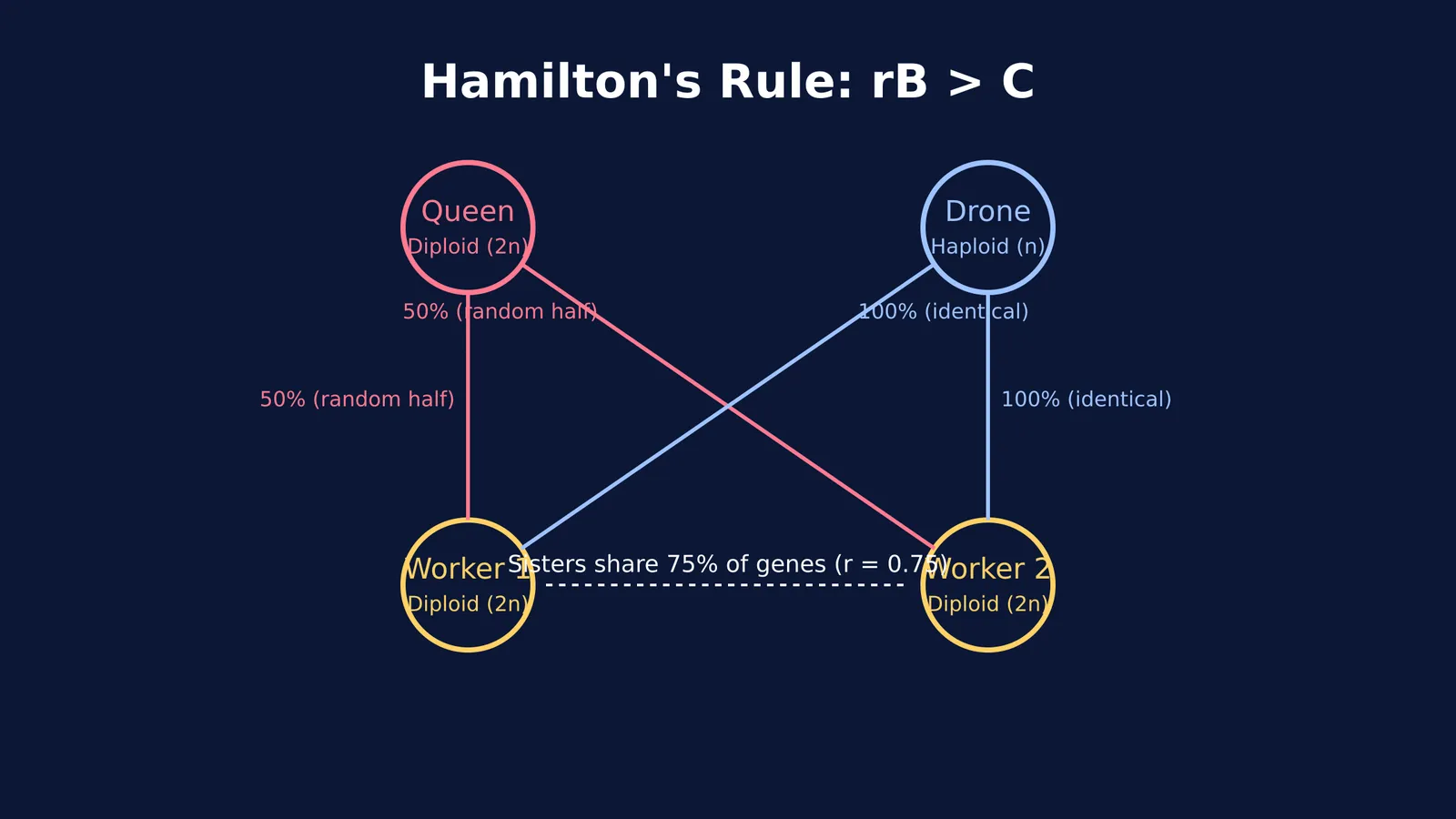
Hamilton used his rule to finally solve Darwin's puzzle of the sterile insects. Bees, ants and wasps belong to the order Hymenoptera, which uses a unique genetic system called haplodiploidy.
As Hamilton detailed in his 1964 paper90038-4), in a beehive, the queen is diploid (she has two sets of chromosomes), but the male drones are haploid (they hatch from unfertilized eggs and have only one set). When a drone mates with a queen, he passes 100% of his identical genes to every daughter. The queen passes on a random 50% of hers.
This creates a mathematical quirk: female worker bees share 75% of their genes with their full sisters (r = 0.75). However, if a worker bee were to reproduce on her own, she would only share 50% of her genes with her own daughters (r = 0.5).
Because r is higher for her sisters than for her own potential offspring, a worker bee gains more inclusive fitness by staying at the hive and helping her mother raise more sisters than she would by leaving to start her own family. The mathematics of rB > C make sterility the winning evolutionary strategy.
How do you calculate relatedness for an exam problem?
Kin selection and relatedness calculations are common in NEET-UG, JEE Main and biology olympiads. If a problem asks you to calculate r between two relatives in a standard diploid family, you can use the path method:
Find the common ancestors. Trace the shortest paths through the family tree from the first person to the second.
Count the steps. For each path, count the number of reproduction steps (links between parent and child).
Calculate 0.5ⁿ. Multiply 0.5 by itself for every step in that path.
Add the paths together. If the individuals share two common ancestors (like two grandparents), calculate the probability for each path and add them up.
If you hit a wall while studying genetics, don't just stare at the text—look for the underlying variables. You can explore the evolutionary trees of different species in the Fermi Concept Library, where every concept connects to its place in the map. And when you need to practice path calculations, the Fermi Problem Library has worked genetics problems with a step-by-step solver that explains the reasoning rather than printing an answer.


