On this page
Every 14 March, written 3/14, people celebrate Pi Day. A better question than "how many digits do you know?" is how anyone knows them at all. No one measures a circle to 100 decimal places; every digit beyond the first few comes from a calculation.
How did Archimedes calculate pi with polygons?
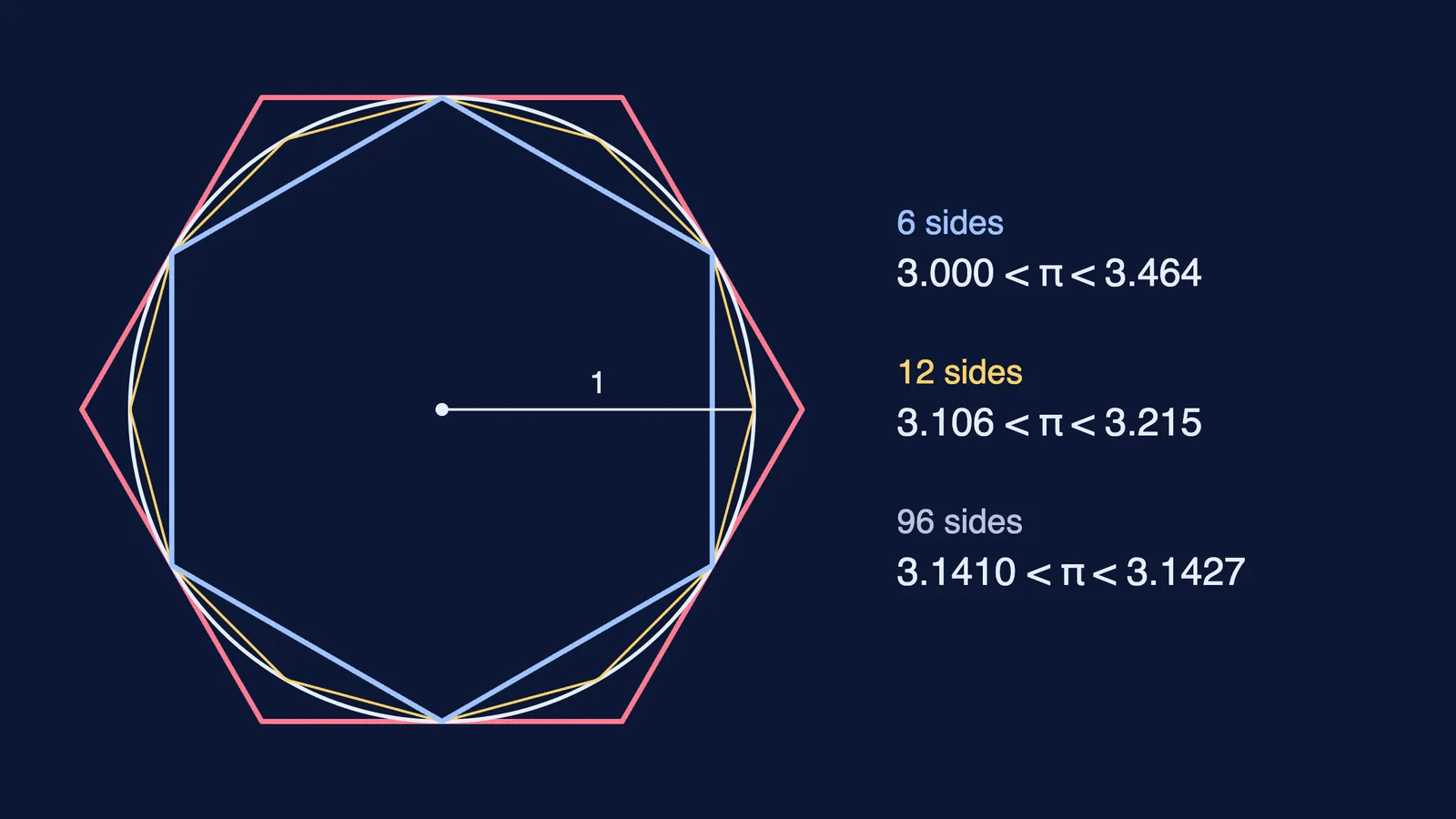
Archimedes of Syracuse (287 to 212 BC) carried out what seems to have been the first theoretical calculation of pi, according to the MacTutor history archive at the University of St Andrews. He drew a regular polygon inside a circle and another outside it. The circle's perimeter must lie between the two, and both can be worked out with geometry alone.
He kept doubling the number of sides until he reached 96. With 96 sides he proved that 223/71 < π < 22/7, which is 3.1408 < π < 3.1429.
You can rerun his calculation on a phone calculator. Take a circle of radius 1 and work with half-perimeters, so the answer is a value for pi directly. Call the outside polygon's value a and the inside one's b. Start with hexagons: a = 2√3 ≈ 3.4641 and b = 3. To double the sides, use two steps:
New a = 2ab ÷ (a + b)
New b = √(new a × old b)
Results, inside value first:
6 sides: 3.0000 < π < 3.4641
12 sides: 3.1058 < π < 3.2154
24 sides: 3.1326 < π < 3.1597
48 sides: 3.1394 < π < 3.1461
96 sides: 3.1410 < π < 3.1427
Each doubling buys less than one new digit, and Archimedes did the square roots by hand.
If the link between a polygon's perimeter and π feels slippery, our post on why the limit of sin x / x in degrees is π/180 shows the same idea in calculus form: n sin(π/n) gets closer to π as n grows.
What was Madhava's series for pi?
Around 1400, Madhava of Sangamagrama, who was born near Cochin in Kerala, replaced polygons with an infinite sum. MacTutor records his series as π/4 = 1 − 1/3 + 1/5 − 1/7 + ..., found more than two centuries before European mathematicians such as James Gregory and Leibniz rediscovered it.
On its own the series is slow: ten terms give 4 × 0.76046 ≈ 3.0418, wrong in the first decimal place. Madhava's insight was a correction for the part left off. One of the three he gave is (n² + 1) ÷ (4n³ + 5n) after n terms. Try it with n = 10: the correction is 101 ÷ 4050 ≈ 0.024938. Add it to 0.760460 to get 0.785398, and multiply by 4: about 3.14159. Ten fractions and one correction beat Archimedes' 96-sided polygon.
Madhava went further. MacTutor records his value of pi correct to 11 decimal places, 3.14159265359, which follows from 21 terms of a faster series he also found: π = √12 × (1 − 1/(3×3) + 1/(5×3²) − ...).
How did Ramanujan's formulas speed things up?
In 1914 Srinivasa Ramanujan published "Modular equations and approximations to π" in the Quarterly Journal of Mathematics. Near the end he gives a series for 1/(2π√2) whose first term is 1103/99², calls it "extremely rapidly convergent", and shows that first term alone gives 0.11253953678 against the true 0.11253953951. That is π ≈ 3.1415927 from one term.
Wolfram MathWorld notes that this series supplies about 8 decimal digits per term. Every term adds a fixed block of digits, and that is the jump that matters.
In 1988 the brothers David and Gregory Chudnovsky published a series built on Ramanujan's ideas that gives 14 decimal digits per term.
How are trillions of digits of pi calculated today?
The pi records listed on y-cruncher's site, from 5 trillion digits in 2010 onward, were all computed with that program. Its rules for a record say the main computation must use its built-in Chudnovsky or Ramanujan formulas and run in "swap mode", working from disk, because few computers have the memory to hold numbers with trillions of digits.
The current record is 314 trillion digits, computed by a StorageReview team in November 2025. According to y-cruncher's site, the run took 110 days on a 384-core AMD Epyc server.
How do they know the digits are right? A separate formula, BBP, found by Bailey and colleagues in 1997, is a digit-extraction algorithm: it produces hexadecimal (base-16) digits of pi at a chosen position without computing the ones before them. The records page requires its result to match the last hexadecimal digits of the main run; for the 314-trillion record, that verification took 4.37 hours.
How can you use this in maths class?
The three methods are three habits you will use with limits and series in Class 11 and 12:
Bound it: trap the answer between two values you can compute (Archimedes).
Correct it: estimate the error you left out, not just the terms you kept (Madhava).
Speed it up: choose a series where each term adds a fixed number of digits (Ramanujan, Chudnovsky).
If the polygons are hard to picture, watching an inscribed shape close in on a circle helps more than reading about it; the Fermi Simulation Lab has interactive simulations for ideas that are easier to see than to read. If infinite series themselves are the gap, the Fermi Concept Library gives each mathematics concept its own lesson. And for where π turns up next, read why e to the iπ equals −1.