
On this page
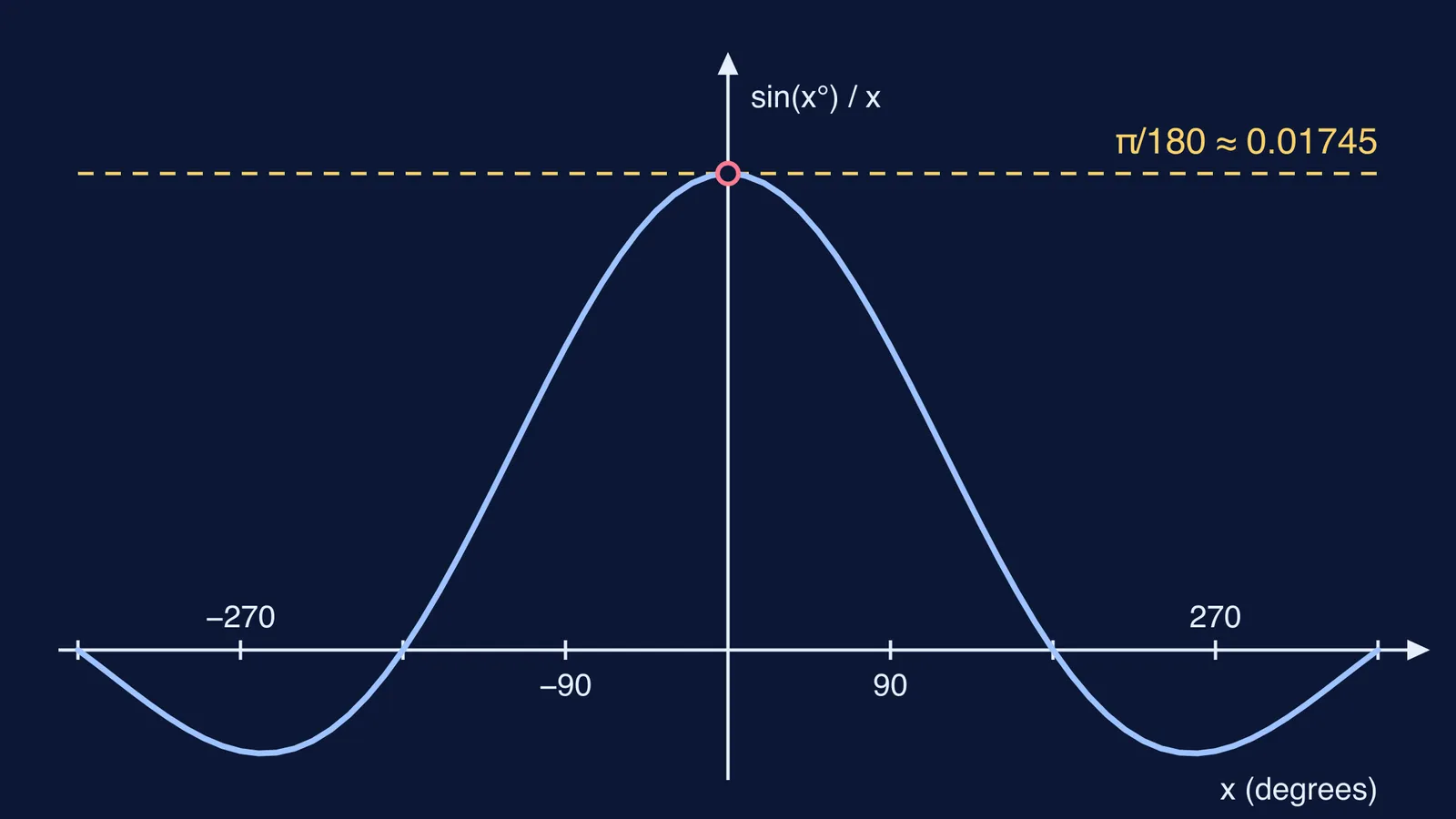
Type sin(1) ÷ 1 into a calculator set to degrees and you get 0.0174524, nowhere near 1. That is not a calculator error. The standard limit, (sin x)/x → 1 as x → 0, is a statement about radians. When x is in degrees, the answer changes to π/180.
Why is the limit of sin x / x equal to 1 only in radians?
The Class 11 NCERT chapter Limits and Derivatives proves Theorem 5, lim x→0 (sin x)/x = 1, with a unit-circle figure in which the angle AOC is "x radians". The proof compares three areas: triangle OAC, sector OAC and triangle OAB. The sector's area is x/2 on a unit circle only because x is in radians, so the arc it cuts off has length x. That gives sin x < x < tan x, and the sandwich theorem squeezes (sin x)/x between cos x and 1, so the limit is 1.
In degrees, an angle of x° cuts off an arc of length πx/180 on a unit circle, not x. The same inequality becomes sin x° < πx/180 < tan x°, and every step after that carries the factor π/180.
If the squeeze step is new to you, read our guide to using the sandwich theorem for limits first.
How do you convert the limit when x is in degrees?
The International Bureau of Weights and Measures lists the degree as 1° = (π/180) rad, in Table 8 (Non-SI units) of the SI Brochure, 9th edition. So an angle of x degrees is πx/180 radians, and the whole conversion is one substitution.
Write the angle in radians: sin x° = sin(πx/180).
Let t = πx/180. As x → 0, t → 0 too, and x = 180t/π.
Rewrite: sin(x°)/x = sin t ÷ (180t/π) = (π/180) × (sin t)/t.
Use the radian limit: (sin t)/t → 1, so the whole expression tends to π/180.
So lim x→0 sin(x°)/x = π/180, which is about 0.0174533.
Can you check it on a calculator?
Yes, and you should. Set your calculator to degree mode (DEG on the screen), then work out sin(x) ÷ x for smaller and smaller x. Here are the values, rounded to eight decimal places, so you can compare each row with your own screen:
x = 30: sin 30° ÷ 30 = 0.5 ÷ 30 = 0.01666667
x = 10: 0.01736482
x = 5: 0.01743115
x = 1: 0.01745241
x = 0.1: 0.01745328
x = 0.01: 0.01745329
Now work out π ÷ 180. To the same eight places it is 0.01745329, the value the list is closing in on.
Then switch to radian mode (RAD) and repeat with x = 0.1 and x = 0.01. You get 0.99833417 and 0.99998333, which close in on 1. Same function key, different unit, different limit.
Where does π/180 show up in exam questions?
A question can test whether you notice a degree sign inside a limit or a derivative. The same substitution handles all of these:
lim x→0 sin(x°)/x = π/180.
lim x→0 tan(x°)/x = π/180, because tan t / t → 1 as well.
d/dx sin(x°) = (π/180) cos(x°), by the chain rule on sin(πx/180).
lim x→0 (1 − cos x°)/x = 0, since the constant multiplies a limit that is already 0.
The third line is a big reason textbooks switch to radians for calculus: without them, every derivative of sine and cosine drags a π/180 along. Our explainer on why we use radians in calculus instead of degrees goes through that in more detail. For a quick test of whether the units have clicked, try which is greater, sin 1 or sin 1°.
How do you check any limit written in degrees?
Use this whenever a question mixes trigonometry and limits:
Spot the unit. A degree sign or the word "degrees" means convert before you do anything else.
Substitute x° = πx/180, pull the constant out in front, and use the radian limit.
Sanity-check with a calculator at x = 0.01 in the matching mode. In degree mode, sin(x)/x should read close to 0.01745; in radian mode, close to 1.
If you want more limits like this to practise on, the Fermi Problem Library has worked problems with a step-by-step solver that explains the reasoning rather than printing an answer, so you can see the exact line where π/180 enters. To revise what a radian is, the Fermi Concept Library gives every concept in mathematics its own lesson and its place in the map.
Next time a limit gives you 0.01745, check the unit before you check your algebra.