

On this page
If you open a physics textbook to the chapter on rotational motion, you will notice that the angles are suddenly measured in radians. In calculus, every trigonometric derivative assumes you are using radians rather than degrees. Why do we abandon the familiar 360-degree circle the moment mathematics gets advanced?
The short answer is that radians are a mathematical necessity for keeping calculus formulas clean. By tying the measure of an angle to a physical distance, radians allow the constants to drop out of derivatives and integrals.
Where do degrees come from?
The division of a circle into 360 degrees is a human convention, not a fundamental mathematical truth. Ancient Babylonian astronomers chose 360 because their calendar year had roughly 360 days. Furthermore, they used a base-60 numeric system that made dividing a circle into thirds, sixths or twelfths very easy without resulting in fractions (source)).
While degrees are perfect for navigation, surveying and static geometry, they are an entirely arbitrary scale. A degree is just a predetermined slice of a pie. You could just as easily divide a circle into 100 slices or 400 slices.
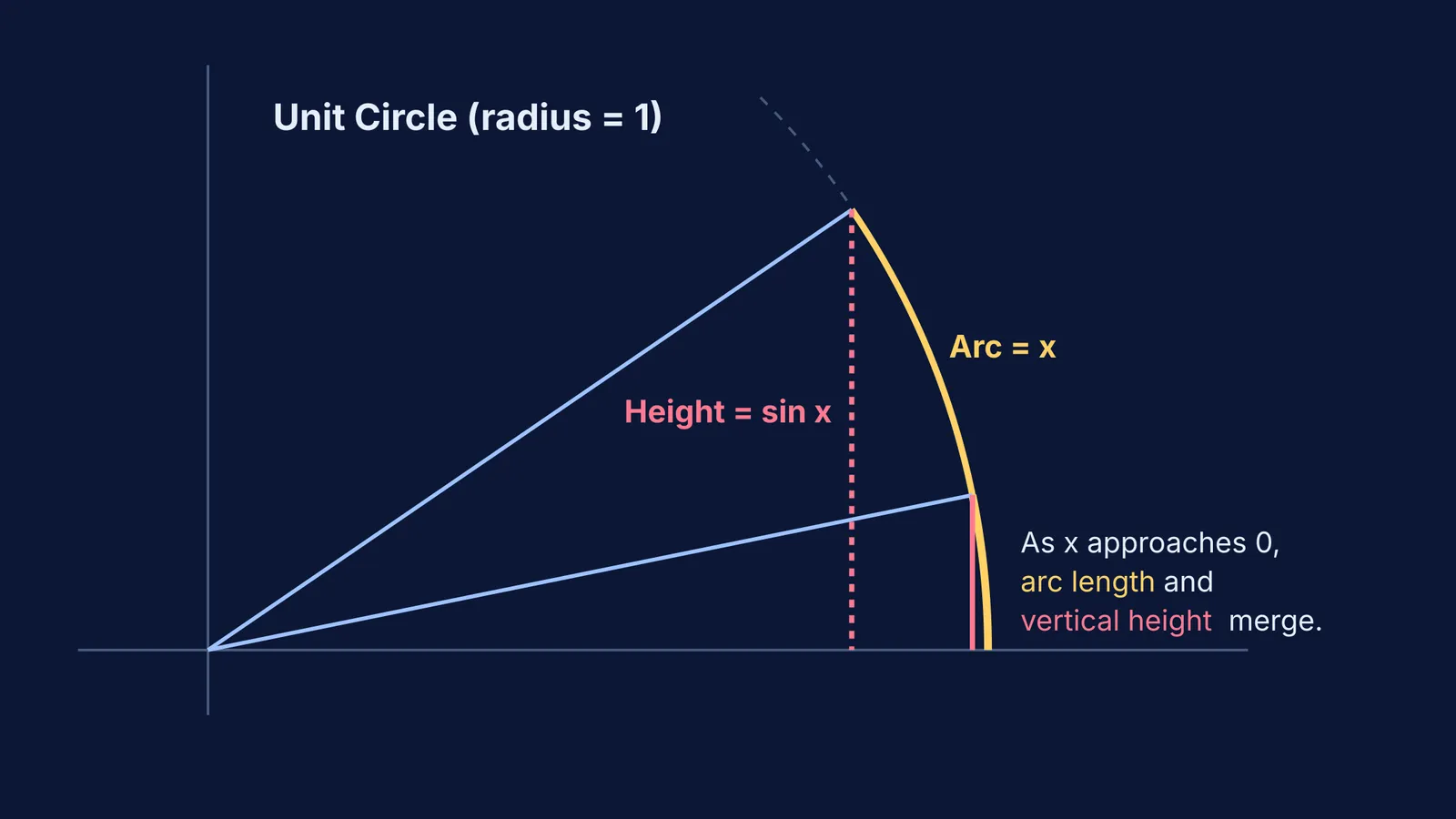
A radian, on the other hand, is a pure ratio of length. It is defined as the angle subtended at the centre of a circle by an arc whose length is equal to the radius. In a unit circle with a radius of 1, an angle of x radians corresponds to an arc length of exactly x. This makes radians dimensionless, tying the angle directly to a physical distance along the curve.
When did we start using radians?
The concept of measuring an angle by the length of its arc was introduced by the mathematician Roger Cotes in the early 1700s. He recognised the mathematical naturalness of this unit and calculated that one radian is equal to roughly 57.3 degrees, though he never gave the unit a specific name.
The term "radian" first appeared in print much later, in 1873. It was used in examination questions written by James Thomson, a physicist at Queen's College, Belfast. The scientific community adopted the term soon after, solidifying its place in advanced mathematics and physics (source).
Why does calculus need radians?
Calculus looks at instantaneous rates of change. To find the derivative of the sine function, you must use the limit definition of a derivative. This process ultimately depends on evaluating the fundamental limit of the function (sin x) / x as x approaches zero.
When x is measured in radians, the vertical height of a right-angled triangle inscribed in a unit circle (sin x) and the curved arc length along the edge of the circle (x) become almost identical as the angle shrinks.
In radians: lim(x → 0) (sin x / x) = 1
Because this fundamental limit evaluates to exactly 1, the derivative of the sine function simplifies perfectly without any extra numbers attached to it:
d/dx(sin x) = cos x
What happens if you use degrees?
If you measure x in degrees, the arc length on a unit circle is no longer x. Instead, it is scaled down by a conversion factor of π/180. Consequently, the ratio of the triangle's height to the angle is scaled by that exact same factor.
In degrees: lim(x → 0) (sin x / x) = π/180 ≈ 0.01745
Using the chain rule of differentiation, this constant cascades into the final derivative:
d/dx(sin x) = (π/180) cos x
Imagine doing physics and having to multiply by π/180 every single time you differentiate a wave function. If you take the second derivative to find acceleration in simple harmonic motion, the constant becomes (π/180)². Integration would be even worse, spitting out the reciprocal constant 180/π everywhere. Taylor series expansions, which rely on repeated derivatives, would become practically unreadable. By using radians, the rate of change of the sine function at the origin is scaled to exactly 1, allowing all higher mathematics to drop the messy constant entirely.
How do you know when to use which?
In general, you should let the context dictate the unit you choose:
Use degrees for static geometry, reading a protractor, finding the angle of a prism, or navigating a compass bearing.
Use radians for calculus (limits, derivatives, integrals), Taylor series expansions, and equations linking linear and angular variables (such as v = rω or a = rα).
If you find yourself memorising derivative formulas without knowing why they work, that is a concept gap that will cost you marks in difficult exam questions. The Fermi Concept Library maps out these fundamental mathematical ideas step by step, and Fermi's AI tutor can work through derivations with you on a shared whiteboard to ensure the foundation is solid. If you need to practice applying these rules, check out our worked examples on differentiating parametric functions or integrating trigonometric forms.


