On this page
In 1948 a new graduate student set out to prove that one kind of bacterium could mate. Four years later he had found something else: a virus that picks up a bacterium's genes and carries them into another cell. That student was Norton Zinder, and the process he found with his supervisor Joshua Lederberg is called transduction.
Who was Norton Zinder?
Norton David Zinder was born in New York City in 1928, went to the Bronx High School of Science, and finished his biology degree at Columbia University in 1947, according to a biographical article in the Journal of Biological Chemistry. He then joined Lederberg at the University of Wisconsin and finished his PhD in 1952. Rockefeller University, where he spent his whole research career, calls him "Josh Lederberg's first graduate student".
Looking back in a 1983 Citation Classic note, Zinder said he arrived in Lederberg's lab in July 1948. Bacterial genetics, he wrote, was so new that there were "discoveries lying around waiting to be picked up."
What were Zinder and Lederberg looking for?
Lederberg had already shown that cells of *E. coli* K12 could exchange genes by conjugation, in which two bacteria make direct contact. Zinder's thesis was meant to find the same thing in *Salmonella typhimurium*. In the same 1983 note, he describes making many mutant strains that could not make certain nutrients and mixing them in pairs, looking for offspring that could grow without them.
Most pairs failed. One strain gave a few such colonies when crossed with several strains, and many with one. The results did not look like conjugation. Genes did not travel together the way they did in *E. coli*, and the exchange ran only one way. It also did not look like transformation: the effect survived DNase, an enzyme that destroys free DNA.
How did the U-tube experiment prove phages carry genes?
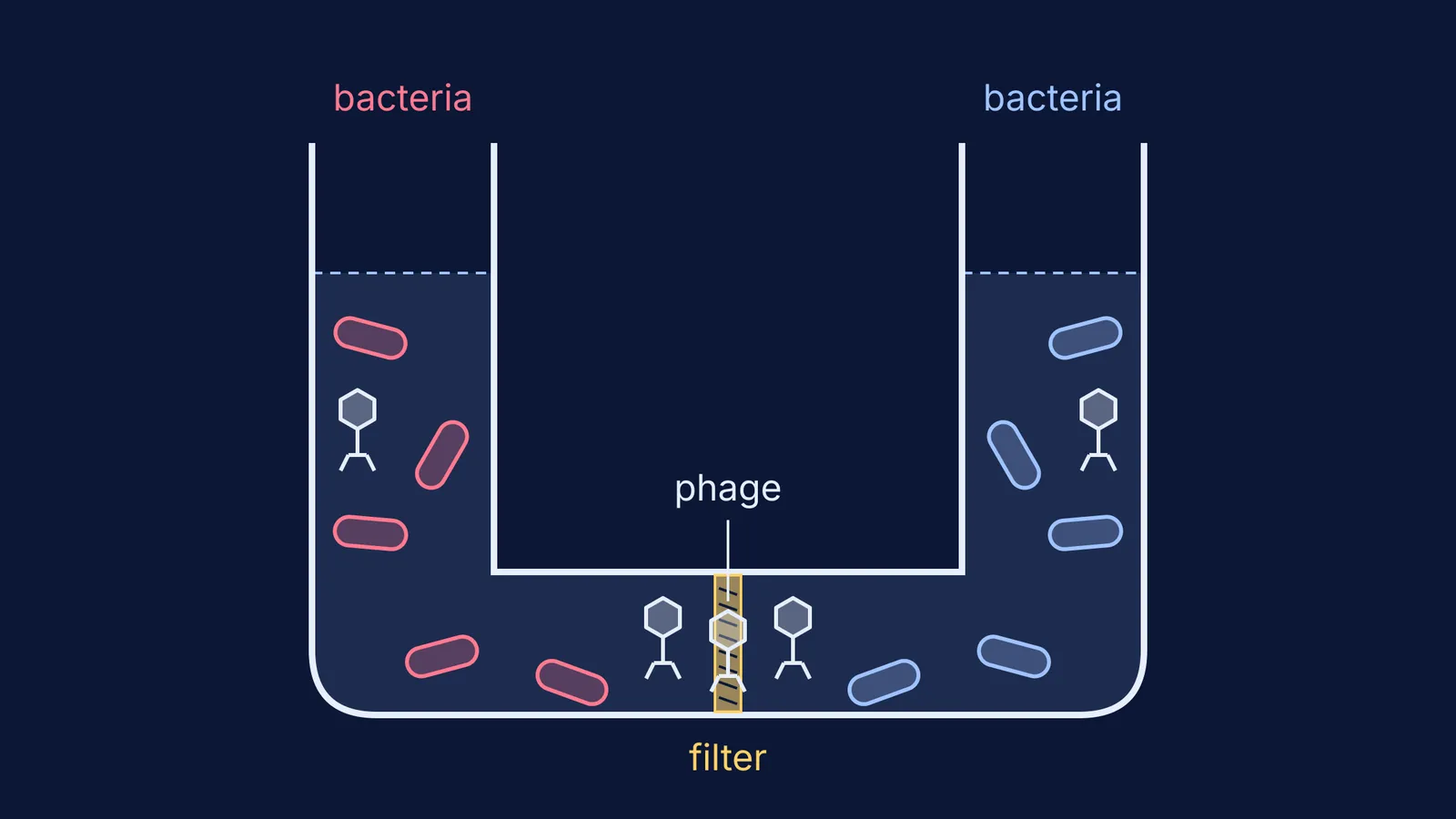
Zinder turned to a device first built by Bernard Davis: a U-shaped tube with a bacterial filter between its two arms. Liquid can pass through the filter, but bacteria cannot. The question was whether cell contact was necessary. "It wasn't," Zinder wrote in his 1983 note. When he told Lederberg, he recalled, Lederberg "sat down heavily".
The filtered liquid carried the activity, and it also contained a temperate bacteriophage: a virus that can live quietly inside a bacterium. In the end the team showed that the gene-carrying activity sat inside phage-like particles. In those particles, bacterial genes had taken the place of the phage's own genes.
The work was published as "Genetic exchange in Salmonella" in the Journal of Bacteriology in November 1952 (volume 64, pages 679 to 699). "We called the phenomenon transduction — to lead across," Zinder wrote. He adds that P22 and phage lambda became the two standard models for studying temperate phages.
Why does transduction still matter?
Transduction is one of the three main ways bacteria exchange genes; the other two are conjugation and transformation. Zinder made this point himself in the 1983 note. In 1958 Lederberg shared the Nobel Prize in Physiology or Medicine "for his discoveries concerning genetic recombination and the organization of the genetic material of bacteria".
Zinder kept working on phages. At Rockefeller in 1960, he and his graduate student Timothy Loeb found seven new bacterial viruses, one of which turned out to be the first known phage with RNA as its genetic material. He also took part in the Asilomar meeting on the safe use of recombinant DNA, according to the Rockefeller obituary, which says he died on 3 February 2012, aged 83.
How can you tell transformation, conjugation and transduction apart?
Exam questions often describe an experiment and ask which process it shows. Zinder's reasoning gives a three-step test:
Is the gene transfer stopped by DNase? If yes, naked DNA is being taken up: transformation. Zinder's effect was not stopped.
Does the transfer stop when a filter keeps the cells apart? If yes, the cells must touch: conjugation. Zinder's transfer kept going.
Does a virus particle carry the DNA? If yes, and the transfer survives both DNase and the filter, it is transduction.
Worked example: you mix two mutant strains. Adding DNase does not stop new colonies forming, and neither does a U-tube filter. The best answer is transduction, because the DNA is protected inside a phage coat and phages are small enough to pass through the filter.
To revise the background, read our explainer on plasmids versus the bacterial chromosome, the guide to how mutation and recombination create variation, and why viruses are exceptions to cell theory.
If the three processes still blur together, the Fermi Concept Library gives each biology concept its own lesson and shows where it fits on the map. That way you see how the three relate instead of memorising separate definitions.