

On this page
When Matthias Schleiden and Theodor Schwann formulated the cell theory in 1839, they unified biology around a single principle: all living things are composed of discrete cells. As historian Paolo Mazzarello (1999) notes, this provided the first universal framework for diverse organisms. In 1855, Rudolf Virchow completed the classical doctrine with *Omnis cellula e cellula*—every cell arises from a pre-existing cell. This established the classical model: one nucleus inside a discrete membrane-bounded cytoplasm, a baseline explored in our Class 11 guide to the cell as the unit of life. Yet several biological entities challenge this neat compartmentalization.
Why are viruses considered the primary exception to cell theory?
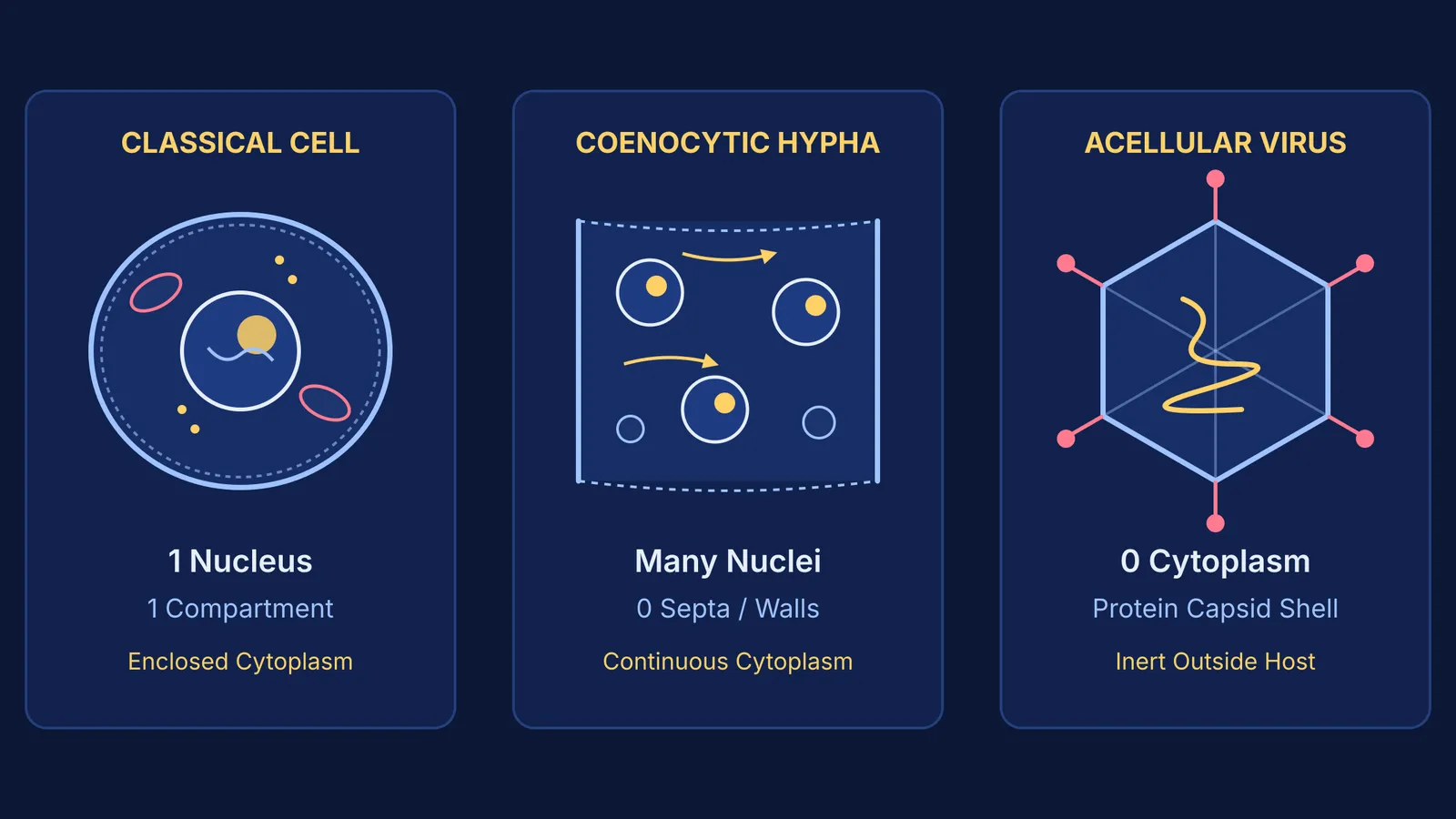
Viruses are the most prominent exception because they lack cellular structure. A virion consists solely of DNA or RNA encased in a protein capsid, with no cytoplasm, ribosomes, or independent ATP generation. Outside a host, it behaves as an inert, crystallizable macromolecule, as noted in our classification of viruses, viroids, and lichens. Because viruses cannot metabolize or replicate autonomously, they violate the tenet that the cell is the minimal independent unit of life.
Microbiologist Patrick Forterre (2013) addressed this paradox with the "virocell" concept. Forterre argues that the extracellular virion is merely a dormant dispersal vehicle, much like a seed. The true living state of a virus is the intracellular "virocell"—the infected host cell whose metabolic machinery is reprogrammed to produce virions. Under this perspective, viruses are obligate cellular parasites rather than autonomous non-cellular organisms.
How do coenocytic hyphae and giant cells challenge cellular compartments?
Classic cell theory assumes that an organism's biomass is divided into distinct, single-nucleus units. Several lineages show that complex structures develop without cellular cross-walls:
Coenocytic fungal hyphae: In zygomycete fungi like bread mold (*Rhizopus stolonifer*), hyphae lack cross-walls (septa). Electron micrographs by Lilian Hawker and Patricia Abbott (1963) confirm continuous cytoplasmic tubes where hundreds of nuclei share an undivided protoplasmic stream.
Siphonous green algae: The alga *Caulerpa taxifolia* forms fronds and stolons spanning up to 3 metres as a single multinucleated cell. Aashish Ranjan and colleagues (2015) demonstrated that *Caulerpa* differentiates pseudo-organs by localizing specific messenger RNAs within its shared cytoplasm.
Uninucleate single-celled giants: Mermaid's wineglass (*Acetabularia*) grows up to 10 centimetres tall with a single basal nucleus. Classic grafting by Joachim Hämmerling (1953)61042-6) proved that morphogenetic substances travel from this single nucleus to direct cap development.
Anucleated specialized cells: Mature mammalian red blood cells and angiosperm sieve tubes function without nuclei. As Lucas M. Newton and colleagues (2024) review, erythroblasts physically expel their nuclei during differentiation, leaving mature erythrocytes to conduct gas transport without ongoing transcription.
How does modern cell doctrine resolve these exceptions?
Modern biology updates classical cell theory rather than discarding it. As František Baluška and colleagues (2004) showed, syncytial and coenocytic systems fit the "energide" model, where each nucleus controls a surrounding cytoplasmic domain without requiring physical walls.
Modern cell doctrine rests on three core tenets:
Metabolic and hereditary unity: Cellular life requires coordinated biochemical metabolism directed by nucleic acids.
Unbroken cellular continuity: Every living cell descends from a nucleated precursor cell. Even multinucleate muscle fibers and anucleated erythrocytes satisfy Rudolf Virchow's doctrine of cellular continuity through their developmental lineage.
Cellular dependency of viruses: Viruses require cellular ribosomes and enzymes to reproduce, proving that the cell remains life's minimal standalone unit.
When connecting cell structure to organelle function, the Fermi Concept Library maps every concept across biology with dedicated lessons showing its place in the subject.
How should students analyse cell theory edge cases in exams?
When evaluating cell theory questions, use this four-step diagnostic checklist:
Check metabolic independence: Does the specimen synthesize ATP and proteins independently? If it requires a host's ribosomes (viruses, viroids), classify it as an acellular pathogen.
Check internal septation: Are nuclei separated by membranes? If protoplasm is continuous (*Rhizopus*, *Vaucheria*), identify it as a coenocytic modification.
Trace developmental lineage: Did the structure originate from a nucleated cell? Mature red blood cells and sieve tube elements lose nuclei during maturation, satisfying cellular origin.
Assess size and morphology: Unicellular giants like *Acetabularia* demonstrate that complex regional differentiation can occur within a single cell.
For students practicing assertion-reason problems, the Fermi Problem Library offers worked problems with a step-by-step solver that explains the reasoning rather than printing an answer.


