

On this page
When you first learn about bacteria in biology, you might imagine a simple cell containing a single tangle of DNA. However, many bacteria carry two distinct types of genetic material: the main bacterial chromosome and one or more plasmids. If you are preparing for exams like NEET, or studying microbial genetics, understanding the difference between a plasmid and a bacterial chromosome is crucial.
While both are made of double-stranded DNA, they have completely different roles. The chromosome acts as the essential operating manual for the cell, while plasmids are optional extras that provide situational advantages. Let us look at what makes them different in size, function, and how they replicate.
What is a bacterial chromosome?
The bacterial chromosome is the primary genomic DNA. It contains all the "housekeeping" genes necessary for the bacterium to survive, grow, and reproduce. These genes code for the structural proteins, enzymes, and RNA molecules that run the cell's daily operations. If a bacterium loses its chromosome, it dies immediately.
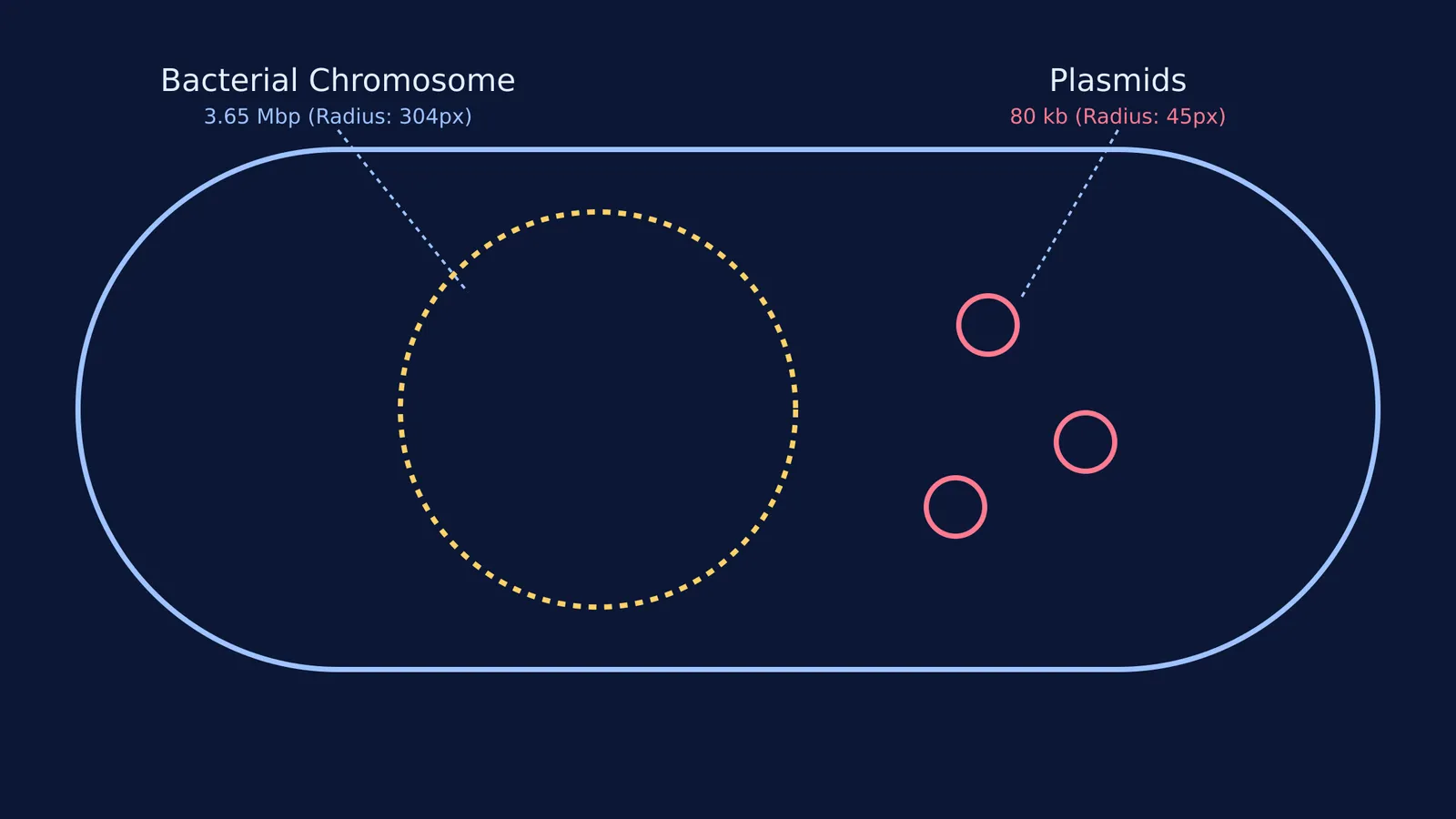
Bacterial chromosomes are massive molecules. According to a large-scale analysis of bacterial genomes, the average bacterial chromosome is about 3.65 million base pairs (3.65 Mbp) long (PMC5440621). In the common laboratory strain of *Escherichia coli*, the circular DNA molecule is roughly 4.6 million base pairs long and measures about 1.5 millimetres when stretched out (PMC3894414). To fit inside a microscopic cell that is only a few micrometres long, this large loop is tightly coiled and packaged into a dense structure called the nucleoid.
Because the chromosome is so large and essential, a bacterium typically has only one copy. Its replication is strictly linked to cell division. When a bacterium prepares to divide, it copies its chromosome starting from a single origin of replication, ensuring each daughter cell receives exactly one complete set of essential instructions.
What is a plasmid?
A plasmid is a small, circular, extrachromosomal piece of DNA. Unlike the main chromosome, plasmids are not essential for basic survival under normal, everyday conditions. You can cure a bacterium of its plasmids, and as long as the environment is friendly, the cell will continue to live and divide normally.
Plasmids are much smaller than chromosomes. Research shows they have an average size of roughly 80 thousand base pairs (80 kb), meaning they are generally much smaller than the host's chromosome (PMC4429665). Instead of carrying thousands of genes, a plasmid might carry just a handful.
Because they have their own origin of replication, plasmids replicate autonomously, independent of the main chromosome's cycle. This allows some plasmids to exist in high copy numbers. A single bacterium might hold just one or two copies of a large plasmid, but it could contain up to several hundred copies of a small one.
How do plasmids spread antibiotic resistance?
While plasmids are non-essential for basic metabolism, they often carry "accessory" genes that provide a major survival advantage in harsh environments. The most critical example in modern medicine is antibiotic resistance.
According to the Centers for Disease Control and Prevention (CDC), plasmids are the primary vehicles for the rapid spread of antibiotic resistance (cdc.gov). Plasmids can be shared between bacteria through a process called conjugation. A bacterium carrying a conjugative plasmid builds a microscopic bridge, called a pilus, to a neighbouring cell and passes a copied DNA strand across.
This mechanism is why antibiotic resistance spreads so quickly. Resistance does not just pass vertically from parent to offspring. Through plasmids, bacteria can transfer antibiotic resistance horizontally to completely unrelated bacterial species. A harmless gut microbe can pass a resistance plasmid to a dangerous pathogen, turning the pathogen into a "superbug" that standard medicines can no longer kill.
What are the key differences between a plasmid and a bacterial chromosome?
When you need to recall the differences quickly for a test, keep these four points in mind:
Size: Chromosomes are massive, measured in millions of base pairs (Mb). Plasmids are tiny, typically measured in thousands (kb).
Essentiality: The chromosome carries all the housekeeping genes required for life. Plasmids carry situational, accessory traits like toxin production or antibiotic resistance.
Replication: The chromosome replicates exactly once per cell division. Plasmids replicate autonomously and can accumulate in high numbers within a single cell.
Mobility: Chromosomes stay locked within the cell line. Many plasmids are highly mobile and can be copied and transferred to other bacteria via conjugation.
Understanding how plasmids work is not just important for answering textbook questions; it is the foundation of genetic engineering. Scientists use the natural mobility of plasmids to introduce new genes into cells. If you want to dive deeper into how biologists cut and paste these genes, the Fermi Concept Library has a lesson for every concept in biology to walk you through the mechanisms. You can also explore how plasmids act as cloning vectors to move genes into plant cells, or review DNA replication and transcription to see how these molecules are copied.


