On this page
In 1976, two German scientists published in Nature the first records of current through a single ion channel in a cell membrane, switching on and off like a square pulse. Their paper, Single-channel currents recorded from membrane of denervated frog muscle fibres, is where the patch clamp begins.
Who invented the patch clamp technique?
Erwin Neher and Bert Sakmann developed the patch clamp together and shared the 1991 Nobel Prize in Physiology or Medicine "for their discoveries concerning the function of single ion channels in cells" (Nobel Assembly press release).
Neher was born in Landsberg, Germany, in 1944 and was at the Max Planck Institute for Biophysical Chemistry in Göttingen at the time of the award (Nobel Prize facts: Neher). Sakmann was born in Stuttgart in 1942 and was at the Max Planck Institute for Medical Research in Heidelberg (Nobel Prize facts: Sakmann).
The 1981 paper that described the improved gigaseal methods had five authors: Hamill, Marty, Neher, Sakmann and Sigworth.
How does a patch clamp record one ion channel?
An ion channel is a protein pore through the membrane, about as wide as a single ion, 0.5 to 0.6 millionths of a millimetre (Nobel press release). The current through one open channel is about a picoampere, 10⁻¹² A (same source).
The tool is a glass micropipette with a tip about a thousandth of a millimetre across, pressed against the membrane. If the glass seals tightly, ions can only pass through the channels in the patch under the tip, and an amplifier measures that current.
In his Nobel lecture, Neher writes that "the square-wave nature of the signals was proof of the hypothesis that channels in biological membranes open and close stochastically in an all-or-none manner." Around 1970, he notes, there was no direct evidence from biological preparations that channels existed, even though Hodgkin and Huxley's squid axon work had used voltage-operated gates to describe the nerve impulse mathematically.
Why did the seal matter so much?
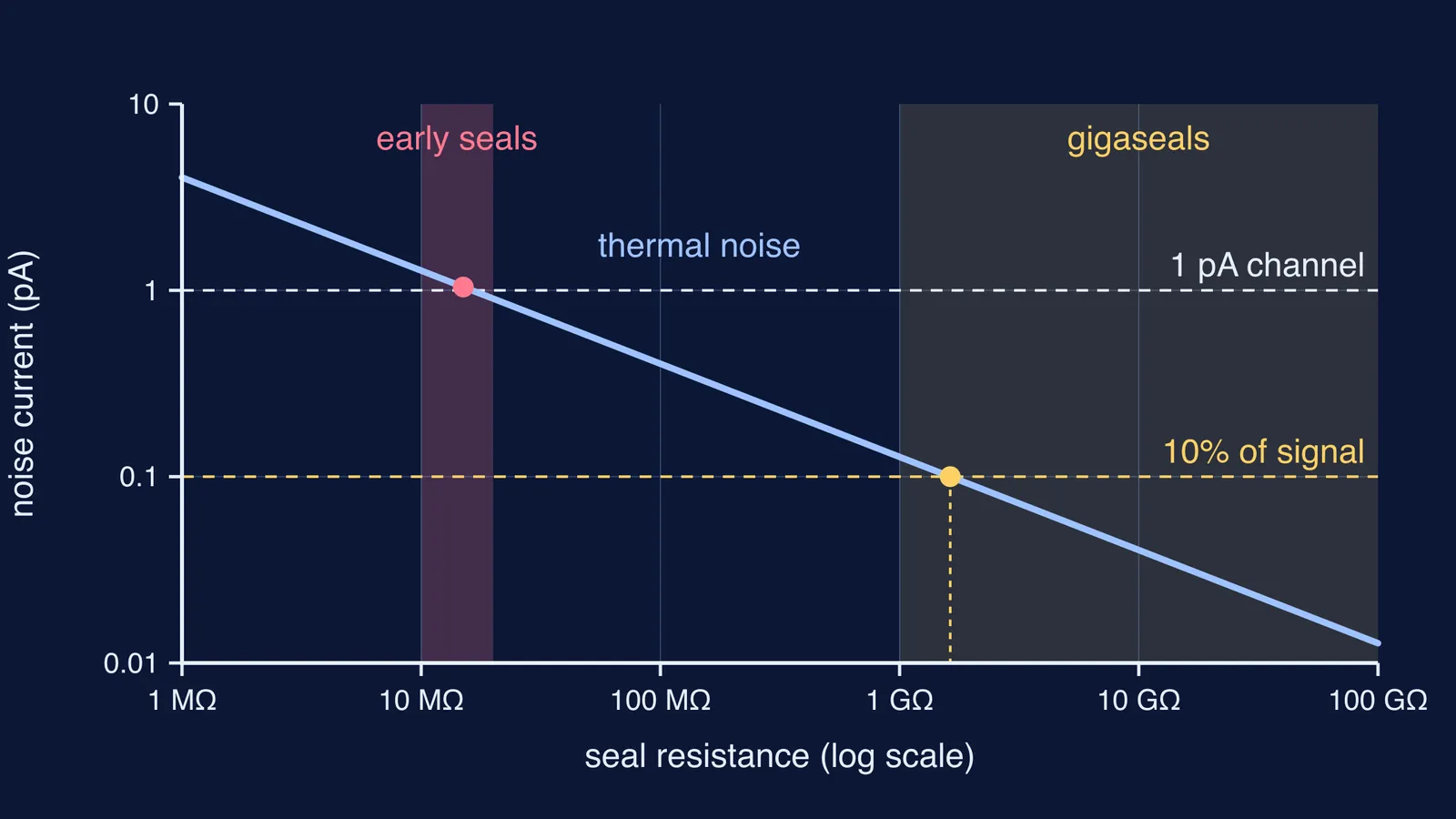
Neher's Nobel lecture gives the thermal (Johnson) noise of a signal source with resistance R as σ = √(4kTΔf / R), where k is the Boltzmann constant, T the absolute temperature and Δf the bandwidth. He states that recording 1 pA at a bandwidth of 1 kHz with 10% accuracy needs a source resistance of about 2 GΩ or more. Check it:
Take k = 1.38 × 10⁻²³ J/K, T = 295 K (room temperature) and Δf = 1000 Hz. Then 4kTΔf ≈ 1.63 × 10⁻¹⁷.
Early seals: Neher writes that their seal resistances were just about 10 to 20 MΩ. With R = 2 × 10⁷ Ω, σ ≈ √(8.1 × 10⁻²⁵) ≈ 0.9 pA. The noise is as large as the signal.
Gigaseal: with R = 2 × 10⁹ Ω, σ ≈ √(8.1 × 10⁻²⁷) ≈ 0.09 pA, under 10% of a 1 pA signal.
Because R sits under a square root, 100 times more resistance gives 10 times less noise. By about 1980, the lecture says, the team noticed by chance that slight suction on the pipette raised the seal resistance by more than two orders of magnitude, into the gigaohm range: the "gigaseal". The 1981 paper reports seals of 10⁹ to 10¹¹ Ω (PubMed abstract).
Now Ohm's law. Neher cites an estimate of 32 pS for one acetylcholine-activated channel at the frog neuromuscular junction (Nobel lecture). Suppose a driving voltage of 100 mV: I = gV = 3.2 pA. Divide by one ion's charge, 1.6 × 10⁻¹⁹ C: about 20 million ions per second through one pore.
If a numerical like this goes wrong in the powers of ten, the Fermi Problem Library has worked problems with a step-by-step solver that explains the reasoning rather than printing an answer.
What did the patch clamp change in biology?
The Nobel press release says the method contributed to understanding the cell mechanisms behind several diseases, including diabetes and cystic fibrosis. In insulin-making cells, ATP acts directly on one type of ion channel, and certain diabetes drugs act on those ATP-controlled channels.
Rupturing the patch while keeping the seal gives "whole-cell recording", which Neher's lecture says is tolerated by cells as small as red blood cells. Sakmann had learned to treat cell surfaces in Bernard Katz's laboratory, the lab behind Katz's work on quantal release at the synapse.
What can you take from this into your own studies?
Estimate before you build. Neher's lecture works out the resistance needed before describing the experiments.
Find the real bottleneck. For Neher and Sakmann it was the seal. When your marks stall, ask which single step loses you the most.
Keep going on the hard part. The lecture describes many systematic attempts to fix the seal, with little success, before the chance finding.
Link the levels. Many channels opening together give a nerve impulse. Try the action potential simulation, where you predict the spike first.
If ion flow is hard to picture from a textbook diagram, the Fermi Simulation Lab has interactive simulations for ideas that are easier to see than to read.