On this page
In October 1970, Karolinska Institutet announced that the Nobel Prize in Physiology or Medicine would go jointly to Bernard Katz, Ulf von Euler and Julius Axelrod "for their discoveries concerning the humoral transmitters in the nerve terminals and the mechanisms for their storage, release and inactivation" (Nobel press release). Katz's share was about how a nerve ending releases acetylcholine where nerve meets muscle. His answer was that it comes out in fixed packets.
Katz, born in Leipzig in 1911, left Germany in 1935 for A.V. Hill's laboratory at University College London (Nobel biography).
What did Bernard Katz discover about neurotransmitter release?
In 1952, Katz and Paul Fatt recorded from inside a muscle fibre at the end-plate, the patch the motor nerve touches (Fatt and Katz, 1952). Even when they did not stimulate the nerve, the muscle showed small, random blips.
In his Nobel lecture, Katz said each of these "miniature end-plate potentials" is only of the order of 0.5 mV, while a nerve impulse produces an end-plate potential of often more than 50 mV (Katz, Nobel lecture, 1970). The blips had the same sharp rise and slow decay as the big response, on a far smaller scale.
Katz concluded that each miniature potential comes from one "multi-molecular quantum" of acetylcholine released by the nerve terminal. On the estimates of the time, he wrote, each packet holds at least a thousand molecules, possibly many more (same lecture).
How did Katz prove release comes in quanta?
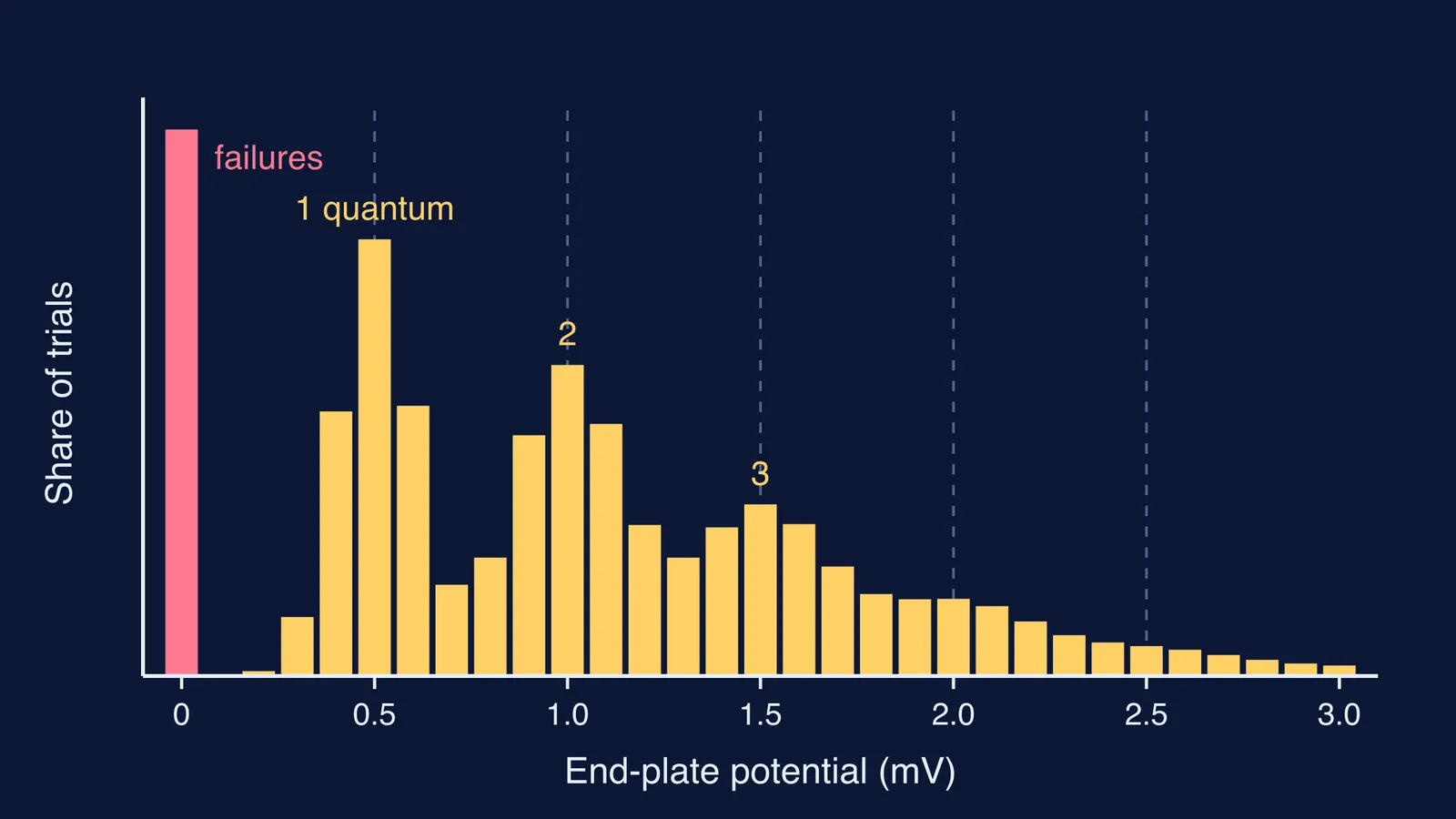
In 1954, Katz and José del Castillo turned the signal down (del Castillo and Katz, 1954). They bathed the junction in solutions with less calcium and extra magnesium, so each impulse released only a few packets.
A review by George Augustine and Haruo Kasai describes the result (Augustine and Kasai, 2007). The responses rose and fell in steps, and each step was roughly the size of one miniature potential. Some impulses released nothing at all. These "failures" happened as often as a Poisson distribution, the maths of random independent events, predicts.
Worked example: count quanta from failures. The Poisson rule says that if a nerve releases m packets on average, the share of impulses that release none is e^(−m). These practice numbers are made up.
You stimulate the nerve 200 times and see 60 failures. The failure share is 60/200 = 0.30.
Solve e^(−m) = 0.30. So m = ln(1/0.30), about 1.2 packets per impulse.
Predict one-packet responses: m × e^(−m) = 1.2 × 0.30, about 0.36, or roughly 72 of the 200 trials.
Predict two-packet responses: (m²/2) × e^(−m) = 0.72 × 0.30, about 0.22, or roughly 43 trials.
Cross-check with size: if one packet gives 0.5 mV, the average response should be about 1.2 × 0.5 = 0.6 mV.
If failures and average size give the same m, the data fit the packet model.
What are the packets, and what does calcium do?
Katz linked the packets to synaptic vesicles, tiny sacs that De Robertis and Bennett, and Palade and Palay, had found clustered near release sites (Katz, Nobel lecture).
Working with Ricardo Miledi, Katz concluded that external calcium is the only immediate ionic requirement for a depolarisation to trigger release. In his sequence, depolarisation opens calcium gates in the nerve ending, and calcium flows in. He saw that much as firmly established. The next step, that the packets sit inside vesicles and calcium makes them fuse with the membrane and empty, he called "a plausible and, I think, very strong hypothesis".
At rest, a nerve ending releases about one packet per second on average. An impulse raises that to a few hundred packets within a millisecond (same lecture).
How do you remember quantal release for a biology exam?
Learn it as a chain:
The impulse reaches the axon terminal.
Calcium channels open and Ca2+ flows in.
Vesicles fuse with the membrane.
Acetylcholine is released into the cleft in packets (quanta).
It acts on the muscle membrane and opens ion channels.
The end-plate potential crosses threshold and the muscle fibre fires.
Three mistakes to avoid:
Writing that transmitter leaks out one molecule at a time. It leaves in packets.
Leaving out calcium. Without it, depolarisation does not trigger release.
Mixing up a miniature potential (one packet, about 0.5 mV) with an action potential.
For the story before Katz, read how Otto Loewi showed that nerves signal with chemicals. To label the parts, use our guide to drawing the synapse structure. For the arriving impulse, see how Hodgkin and Huxley explained the action potential.
If one link still feels shaky, the Fermi Concept Library has its own lesson for every biology concept, so you can revisit synapses on their own. If the Poisson step trips you up, Fermi's AI tutor works out what you already know and builds a plan for the session.
When you read about vesicles, picture Katz's tiny blips: each one is a single packet.