On this page
In 1617, the year he died, the Scottish mathematician John Napier published Rabdologiae, a Latin book describing what he called numbering rods, according to the MacTutor biography from the University of St Andrews. The same source says the rods were made of ivory, so they looked like bones, and the name Napier's bones stuck. In the dedication, MacTutor says, Napier explained that friends who had seen the rods liked them so much that they were already in wide use, even abroad.
The Science Museum in London describes its 18th-century ivory set as rods "which allow the user to multiply by simply adding figures" (Science Museum Group collection).
What are Napier's bones?
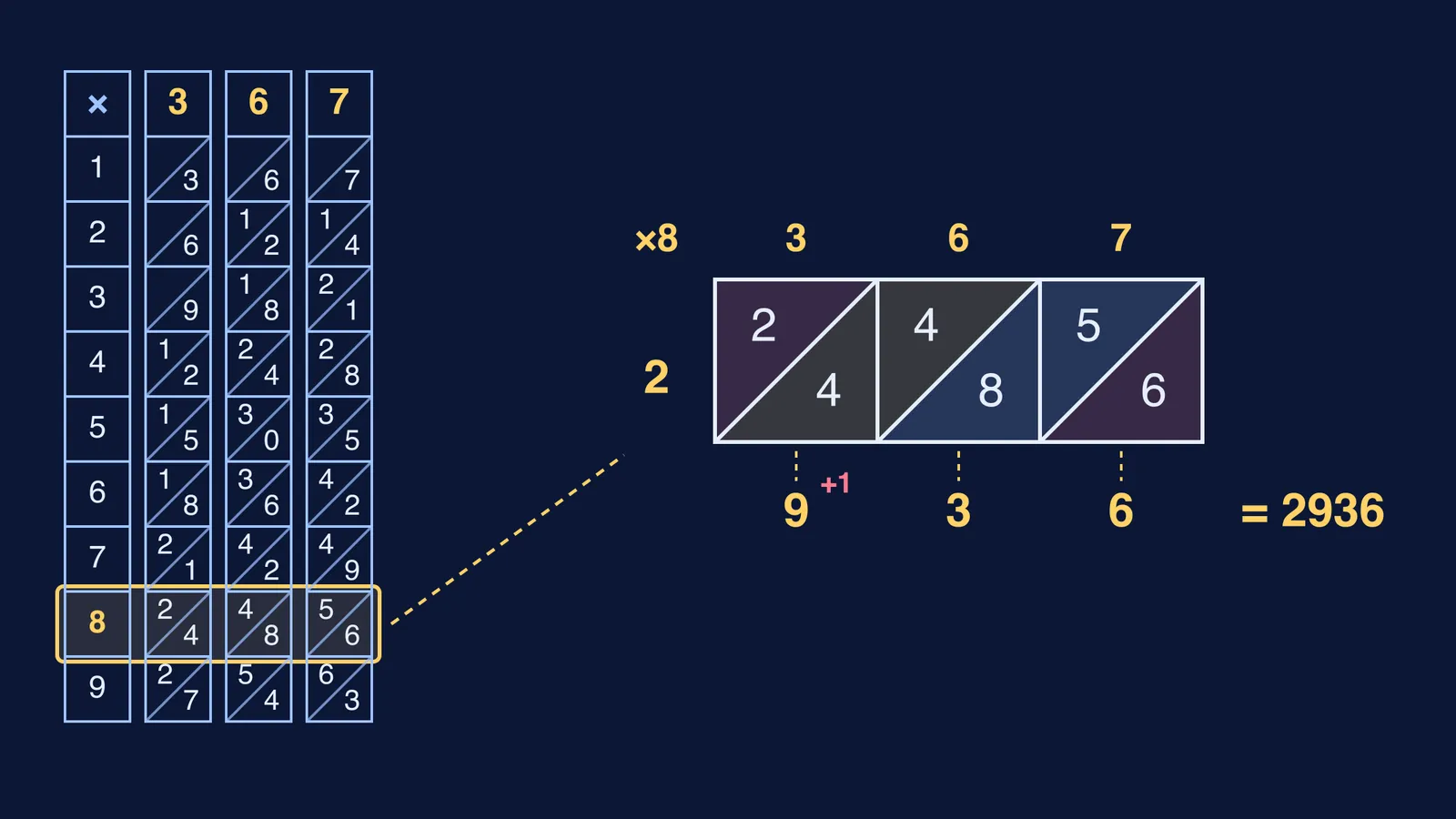
Each rod is a column of squares holding one digit's times table, from 1 times to 9 times that digit. Each product square is cut by a diagonal running from bottom left to top right. A one-digit answer sits in the lower-right triangle, and a two-digit answer is split, with tens above the diagonal and units below (Napier's bones, Wikipedia). The left edge of the board, or a separate index rod, lists 1 to 9, so you know which row to read.
The same Wikipedia article explains that the method is based on lattice multiplication. Napier had good reason to want it. In the preface to his 1614 book on logarithms, he complained that multiplying and dividing large numbers was "subject to many slippery errors", in the words of the 1616 English translation (MacTutor).
How do you multiply with Napier's bones?
Take 367 × 8.
Put the rods for 3, 6 and 7 side by side, in that order, next to the index rod.
Find 8 on the index rod and read across that row. You see 2/4, 4/8 and 5/6, which are 24, 48 and 56 split at their diagonals.
Start at the right. The last diagonal holds just 6. Write 6.
The next diagonal holds 8 and 5. That makes 13, so write 3 and carry 1.
The next diagonal holds 4 and 4, plus the carry: 9. Write 9.
The last diagonal holds 2. Write 2.
Read the digits from left to right: 367 × 8 = 2936.
How do you multiply by a two-digit number?
Read one row for each digit, then add the results with a shift, just as in long multiplication. Here is 367 × 48:
Row 4 shows 1/2, 2/4 and 2/8. The diagonals give 8, then 4 + 2 = 6, then 2 + 2 = 4, then 1. That is 1468.
Row 8 gives 2936, as above.
The 4 stands for 40, so shift 1468 one place left to get 14680.
Add: 14680 + 2936 = 17616.
Check it with an estimate: 367 × 50 = 18350, minus 367 × 2 = 734, leaves 17616. The rods give you every partial product, so the only work left is addition. If your carries or place values keep going wrong in longer problems, the Fermi Problem Library has worked problems with a step-by-step solver that explains the reasoning rather than printing an answer.
How do you make your own set at home?
This makes a good weekend project for a student and a parent.
Cut 11 strips of stiff card, all the same width, and divide each into 10 equal squares.
Make one strip the index rod: leave the top square blank and write 1 to 9 down the rest.
On the other 10 strips, write 0 to 9 in the top squares. Fill in each strip's times table below, drawing the diagonal first and putting tens above it.
Make a second strip for any digit you will repeat. Wikipedia notes that 20 rods, two copies of Napier's 10 four-sided rods, can handle numbers of up to eight digits.
Test your set on a sum you can check: 25 × 4 should read 100.
A script for parents: "Before you use the rods, guess the answer roughly. Then let's see if the rods agree." For more on building times tables without pressure, see our guide on helping your child learn multiplication tables at home.
What happened to Napier's rods after 1617?
Seth Partridge's English book Rabdologia, printed in London in 1648, explained "the Art of Numbring by Rods" from rules he had collected out of Napier's Latin book (Georgetown University Library). Royal Museums Greenwich holds a boxwood set from about 1679, with turning cylinders in place of loose rods, that was probably meant for use at sea, because its box cover carries a tide table for British ports (Royal Museums Greenwich).
Later inventors used gears instead of rods. You can follow that story in our pieces on how teenage Pascal built the Pascaline and how Leibniz's stepped drum calculator mechanised multiplication.
Build a set, try 367 × 48, then try a number of your own.