On this page
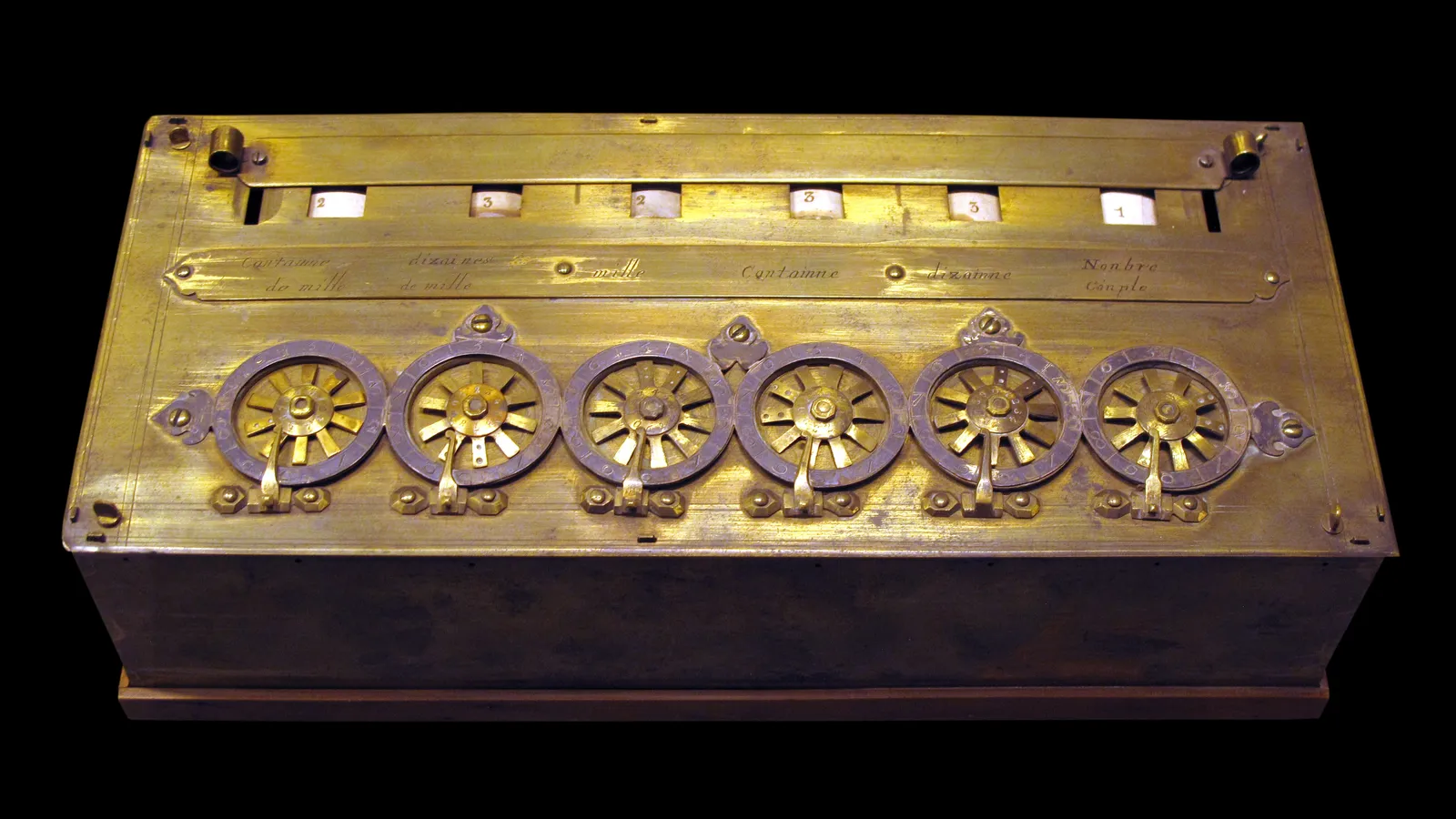
In 1642 a French teenager watched his father drown in arithmetic. Étienne Pascal had been posted to Rouen as a tax collector for Upper Normandy, and his son Blaise, born on 19 June 1623, decided a machine should do the adding instead (MacTutor, University of St Andrews). The result, the Pascaline, still sits in museums, and its central idea is one you use every time you carry a 1.
Why did Blaise Pascal build the Pascaline?
The short answer is tax. Pascal's calculator "was born out of a desire to help his father in collecting taxes", and he kept improving it from 1642 until 1645 (Lemelson-MIT).
French money made the job harder. There were 20 sols in a livre and 12 deniers in a sol, so the wheels could not all count in tens (Lemelson-MIT). Pascal went through about 50 prototypes before showing the machine in public in 1645, and in 1649 King Louis XIV granted him a royal privilege, similar to a patent, over calculating machines in France (Pascal's calculator, Wikipedia).
How did the Pascaline add and carry?
Each digit had its own wheel. You turned it with a stylus by the number to add, and the answer appeared in windows above. Lemelson-MIT describes a machine with "eight movable dials" that could add sums up to eight figures long (Lemelson-MIT).
The clever part was the carry. As a wheel turned towards 9 it lifted a weighted lever called the sautoir; when the wheel passed from 9 to 0, the sautoir dropped under gravity and pushed the next wheel on by one step (Pascal's calculator, Wikipedia). The wheels never touch, so a chain of carries such as 9,999 + 1 passes from sautoir to sautoir.
How would the Pascaline add old French money?
Add 3 livres 15 sols 8 deniers to 2 livres 7 sols 9 deniers, as the mixed wheels did.
Deniers: 8 + 9 = 17. That is 1 sol and 5 deniers, because 12 deniers make a sol. Write 5, carry 1.
Sols: 15 + 7 + 1 = 23. That is 1 livre and 3 sols, because 20 sols make a livre. Write 3, carry 1.
Livres: 3 + 2 + 1 = 6.
Answer: 6 livres 3 sols 5 deniers. Only the point where a wheel "fills up" differs from base ten. Our guide to explaining place value with sticks and coins uses the same idea.
How did a machine that only adds do subtraction?
On the Pascaline, subtraction was done like addition, using nines' complements: a sliding bar let the windows show either the result or its complement (Pascal's calculator, Wikipedia). You can check the trick on paper.
Work out 562 − 187 with three digits:
Take the nines' complement of 562: 999 − 562 = 437.
Add 187: 437 + 187 = 624.
Take the nines' complement again: 999 − 624 = 375.
And 562 − 187 is indeed 375, because 999 − 562 + 187 equals 999 − (562 − 187). Multiplication and division were done as a series of additions and subtractions (Lemelson-MIT).
Was the Pascaline really the first mechanical calculator?
It depends on what you count. Wilhelm Schickard designed a calculating clock around 1623 or 1624, but his machine burned during construction and was never completed (Pascal's calculator, Wikipedia), so MacTutor calls Pascal "almost certainly, the second person to invent a mechanical calculator" (MacTutor). The Pascaline was built, shown and sold, which is why Laurence Plazenet, director of the Centre International Blaise Pascal, called it "the first functional calculator in the history of mankind" (Euronews).
It was not a business success. Only about 20 machines were built, held back by "the lack of market demand and the cost and difficulty of producing the components" (Museo Galileo). Eight machines from Pascal's time and a ninth made shortly after survive; six are in French museums and two in German ones (Euronews). In November 2025 a Paris court blocked the export of a privately owned one, estimated at 2 to 3 million euros, halting its sale at Christie's (same source).
Gottfried Leibniz later tried to extend Pascal's design; read how Leibniz's stepped drum mechanised multiplication.
What can a student take from Pascal's machine?
Pascal asked which part of a tiring job was pure rule. Try the same:
Find the rule. Pick one step you keep getting wrong, such as sign changes in algebra, and write it as one sentence.
Test it on an extreme case. Pascal's sautoir had to cope with 9,999 + 1. Try your rule on the nastiest example you can invent.
Check by a second route. The complement trick above checks any subtraction.
When an idea is easier to see than to read, the Fermi Simulation Lab has interactive simulations, and the Fermi Problem Library works problems step by step and explains the reasoning, so you can spot exactly where a method slips.
Pascal went on to much more, including the number pattern that carries his name; explore the patterns in Pascal's triangle next.