On this page
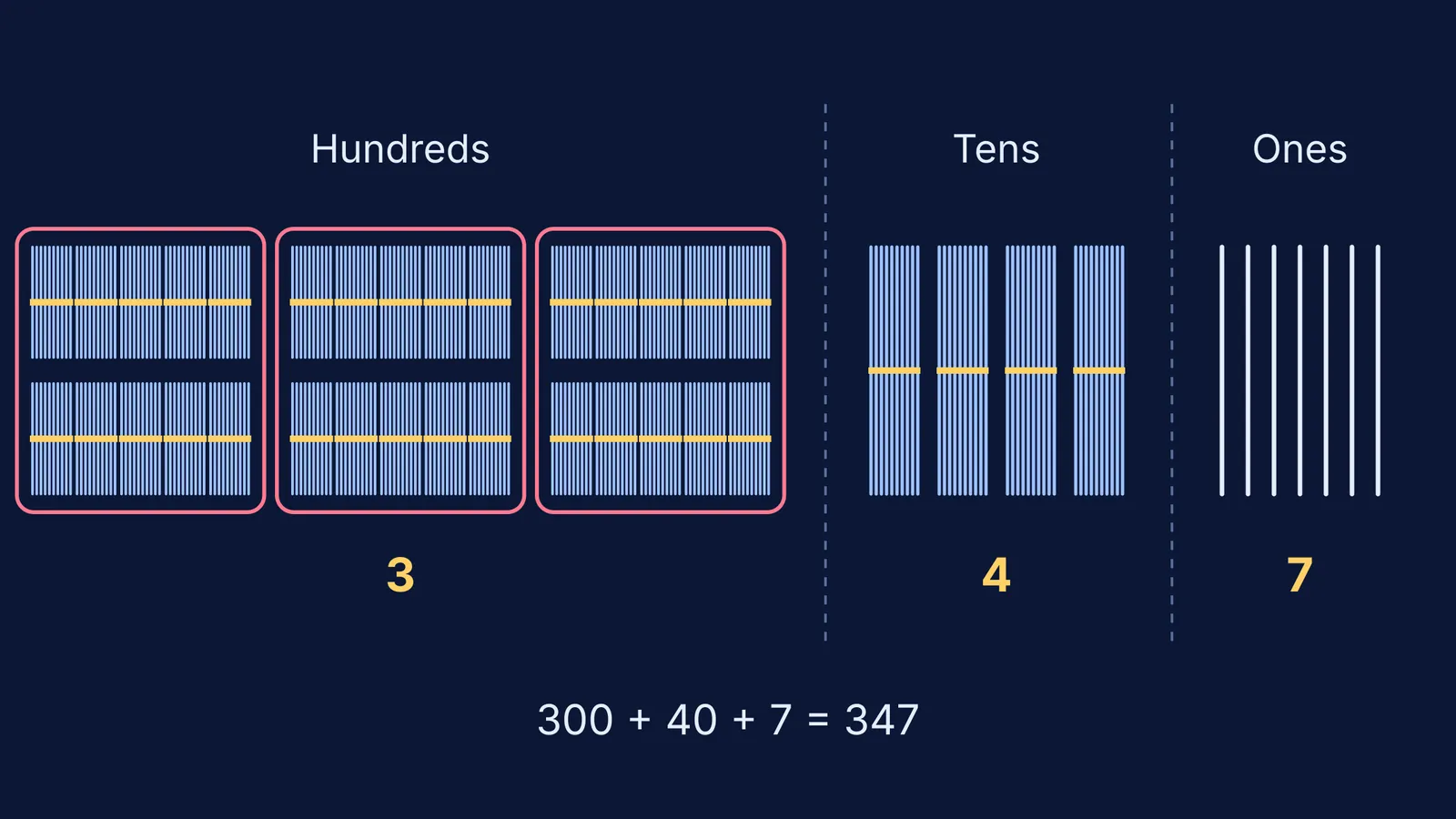
If your child writes "one hundred and five" as 1005, or says the 4 in 47 is worth four, they are not being careless. They have not yet seen that a digit's value depends on where it sits. That idea is place value: in 347, the 3 means three hundreds, the 4 means four tens and the 7 means seven ones.
Why does place value confuse so many children?
Number words hide the pattern. "Twelve" does not sound like "ten and two", so a child can recite numbers fluently and still treat 47 as one label rather than 40 and 7.
India's Annual Status of Education Report tests whether children can recognise numbers from 11 to 99 and do a 2-digit subtraction with borrowing. In 2024, 33.7% of Std III children in rural India could at least do that subtraction, and the survey reports basic arithmetic levels at their highest in over a decade (ASER 2024 national findings). Borrowing is place value in action: you break one ten into ten ones.
A longitudinal study that followed children from first to third grade found that first-grade place-value understanding reliably predicted parts of their third-grade addition performance (Moeller and colleagues, 2011).
How do you teach tens and hundreds with sticks?
In one classroom study, children carried out each step of addition and subtraction with base-ten blocks and wrote it in numerals straight away. In six of eight first- and second-grade classes (169 children across all eight), children showed meaningful place-value understanding up to at least four-digit numbers, though average-achieving first graders understood less (Fuson and Briars, 1990). At home, do the same with ice-cream sticks and rubber bands: build it, then write it.
Put 23 loose sticks on the table and ask, "How many?" Let your child count them one by one.
Say, "Let's make them quicker to count," and help them band ten sticks together, then another ten. Three are left over.
Count again: "ten, twenty, twenty-one, twenty-two, twenty-three." Same number, faster.
Draw two columns on paper, Tens and Ones. Place the bundles and loose sticks, then write 2 and 3 below.
For hundreds, band ten bundles into one big bundle. Ask, "How many sticks are inside?"
Build 347, then 307. The empty Tens column is why we write 0: it holds the place.
Ten minutes a few times a week is plenty.
How can money help with tens and hundreds?
Use 1-rupee coins, 10-rupee coins and 100-rupee notes, real or paper copies.
Shop: price a toy at 47 rupees. Your child pays with four tens and seven ones, then writes 47.
Change-maker: when they collect twelve 1-rupee coins, they swap ten of them for one 10-rupee coin. That swap is "carrying".
Borrowing works the same way. Take 52 minus 27. Your child holds five 10s and two 1s. They cannot hand over seven 1s from two, so they change one 10 for ten 1s and now hold four 10s and twelve 1s. They give away two 10s and seven 1s and keep two 10s and five 1s, which is 25. Then write the same steps as a column sum.
Our guide to maths talk with young children has more everyday ideas.
What are the signs a child has not grasped place value?
Look for a pattern over weeks, not one bad evening:
Writes "one hundred and five" as 1005, or "forty-six" as 406.
Says the 4 in 47 is worth four, not forty.
With bundles ready on the table, still counts out 26 loose sticks to show 26.
Lines digits up from the left in column sums.
In subtraction, takes the smaller digit from the larger in each column, so 52 minus 27 becomes 35.
Cannot say what 10 more than 38 is without counting on in ones.
A two-minute check: put down 2 bundles and 6 loose sticks and ask how many. Then write 26, point to the 2 and ask, "Show me with the sticks what this 2 means." If your child points to two loose sticks, the digit and the bundles are not linked yet. Go back to building and writing together.
When should you ask for more help?
If the signs persist after a term of patient practice, talk to your child's teacher. Our post on dyslexia and dyscalculia explains what to look for and who can assess it, and what to do when a child says they are bad at maths helps if their confidence has taken a knock.
Place value returns in decimals, powers of ten and scientific notation. The Fermi Concept Library gives each mathematics concept its own lesson and its place in the map, so an older child can see what an idea builds on.
Tonight, find 30 ice-cream sticks and a few rubber bands, and let your child make their first bundle of ten.