On this page
In February 1968 the Japanese geneticist Motoo Kimura published a three-page paper in Nature called Evolutionary rate at the molecular level. Its claim went against the biology of the time: most of the changes that build up in DNA and proteins are neither good nor bad, and spread by luck, not natural selection. That idea, the neutral theory of molecular evolution, also explains why genes work as clocks.
What did Motoo Kimura argue in 1968?
Kimura worked at the National Institute of Genetics in Mishima, Japan (Kimura, PNAS 1991). His starting point was protein data: rates of amino-acid change that Zuckerkandl and Pauling had published in 1965 (Takahata, Genetics 2007).
From those rates Kimura estimated about one amino-acid substitution every 28 million years in a protein 100 amino acids long. Scaled up to the whole genome, that meant roughly one nucleotide substitution in the population every two years (summary of Kimura 1968 by Michael Dietrich and Jay Aronson).
By J.B.S. Haldane's "cost of natural selection", that rate was too high for natural selection to explain (Takahata 2007). So, Kimura argued, most of these mutations must be neutral, fixed by random genetic drift.
In 1969 Jack King and Thomas Jukes independently published "Non-Darwinian evolution" in Science, subtitled "Most evolutionary change in proteins may be due to neutral mutations and genetic drift" (Science 164:788-798).
How does genetic drift spread a neutral mutation?
Genetic drift is random change in how common a gene variant is, set by which individuals happen to breed. Watch it in our simulation of genetic drift in small populations; it is one force that breaks Hardy-Weinberg equilibrium.
A new neutral mutation in a population of N diploid individuals has a 1 in 2N chance of eventually spreading to every copy of that gene (overview of the neutral theory). There are 2N copies of each gene, and if they are all equally fit, each is equally likely to be the one whose descendants end up replacing the rest.
Why does the neutral theory give a molecular clock?
Apply the 1-in-2N rule (overview) to one lizard species in two places, using made-up numbers.
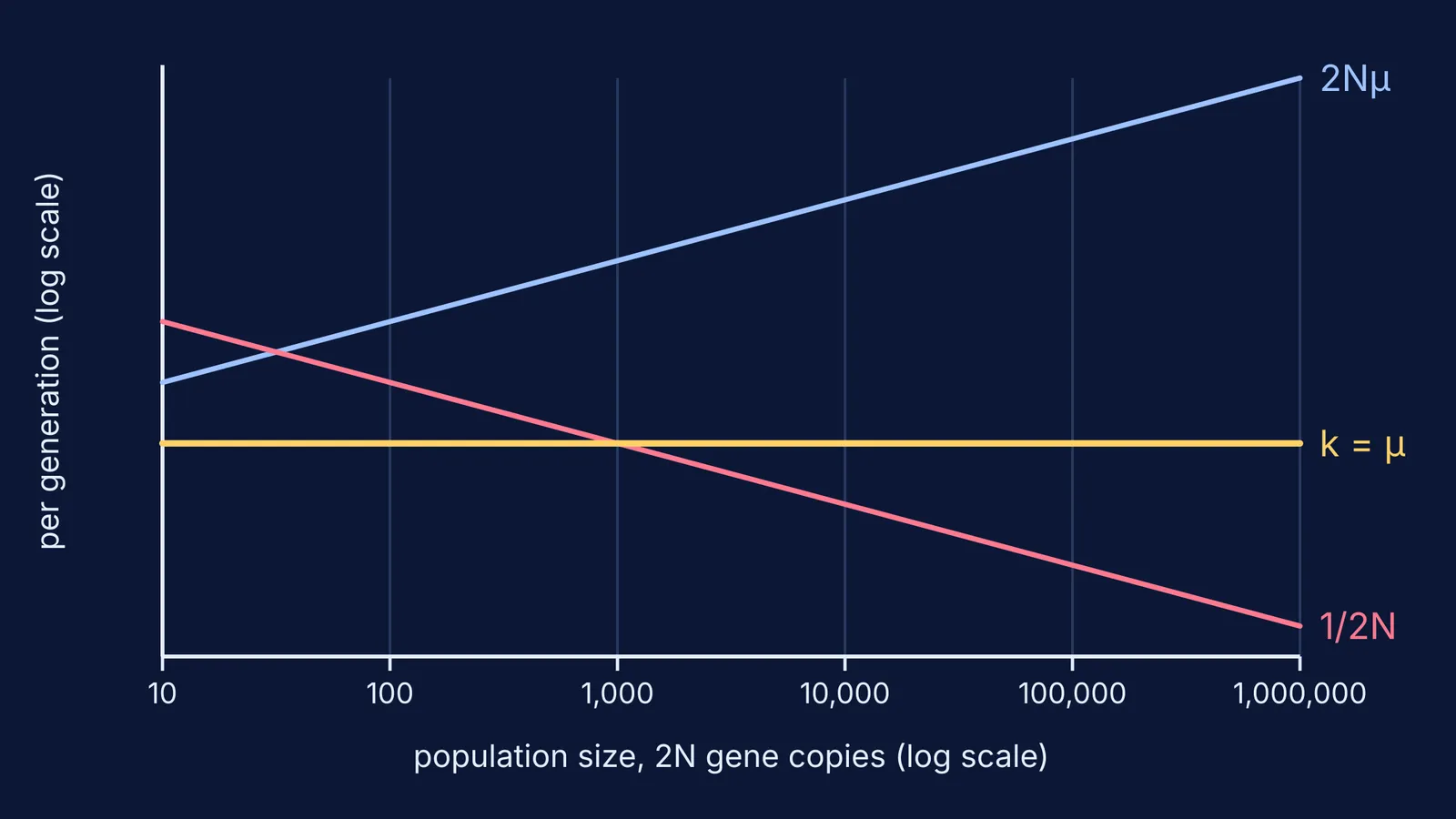
Island population of 500 lizards: 1,000 gene copies. If each copy gains a neutral mutation at some site with probability μ per generation, about 1,000μ new mutants appear each generation.
Each of those mutants fixes with probability 1/1,000. Substitutions per generation = 1,000μ × 1/1,000 = μ.
Mainland population of 500,000 lizards: 1,000,000 copies, so 1,000,000μ new mutants, each with a 1/1,000,000 chance. Again the answer is μ.
More mutations, worse odds each: the two cancel exactly. As a paper in Evolution puts it, "the rate of substitution of neutral mutations between species is equal to the mutation rate" (Jensen et al. 2019).
If the mutation rate is steady, differences between two species pile up at a steady rate: a molecular clock. Kimura and Ohta wrote in 1971 that "probably the strongest evidence for the theory is the remarkable uniformity for each protein molecule in the rate of mutant substitutions in the course of evolution", as quoted by Kern and Hahn (2018).
It also predicts which parts of a gene change fastest. In Kimura and Ohta's 1973 words, "the more stringent the functional requirement of the molecule [or part of the molecule], the slower is its evolutionary change" (Takahata 2007). Where most mutations do harm, few are neutral, so few get fixed. Takahata notes that silent (synonymous) changes, which leave the protein unchanged, were later seen to build up fast; see how a point mutation changes a codon and a protein.
Is the neutral theory still accepted today?
Mostly yes, with refinements. Tomoko Ohta's nearly neutral theory of 1973 added slightly harmful mutations that act neutral in small populations but are removed by selection in large ones (overview).
In 2018 Andrew Kern and Matthew Hahn argued that genome data show selection matters more than Kimura allowed (Molecular Biology and Evolution). Seven population geneticists replied in Evolution with "The importance of the Neutral Theory in 1968 and 50 years on" (Jensen et al.). Kimura, who died in 1994, is remembered for the view that "the bulk of molecular evolutionary changes are driven by mutation and random chance" (Crow, Royal Society memoir).
How do you use neutral theory in a biology answer?
For questions on drift, neutral mutations or evolutionary rates, check:
Does the change affect survival or reproduction? If not, it is neutral, and its fate is decided by drift.
Is the population small? Then drift moves gene frequencies a lot in each generation.
Is the question about the rate of change between species? For neutral mutations the answer is the mutation rate, and population size drops out.
Is the region under strong functional constraint? Then expect slower change.
A one-line definition: neutral theory says most molecular evolutionary changes are selectively neutral and fixed by random genetic drift, so they build up at a rate equal to the mutation rate.
If the cancellation still feels slippery, the Fermi Simulation Lab has interactive simulations for ideas that are easier to see than to read.