

On this page
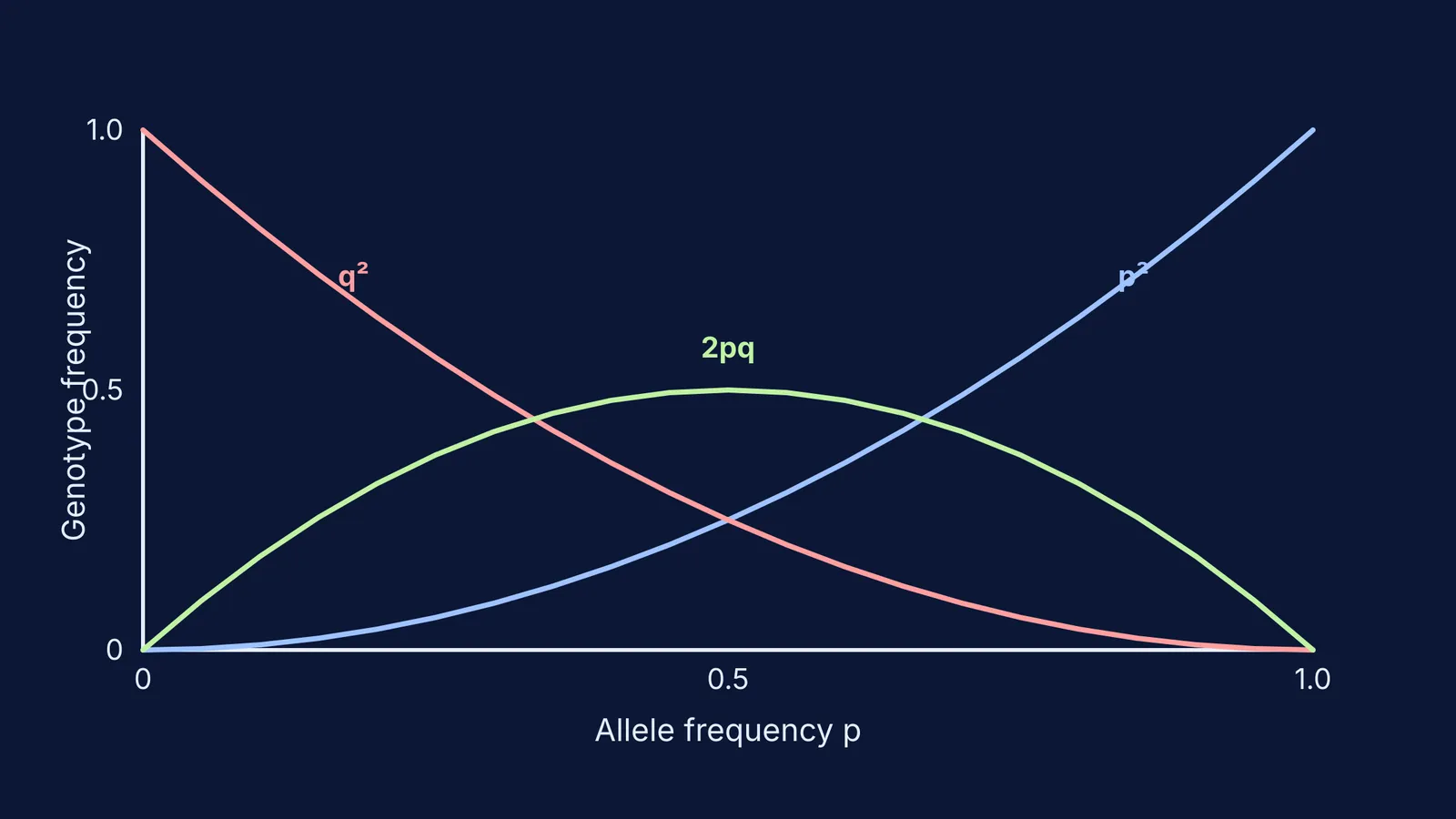
It is known to every biology student as the Hardy-Weinberg principle. The equation p² + 2pq + q² = 1 describes a population in genetic equilibrium, where allele frequencies do not change from generation to generation.
While the British mathematician G.H. Hardy is often remembered for providing the simple mathematical proof, the rule was discovered independently—and earlier in the same year—by a German obstetrician named Wilhelm Weinberg. This mathematical foundation eventually shaped the modern synthesis of biology pioneered by researchers like Theodosius Dobzhansky.
Who discovered the Hardy-Weinberg principle?
Wilhelm Weinberg worked as a physician in Stuttgart, Germany. Unlike Hardy, who was a pure mathematician drawn into biology by a colleague's question at dinner, Weinberg was deeply invested in medical genetics. He studied twins, inheritance in families, and how traits passed through human populations.
On 13 January 1908, Weinberg delivered a lecture titled *Über den Nachweis der Vererbung beim Menschen* (On the Demonstration of Heredity in Man) to the Society for Natural History in Württemberg. In this talk, he showed that the frequency of dominant and recessive alleles remains stable in a large, random-mating population over time.
What did G.H. Hardy publish in 1908?
Six months later, on 10 July 1908, G.H. Hardy published a two-page paper in the journal *Science* called "Mendelian Proportions in a Mixed Population".
Hardy used a simple binomial expansion to prove that if the frequencies of two alleles are p and q, the genotypes in the next generation will be distributed as p² for the homozygous dominant, 2pq for the heterozygous, and q² for the homozygous recessive. Because p + q = 1, the sum of the genotype frequencies is (p + q)² = 1.
This mathematical model acts as a null hypothesis for evolution. If a real population deviates from these proportions, forces like natural selection or migration must be at work. In very small populations, random chance can rapidly change allele frequencies—a process explained by Sewall Wright and genetic drift.
When you need to trace why a population has shifted out of equilibrium, the Fermi Concept Library has every concept in physics, chemistry, biology, mathematics and computing, each with its own lesson and its place in the map.
How do you find allele frequencies?
The true power of the Hardy-Weinberg principle is that it lets you work backward from what you can see (phenotypes) to what you cannot see (allele frequencies).
Consider a hypothetical population where the proportion of white flowers (the recessive trait) is 0.09, and the rest are red. When dealing with individuals, you might need a test cross or back cross to find a hidden genotype. But across a whole population, the Hardy-Weinberg rule lets us calculate it directly.
If the recessive phenotype has a frequency of 0.09, you can find the frequency of every genotype:
The white flowers are homozygous recessive (rr), so they represent q².
Therefore, q² = 0.09.
Take the square root to find the recessive allele frequency: q = 0.3.
Since p + q = 1, the dominant allele frequency is p = 1 − 0.3 = 0.7.
The proportion of heterozygous (Rr) plants is 2pq = 2 × 0.7 × 0.3 = 0.42.
This means a proportion of 0.42 carries the hidden recessive allele. Mathematical steps like these can sometimes feel like a leap, especially when you are unsure which term represents the phenotype and which represents the allele. The Fermi Problem Library has worked problems with a step-by-step solver that explains the reasoning rather than printing an answer.
Why was Wilhelm Weinberg ignored until 1943?
Because Weinberg published in German in a regional natural history journal, his discovery was completely missed by the English-speaking scientific community, and for over three decades biologists simply referred to the rule as "Hardy's law" before Curt Stern published a corrective short note in *Science* in 1943.
Stern wrote that "it seems a matter of justice to attach the names of both the discoverers to the population formula," creating the hyphenated name we use today.
Stern also noted that Weinberg had actually gone further than Hardy, extending his mathematics to cover multiple alleles and polyhybrid populations. Weinberg's work was not just a mathematical curiosity; it was a deliberate attempt to understand how genetic traits move through human populations in the real world.


