

On this page
DNA is read in triplets, or codons, where each three-letter word specifies one amino acid in a protein. When a copying error alters just one letter, the impact on the final protein can range from nothing at all to a complete loss of function. Understanding these mutations is essential for anyone studying molecular biology or genetics.
What is a point mutation?
A point mutation occurs when a single base pair in a genome is added, deleted, or changed (Source). This is not a rare event: the 37 trillion cells in the human body acquire trillions of point mutations every single day (Source).
Because much of our genome does not code for proteins, most of these daily changes are benign. They occur in non-coding regions and have no observable effect on a person's health. However, when a point mutation strikes a protein-coding gene, its effect depends entirely on how it alters the triplet codons that the ribosome reads during translation. A single substitution can drastically change a protein's function.
What happens in a missense mutation?
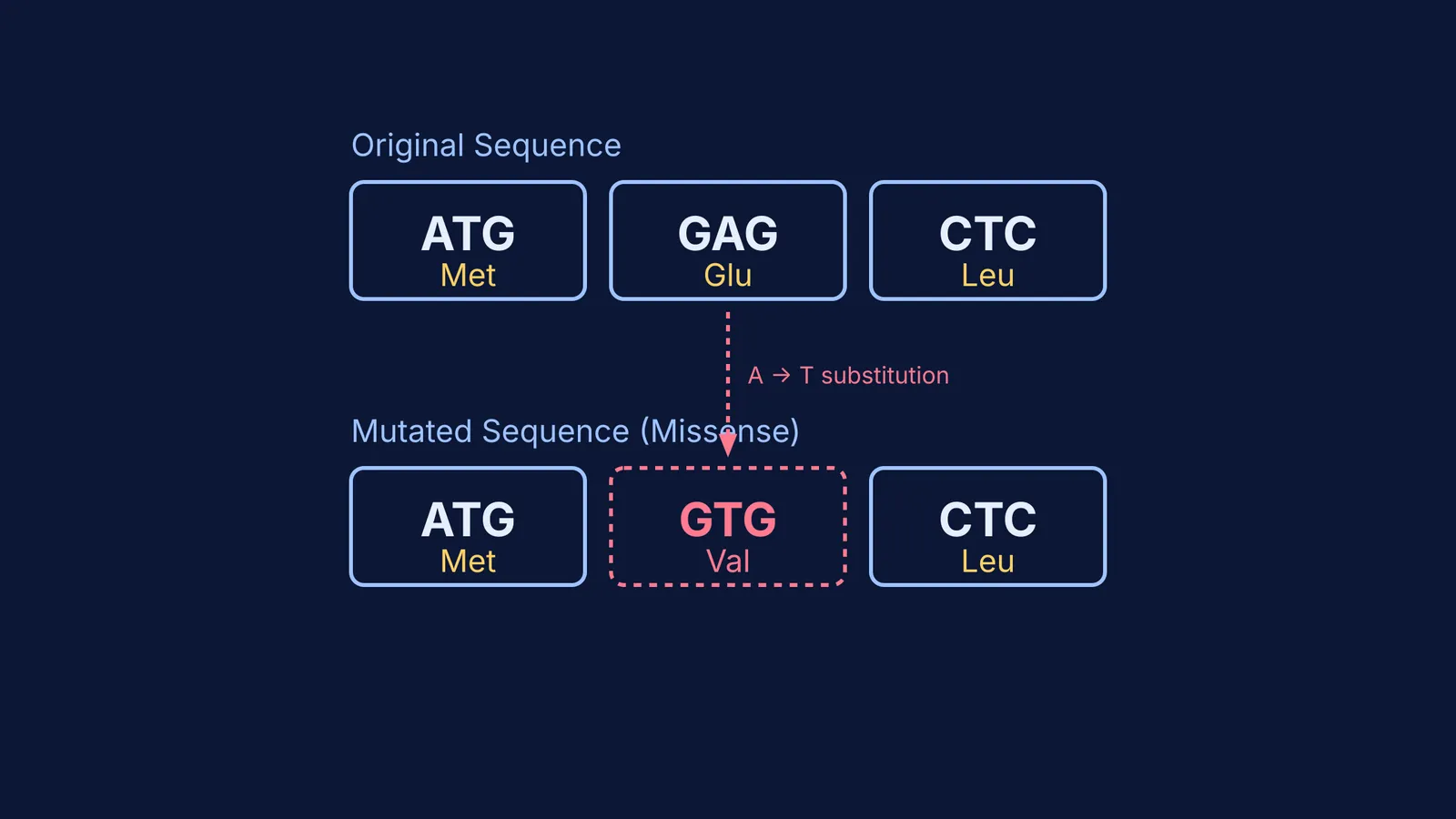
When a single nucleotide is swapped for another, it changes exactly one codon. This type of substitution can lead to a silent or a missense mutation.
A silent mutation changes a base but does not change the resulting amino acid. For example, if the DNA sequence `GAA` mutates to `GAG`, the mRNA still codes for the amino acid glutamic acid. The protein's primary structure and its overall function remain completely identical. These mutations are often considered neutral.
A missense mutation changes the codon so that it specifies a different amino acid entirely. This substitutes one building block for another in the final protein chain. Sometimes the new amino acid has very similar chemical properties, leaving the protein mostly functional and stable. In other cases, a single missense mutation can alter the protein's three-dimensional shape entirely, destroying its function. This is exactly what happens in Mendelian disorders like sickle-cell anaemia, where a single missense mutation causes red blood cells to become distorted and fragile.
Why is a nonsense mutation harmful?
A nonsense mutation occurs when a sequence change gives rise to a premature stop codon rather than a codon specifying an amino acid (Source).
Instead of adding another amino acid to the growing polypeptide chain, the ribosome encounters the stop signal and stops translation early. This yields a truncated, or shortened, protein that usually cannot fold correctly and is rapidly degraded by the cell's internal machinery. Nonsense mutations are highly disruptive and account for approximately 11% of all described gene lesions causing human genetic diseases (Source). Because they eliminate large sections of the intended protein, they often lead to severe loss-of-function phenotypes in genetic conditions.
How does a frameshift mutation change the reading frame?
A frameshift mutation is the insertion or deletion of nucleotide bases in numbers that are not multiples of three (Source).
Because the sequence is read strictly in groups of three, adding or removing a single letter shifts the entire "reading frame" for the rest of the gene. Even if only one base is removed, every subsequent codon is read incorrectly.
Consider a simple sentence made entirely of three-letter words: `THE BIG BAD DOG ATE THE RED CAT`. If we delete the `E` in `THE`, the spaces do not move with the letters. The new reading frame becomes: `THB IGB ADD OGA TET HER EDC AT`.
Every codon downstream of a frameshift is completely scrambled. This almost always results in a completely non-functional protein, and often introduces a random stop codon shortly after the mutation site. Before doing Chargaff's rule numericals or predicting protein products on paper, you must carefully check if an insertion or deletion has shifted the frame.
Testing mutations in a live sequence
Predicting a protein's final sequence requires tracking the reading frame and checking each new codon against a reference chart. If you are struggling to picture how one shifted base alters every subsequent amino acid in a long chain, the Fermi Simulation Lab lets you test silent, missense, nonsense and frameshift mutations on a live sequence to see the protein change instantly.
To practice predicting point mutations on your own, use this four-step checklist:
Identify the change: Is the mutation a simple substitution, an insertion, or a deletion?
Check the frame: If bases were added or removed, are they a multiple of three? If not, the frame has shifted.
Translate the codon: For substitutions, use a standard codon table to see if the new triplet codes for the same amino acid (silent), a new one (missense), or a stop signal (nonsense).
Determine the protein's fate: Decide whether the final protein will be normal, slightly altered, truncated, or completely scrambled.


