On this page
If you have studied Down syndrome in Class 12 biology, you know the short version: three copies of chromosome 21 instead of two. The longer version involves a young paediatrician, a bare lab with a cheap microscope, slides handed to a colleague, and an argument about credit that has lasted more than half a century.
How was the extra chromosome in Down syndrome discovered?
The story starts with a count. In 1956, Joe Hin Tjio and Albert Levan reported in Hereditas that human cells have 46 chromosomes. With the normal number settled, researchers could start asking whether a disease came with the wrong one.
Marthe Gautier was a French paediatrician. According to CNRS Le Journal, in the early 1950s she was one of only 2 women among 80 hospital residents (internes) in Paris. In 1955 she won a scholarship to study paediatric cardiology at Harvard, where she spent a year and learned to grow cells in vitro.
Back in Paris, she joined Raymond Turpin's team at the Trousseau hospital. The Science History Institute describes what she was given: a bare lab with a fridge, a centrifuge and a cheap microscope, no salary, and a loan she took out herself to buy glassware. The French Society of Genetics credits her with setting up a laboratory for growing cells in vitro and working out a protocol for counting chromosomes in fibroblasts, the cells of connective tissue.
She also improved the slides. She developed a dye that made chromosomes stand out and dried the cells slightly on the glass so they spread apart for counting, the Science History Institute reports. In early 1958, by her account, she cultured cells from a patient with Down syndrome and counted 47.
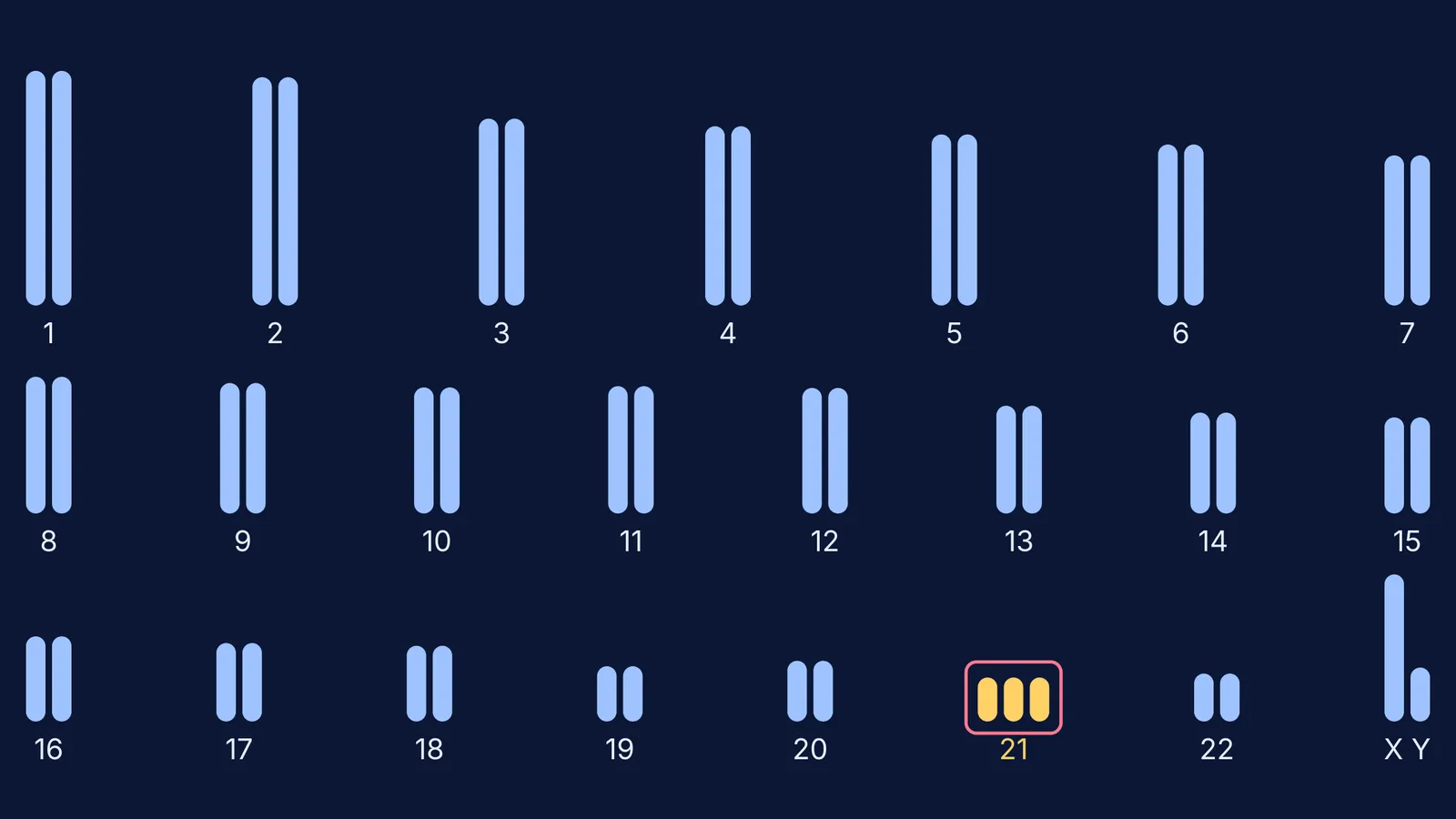
Trisomy 21 means each cell in the body has three copies of chromosome 21 instead of the usual two, as MedlinePlus, from the US National Library of Medicine, defines it. The same page puts Down syndrome at about 1 in 700 newborns.
Why did the credit go to Jérôme Lejeune?
Her microscope could not take photographs, and a count nobody can see is hard to publish. CNRS Le Journal reports that Jérôme Lejeune, who worked in Turpin's department, offered to photograph her slides in a better-equipped lab. The Science History Institute says it was Lejeune who identified the extra chromosome as number 21.
The key paper appeared in the Comptes rendus of the French Academy of Sciences on 16 March 1959: a study of the chromosomes of nine children with Down syndrome, signed Lejeune, Gautier, Turpin. The Science History Institute notes that this order implied Lejeune had done the most important work, and that French hospitals were strictly hierarchical, with Lejeune two ranks above her. Her name was misspelt as "Gauthier", according to CNRS Le Journal. She left research and became a respected cardiologist.
Who really discovered trisomy 21?
The two sides still disagree. In a 2014 statement, the Jérôme Lejeune Foundation said Lejeune's lab notebook shows he was the first to count the 47 chromosomes, on 22 May 1958, and that Gautier's contribution was an American cell culture technique. It also cites a letter of 27 October 1958 in which Turpin told Lejeune that Gautier was still counting 46.
Others weighed it differently. In 2014 the French Federation of Human Genetics gave Gautier its grand prize, though the Lejeune Foundation managed to stop her acceptance speech, and Inserm's ethics committee issued an opinion recalling her decisive role, according to the French Society of Genetics. The same page records that she died on 30 April 2022.
How do you get 47 chromosomes? A worked example
Here is the arithmetic behind the count, the version you need for board exams:
A body cell has 46 chromosomes in 23 pairs.
Meiosis halves this, so a normal egg or sperm carries 23.
If the two chromosome 21s fail to separate (nondisjunction), one gamete gets both copies and has 24; its partner gets none and has 22.
The 24-chromosome gamete meets a normal 23-chromosome gamete: 24 + 23 = 47, with three copies of chromosome 21.
The 22-chromosome gamete would give 22 + 23 = 45.
To see when in meiosis this goes wrong, read our explainer on how nondisjunction produces an extra chromosome and the comparison of nondisjunction in meiosis I and meiosis II. If meiosis itself is shaky, the Fermi Concept Library has a lesson for every concept in biology, so you can fill the gap before tackling the numericals.
What can you learn from Gautier's story?
You will work on group projects, lab reports and, one day, perhaps papers. A few habits protect your work:
Keep a dated notebook of what you did and what you saw, even for school practicals.
Agree on who does what, and how names will appear, before the work starts.
Keep a copy of your raw data before you hand it to someone else.
When you present group work, say who did which part.
And if you want the first half of this story, read how Joe Hin Tjio found that humans have 46 chromosomes.