
On this page
In 1370, at Firuz Shah Tughluq's court in Delhi, a Jain monk from Gujarat finished a short Sanskrit book on the astrolabe, a brass instrument. Mahendra Suri titled it *Yantraraja*, which means king of instruments. Its maths is trigonometry you meet in Class 11.
Who was Mahendra Suri?
Mahendra Suri was a Jain astronomer, born around 1340 in western India and a pupil of Madana Suri, according to the MacTutor History of Mathematics archive, which calls the Yantraraja "the first Sanskrit treatise on the astrolabe".
The fullest account is in historian Sreeramula Rajeswara Sarma's Descriptive Catalogue of Indian Astronomical Instruments. Mahendra and his pupil Malayendu Suri were Jaina monks from Bharuch who spent time at the court of Firuz Shah (r. 1351-1388). The book's star positions are set for 11 April 1370.
Mahendra was open about his sources. In verse 1.3, in Sarma's translation, he says many manuals on instruments had been composed "by Muslims in their own language", and that he churned them "like oceans" for their essence. In verse 1.4 he says an astronomer without instruments is like a soldier without weapons. For an earlier chapter in the astrolabe's story, read how al-Sijzi built an astrolabe around a rotating Earth.
What is in the Yantraraja?
Sarma's catalogue lists five chapters:
Computation: the trigonometric values needed to draw the astrolabe.
The parts of the astrolabe.
Constructing northern, southern and combined astrolabes.
Testing whether an astrolabe is made correctly.
Using it to observe and to solve problems in astronomy and spherical trigonometry.
Malayendu's commentary adds tables for each degree from 1° to 90°, including sines and cosines for a radius of 3000, and a list of 76 places with their latitudes (Sarma). Sarma reports that nearly a hundred manuscript copies of the text and commentary survive, and that later Sanskrit astrolabe texts broadly follow it.
Sarma is also frank about its limits. He reports that Kim Plofker's analysis of verses 41-54 of chapter 1 shows the two monks did not fully grasp the principles of spherical trigonometry and used approximations instead. A first book does not have to be a perfect one.
How does an astrolabe tell time?
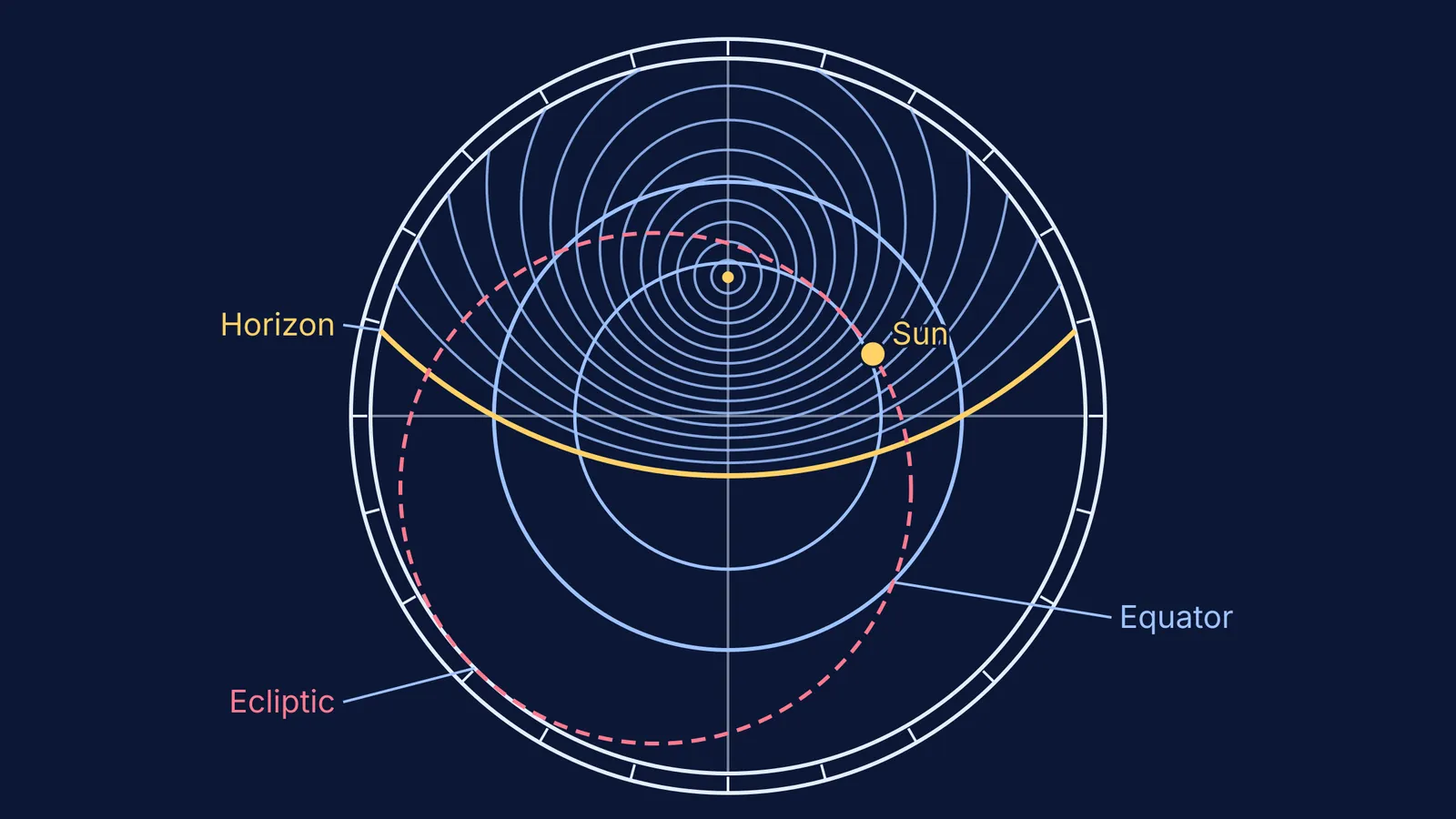
An astrolabe is a flat, turnable map of the sky. Its plate carries the altitude circles for one latitude in stereographic projection, so each latitude needs its own plate (Museo Galileo). Stereographic projection keeps circles as circles (UBC course notes), so the horizon, altitude circles and tropics can all be drawn with a compass. Over the plate turns the rete, an open frame carrying the ecliptic and pointers for bright stars (World History Encyclopedia).
In outline, to find the time during the day:
Sight the Sun through the alidade on the back and read its altitude.
Find today's position of the Sun on the rete's ecliptic.
Turn the rete until that point sits on the altitude circle you measured: east before noon, west after.
Read the angle on the rim, which converts to the hour.
The turn of the rete stands for the turning of the sky. That is how an angle becomes a time.
How did Malayendu draw Delhi's horizon?
Sarma reproduces a worked example from Malayendu's commentary on verses 1.13-15. Delhi, called Yoginipura, is at latitude 28°39′. Numbers are in base 60, so 76;58 means 76 + 58/60.
180° − 28°39′ = 151°21′.
From the table: A = 76;58 for 151°21′, and B = 5;1 for 28°39′.
Distance of the horizon circle's centre from the plate's centre: (A − B) ÷ 2 = 35;58,30.
Radius of the horizon circle: (A + B) ÷ 2 = 40;59,30.
For the next altitude circle, take 6° off both angles and repeat.
Now check it yourself. The UBC notes give the projection of a unit sphere as x′ = x/(z + 1). A point at angle p from the pole lands at sin p/(1 + cos p) = tan(p/2) from the centre. The horizon crosses the meridian 151°21′ from the pole on one side and 28°39′ on the other, so A ÷ B should equal tan 75°40.5′ ÷ tan 14°19.5′ ≈ 3.916 ÷ 0.2554 ≈ 15.3. Malayendu's 76;58 ÷ 5;1 also gives about 15.3. His table behaves like a scaled table of half-angle tangents.
What can a student take from it today?
Half-angle formulas have a job. The step from sin p/(1 + cos p) to tan(p/2) lets you draw a whole sky with a compass.
Recompute old numbers. Checking a 650-year-old table, as above, is good geometry practice and shows where approximations creep in.
Follow the thread. Spherical triangles came next in Europe too: see how Regiomontanus organised trigonometry in De triangulis.
If the projection is hard to picture, the Fermi Simulation Lab has interactive simulations for ideas that are easier to see than to read. To revise half-angle identities first, the Fermi Concept Library gives each mathematics concept its own lesson.
Next time you see an astrolabe in a museum, look at its plate. Each circle was set by a calculation like Malayendu's.