

On this page
For over a thousand years, Western scholars treated trigonometry not as an independent science, but as an astronomical calculating tool. Ptolemy laid out spherical calculations in the *Almagest* using chords of a circle, which required tedious sexagesimal fractions. While Indian astronomers like Aryabhata introduced half-chords (*jya*) and Islamic scholars advanced sine methods, Europe lacked a standalone text on triangles. In 1464, German mathematician Johann Müller, known as Regiomontanus, completed *De Triangulis Omnimodis libri quinque* (Five Books on Triangles of All Kinds), as documented in his MacTutor biography.
Regiomontanus realized triangles deserved the deductive structure Euclid gave to plane geometry. In *The Mathematics of the Heavens and the Earth*, Glen Van Brummelen shows how Regiomontanus organized the work into five axiomatic books dedicated to Cardinal Basilios Bessarion. Book I presents 56 geometric propositions on ratios and circles, Book II develops plane trigonometry, and Books III through V cover spherical triangles. To simplify calculations, Regiomontanus replaced sexagesimal chords with sine tables scaled to a base radius of 60,000 and later a decimal radius of 10,000,000.
Why was De Triangulis written as an independent book?
Before Regiomontanus, angle calculations were scattered across astronomy handbooks without systematic proofs. Astronomers computed planetary positions, solar declinations, and eclipses by borrowing spherical formulas on the fly. Regiomontanus set out to build an axiomatic discipline where plane triangles formed the logical foundation for spherical ones, just as Euclid built solid geometry upon plane figures. By treating the triangle as an autonomous geometric figure rather than an arc in the sky, he showed that the same relations governed surveying, architecture, and navigation.
How did Regiomontanus prove the sine rule for plane triangles?
Book II, Theorem 1 provides Europe's first systematic proof of the Law of Sines for plane triangles: in every rectilinear triangle, the ratio of any side to another equals the ratio of the sines of their opposite angles (a / sin A = b / sin B). While Islamic scholars knew the relationship earlier, Regiomontanus framed the theorem in Euclidean terms, as detailed by S. A. Jayawardene in Isis.
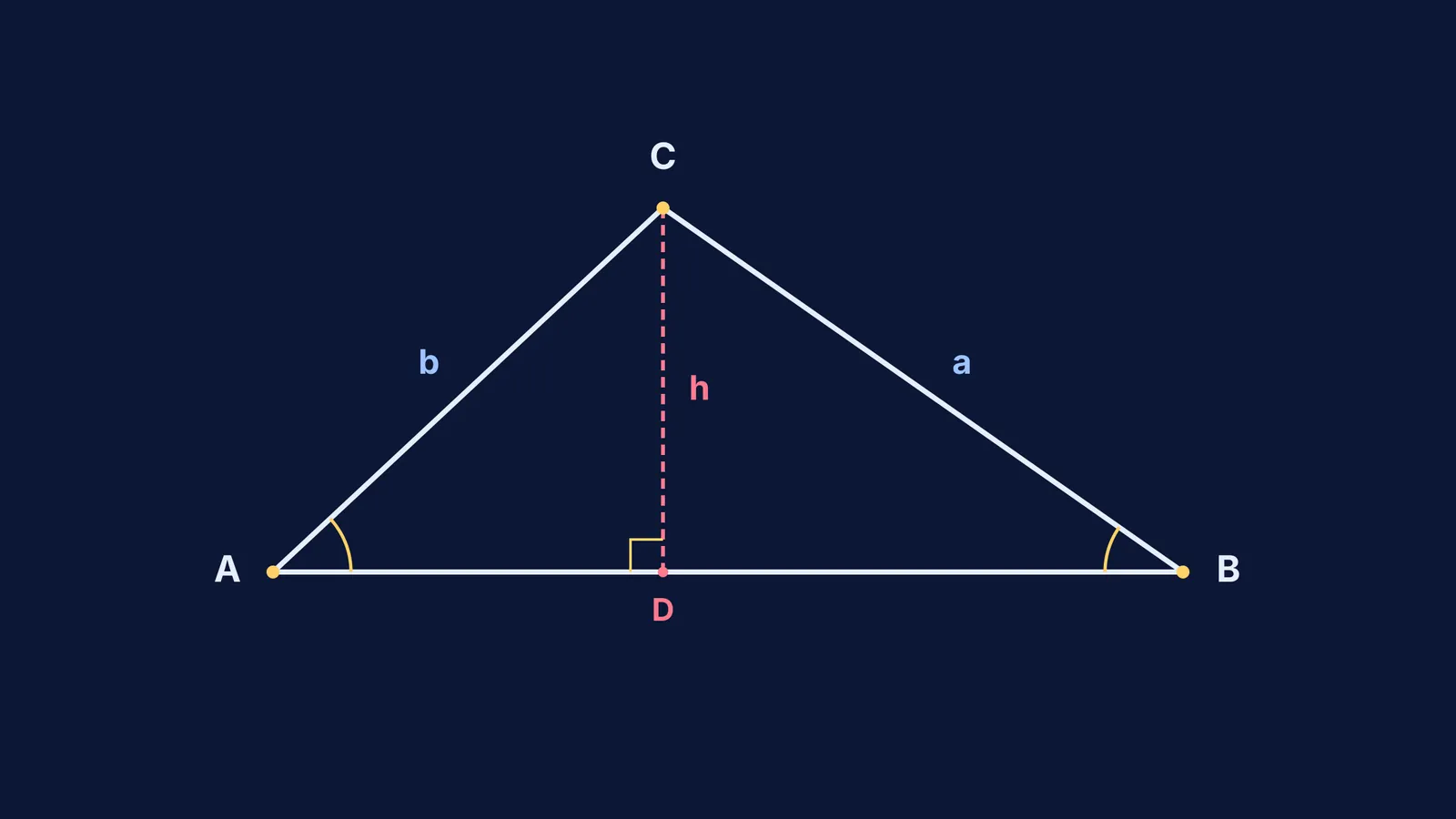
His geometric demonstration drops a perpendicular altitude h from vertex C to base AB at point D, splitting triangle ABC into two right triangles, ACD and BCD. In right triangle ACD, h = b × sin A. In right triangle BCD, h = a × sin B. Equating both expressions for the common altitude:
b × sin A = a × sin B
Dividing both sides by sin A × sin B yields the Law of Sines:
a / sin A = b / sin B
Regiomontanus proved this for both acute triangles, where D falls inside AB, and obtuse triangles, where D falls on the base extended.
This transition mirrors what students experience today. In introductory Class 10 trigonometry, ratios are taught strictly within right-angled triangles. In higher classes, the sine rule can feel like an arbitrary formula rather than an altitude decomposition. The Fermi Concept Library covers every concept in physics, chemistry, biology, mathematics and computing, each with its own lesson and its place in the map, so you can trace how advanced theorems build directly from basic right-angled geometry.
How did De Triangulis shape modern mathematics and astronomy?
Regiomontanus died in Rome in 1476 at age 40 before printing *De Triangulis*. The manuscript circulated privately for 69 years until Nuremberg printer Johannes Petreius published it in 1533, edited by Johannes Schöner. As historian N. G. Hairetdinova showed in Historia Mathematica90026-1), this 1533 edition became Europe's core textbook, transmitting medieval Near Eastern trigonometry into Renaissance science.
The book quickly shaped astronomy. Nicolaus Copernicus studied the 1533 edition, using its plane and spherical trigonometry to compute celestial orbits in *De revolutionibus* (1543). Just as Indian astronomers like Bhaskara I formulated sine approximations and Kerala mathematicians proved series expansions in Jyesthadeva's Yuktibhasa, Regiomontanus synthesized centuries of triangle mathematics into a foundational European text.
When solving multi-step triangle problems in mechanics or geometry, selecting the right side-angle pairs is critical. The Fermi Problem Library offers worked problems with a step-by-step solver that explains the reasoning rather than printing an answer, helping you trace solutions with confidence.
A worked example using the altitude decomposition method
In the translation analyzed by S. A. Jayawardene in Isis, Regiomontanus solves non-right triangles by splitting them into right-angled pairs. For triangle ABC with side b = 10, angle A = 30°, and angle B = 45°:
Drop perpendicular altitude h from vertex C to base AB.
In right triangle ACD: h = b × sin(30°) = 10 × 0.5 = 5.
In right triangle BCD: h = a × sin(45°) = a × (1 / √2).
Equating the altitudes gives a × (1 / √2) = 5, so a = 5√2 ≈ 7.07.
Decomposing any general triangle into two right-angled frames means you never need to rely on rote memory; the sine rule emerges directly from basic Euclidean geometry.


