

On this page
Around a thousand years ago, astronomers debated whether the daily sweep of the stars across the sky was caused by the heavens turning or the Earth spinning. Abu Sa'id al-Sijzi, a Persian astronomer who lived from 945 to 1020 CE (Wikipedia), built a mechanical model to show exactly how a moving Earth would work.
He created an astronomical instrument to demonstrate that the daily rotation we observe could be entirely due to the Earth's own movement, a concept that challenged the prevailing stationary-Earth models of his era.
What is the al-Zuraqi astrolabe?
The astrolabe was the most important astronomical calculating device before the invention of the telescope. It served as a clinometer, an analogue calculator, and a portable map of the heavens. By capturing the three-dimensional sky on a two-dimensional brass plate using stereographic projection, an astronomer could quickly solve problems involving time, the position of stars, and the timing of sunrise and sunset.
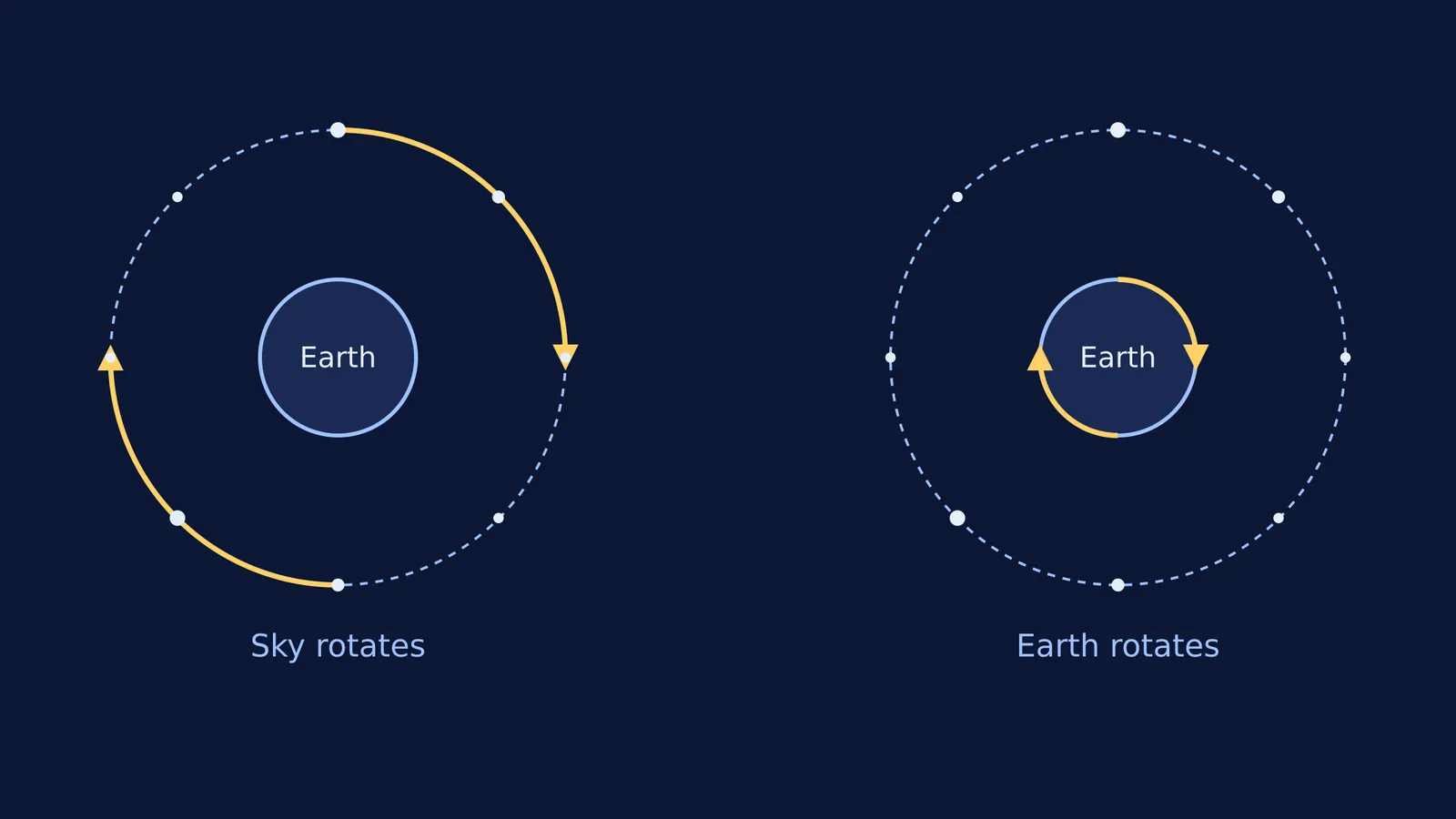
Standard astrolabes of the 11th century modelled the geocentric universe, placing a stationary Earth at the centre of all creation. They featured a fixed background plate that represented the Earth and the observer's local horizon. Over this plate, an openwork metal disc called the "rete" — which carried pointed markers for the brightest stars and a solid ring for the Sun's annual path — was manually rotated. Turning the rete simulated the entire sky spinning around a fixed observer.
Al-Sijzi decided to invert this fundamental mechanical design. In his astrolabe, which he called the *al-Zuraqi*, the rete representing the stars was locked in a fixed position. Instead, the plate representing the Earth and the observer's local horizon was made to rotate beneath it. This mechanical swap successfully reproduced the apparent motion of the stars by assuming an axial rotation of the Earth, rather than the rotation of the enormous celestial sphere.
By building the *al-Zuraqi*, al-Sijzi proved mechanically that if the Earth rotated on its axis once a day, the mathematics of celestial observation would work exactly the same way.
Did al-Biruni believe the Earth rotates?
We know about al-Sijzi’s invention largely because his younger contemporary, the polymath al-Biruni, examined the instrument and wrote about it. Al-Biruni, who lived from 973 to 1048 CE (Wikipedia), was deeply interested in the geometry of the heavens, the structure of the universe, and the physical laws that governed them.
In his comprehensive writings on astrolabes, al-Biruni praised the design directly: "I have seen the astrolabe called Zuraqi invented by Abu Sa'id Sijzi. I liked it very much and praised him a great deal, as it is based on the idea entertained by some to the effect that the motion we see is due to the Earth's movement and not to that of the sky" (Wikipedia).
Al-Biruni saw that the choice between a rotating Earth and a rotating sky was mathematically neutral. If you calculate the rising and setting of a star, the geometry works out identically whether the observer's horizon turns toward the star, or the star turns toward the observer's horizon.
Because geometry could not settle the debate, al-Biruni concluded that the question of the Earth's rotation fell firmly into the domain of physics (or natural philosophy) rather than pure astronomy. He famously called it "a problem difficult of solution and refutation." While al-Biruni ultimately leaned towards a stationary Earth because he felt the physical effects of high-speed rotation (such as constant high winds) were missing, his respect for al-Sijzi's model showed that the moving Earth was treated as a serious, mathematically viable hypothesis.
Why is relative motion important in physics?
The debate over the *al-Zuraqi* astrolabe occurred roughly five centuries before Nicolaus Copernicus published his heliocentric theory. It highlights an understanding of frames of reference in the Islamic Golden Age. Al-Sijzi and al-Biruni clearly recognised that motion is entirely relative to the observer, a concept that remains the bedrock of physics today.
When you study mechanics, shifting between different frames of reference can be difficult to picture in your head. You have to imagine how a system looks from a stationary point, and then re-evaluate how it looks from a moving point. If you struggle to visualise these mental shifts in perspective, the Fermi Simulation Lab has interactive simulations for the ideas that are easier to see than to read.
Understanding that a moving observer will perceive a stationary object as moving is the foundation of relative velocity. Just as al-Sijzi's rotating Earth mathematically produced a moving sky, shifting your coordinate system changes how velocities, accelerations, and forces are measured in any physics problem.
Read more:


