On this page
Every aluminium window frame starts as a red rock called bauxite, which must become pure white alumina, Al₂O₃, before electrolysis. The method that makes nearly all the world's alumina is named after Karl Josef Bayer, an Austrian chemist working in Russia in the 1880s (Bayer process overview). Here is what he found, how each step works, and a worked sum you can do on paper.
Who was Karl Josef Bayer?
Bayer was born on 4 March 1847 in Silesia, then part of the Austrian Empire, and died in 1904 (biography on Wikipedia). In Saint Petersburg he worked for the textile industry, where aluminium hydroxide was used to help fix dye to cotton.
His US patent, "Process of obtaining alumina", was filed on 18 August 1887 and granted on 8 May 1888, with Bayer living in St. Petersburg (US patent 382,505). The German version, patent 43977, was filed from Tentelewa near St Petersburg in July 1887 and published on 3 August 1888 (chemie.de lexicon entry).
The 1887 patent is about getting the alumina back out of solution. Bayer noticed that an aluminate solution "begins to decompose if hydrate of alumina is added while constantly stirring the liquid", and the product "forms a crystalline powder, which can be washed very easily" (US patent 382,505). The patent compares this with the older method of bubbling carbonic acid through the liquor, and says silicic acid and similar impurities are not brought down with the alumina.
The second patent was filed on 31 January 1892 from Jelabuga in Russia (chemie.de). In it Bayer used an autoclave, a sealed pressure vessel, with sodium hydroxide to get a very pure sodium aluminate solution (biography on Wikipedia).
How does the Bayer process purify bauxite into alumina?
Bauxite contains only 30-60% alumina; the rest is silica, iron oxides and titanium dioxide (Bayer process overview). The process works because alumina is amphoteric: it dissolves in a strong base, while iron(III) oxide, a basic oxide, does not. If that idea is shaky, read our explainer on amphoteric oxides like Al₂O₃ and ZnO first.
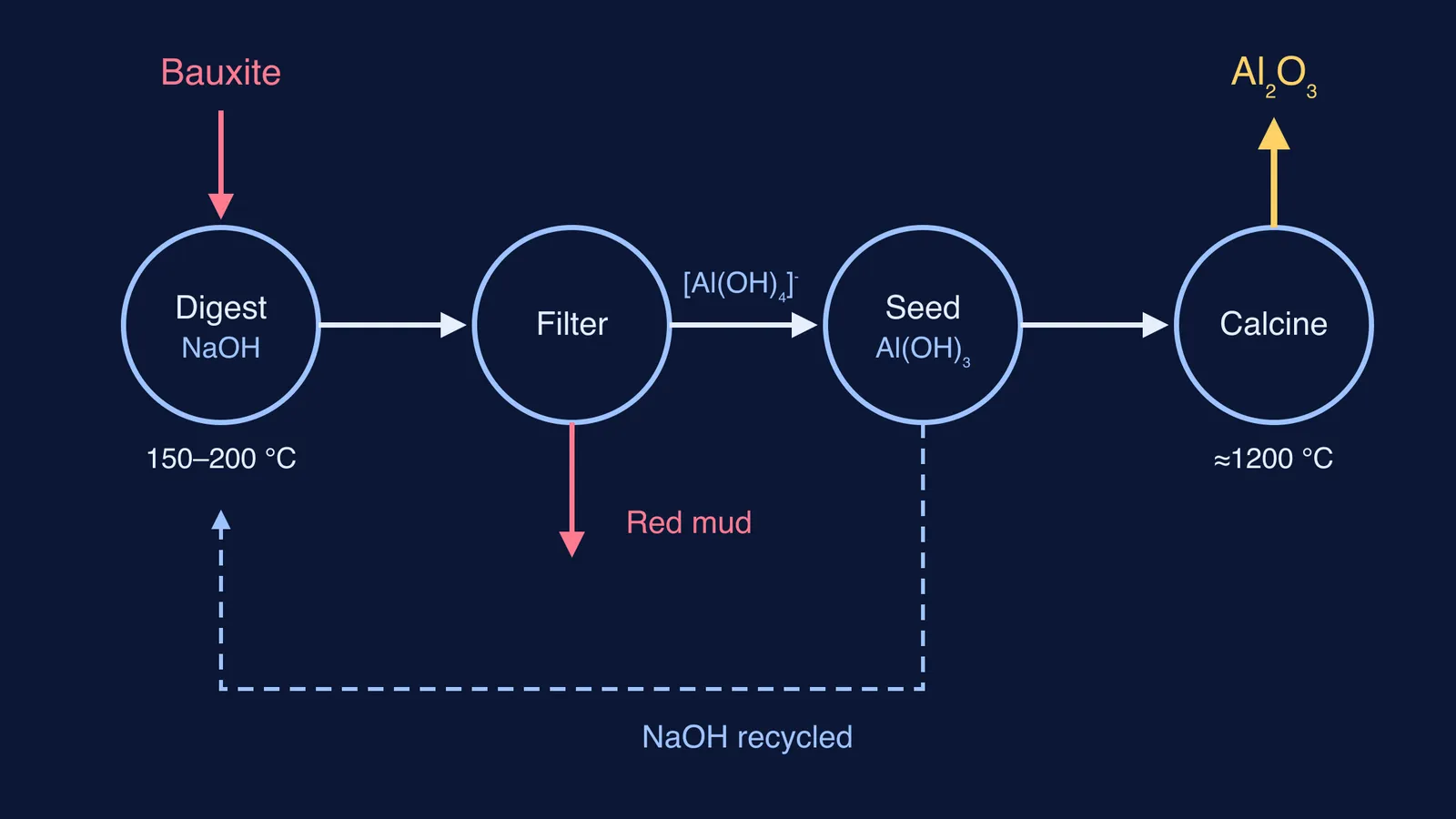
Digestion: crushed bauxite is heated with sodium hydroxide solution in a pressure vessel at 150 to 200 °C. Al₂O₃ + 2OH⁻ + 3H₂O → 2[Al(OH)₄]⁻
Clarification: the undissolved iron oxides and sand settle and are filtered off as red mud, a strongly caustic waste.
Precipitation: the clear liquor is cooled and seeded with aluminium hydroxide crystals, Bayer's 1887 step. [Al(OH)₄]⁻ → Al(OH)₃ + OH⁻
Calcination: the washed aluminium hydroxide is heated to about 1,200 °C. 2Al(OH)₃ → Al₂O₃ + 3H₂O
Recycling: the hydroxide released in step 3 goes back to step 1, so the sodium hydroxide runs in a loop.
Over 90% of the alumina made this way goes on to the Hall-Héroult electrolysis cell (Bayer process overview), the story we tell in how Hall and Héroult made aluminium cheap.
Why use sodium hydroxide and not an acid?
An acid would dissolve the iron oxide along with the alumina, and you would be back to a mixture. The base picks out only the amphoteric oxide.
In India this chemistry runs at scale in Odisha. A 2003 Press Information Bureau release describes NALCO's alumina refinery at Damanjodi, fed with bauxite mined on the Panchpatmali hills of Koraput district, and the company's smelter at Angul (PIB release). For why bauxite counts as an ore and clay does not, see minerals vs ores: bauxite vs clay.
How much bauxite makes one tonne of aluminium?
About 1.7 to 3.3 tonnes of bauxite give 0.91 tonnes of alumina, depending on the ore (Bayer process overview). Work it through:
Bauxite per tonne of alumina: 1.7 ÷ 0.91 = 1.87 t, and 3.3 ÷ 0.91 = 3.63 t.
Aluminium in alumina: 2 × 26.98 = 53.96 g of Al in 101.96 g of Al₂O₃, a mass fraction of 0.529.
Alumina per tonne of aluminium: 1 ÷ 0.529 = 1.89 t.
Bauxite per tonne of aluminium: 1.89 × 1.87 = 3.5 t, up to 1.89 × 3.63 = 6.9 t.
So every kilogram of aluminium starts as roughly 3.5 to 7 kg of red rock. The rest leaves as red mud, as water driven off in calcination, and, in the electrolysis cell, as oxygen.
What should you remember for the exam?
Cover the page and write these four lines from memory before a test.
What dissolves: Al₂O₃ in hot NaOH, as aluminate. What stays: Fe₂O₃ and sand, as red mud.
What brings alumina back: seeding with Al(OH)₃, not acid.
What heat does: 2Al(OH)₃ → Al₂O₃ + 3H₂O.
What happens next: electrolysis of alumina to aluminium.
If amphoteric behaviour still feels like a rule to memorise, the Fermi Concept Library gives every concept in chemistry its own lesson and its place in the map. For mass-balance sums like the one above, the Fermi Problem Library has worked problems with a step-by-step solver that explains the reasoning rather than printing an answer.
Next time you crush an aluminium can, run the loop backwards: electrolysis, calcination, seeding, a hot caustic tank, and a hill of red rock.