

On this page
A Class 10 question on the difference between minerals and ores is really asking about one word: profitably. Below are the textbook definitions, the bauxite and clay example in numbers, and an answer you can write in the board exam.
What is the difference between minerals and ores?
Minerals are "the elements or compounds, which occur naturally in the earth's crust", according to section 3.4 of NCERT Class 10 Science, Chapter 3: Metals and Non-metals. The same section says that at some places minerals contain a very high percentage of a particular metal and "the metal can be profitably extracted from it. These minerals are called ores."
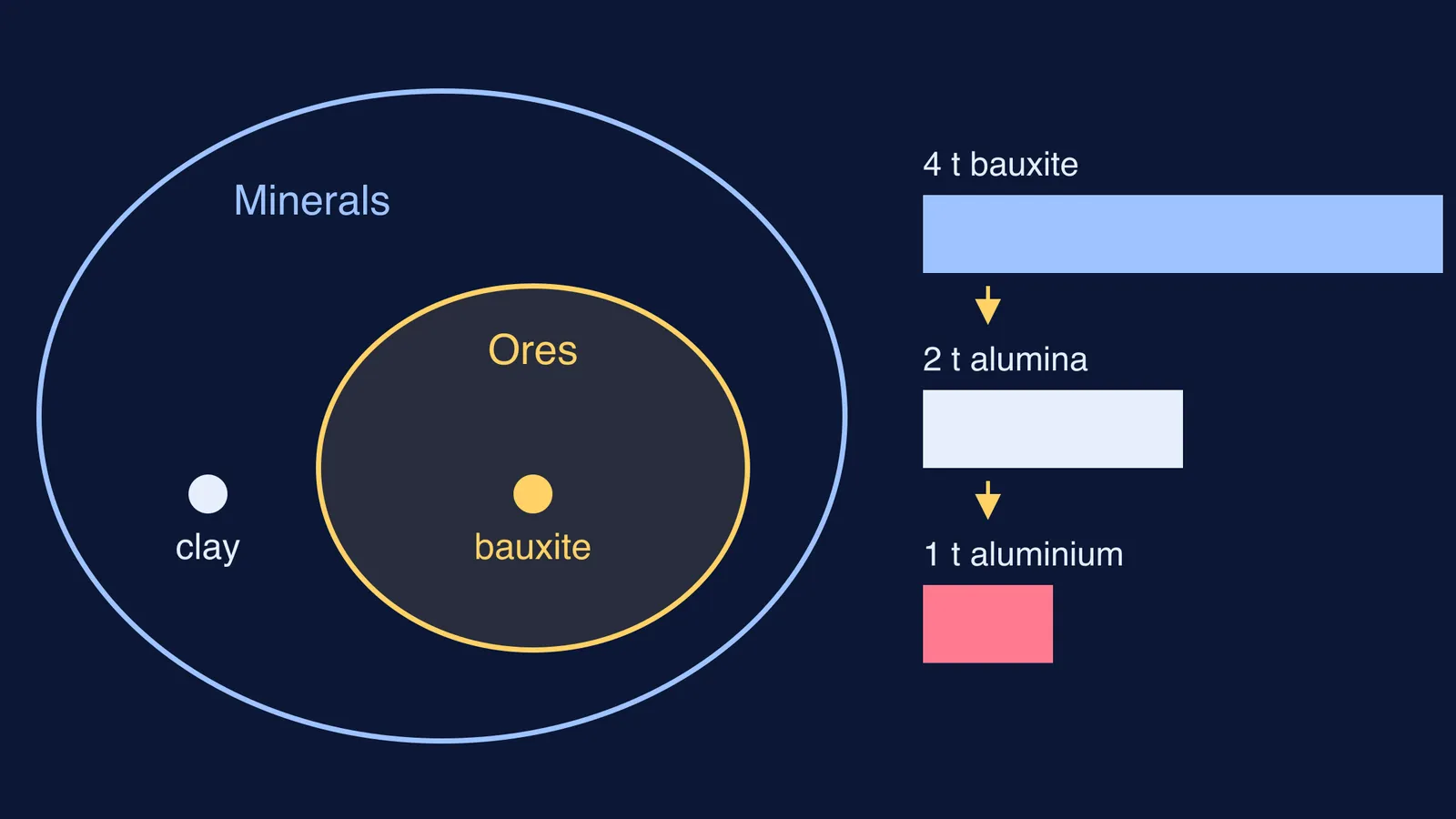
So ores are a smaller set inside the bigger set of minerals. Every ore is a mineral first. Not every mineral is an ore, because many hold too little metal, or cost too much to process, for extraction to pay.
What makes extraction pay? The NCERT geography chapter Minerals and Energy Resources (Class 10, Contemporary India II) names three factors: the concentration of the mineral in the ore, the ease of extraction and closeness to the market. It also gives a clear case of minerals that are not ores: ocean waters contain vast quantities of minerals, but most are too widely diffused to be of economic significance.
Why is bauxite an ore of aluminium but clay is not?
Both bauxite and clay contain aluminium. Kaolinite, a clay mineral, has the formula Al2Si2O5(OH)4, according to the US Geological Survey's notes on kaolinite.
The NCERT geography chapter notes that alumina, and later aluminium, is obtained from bauxite. The USGS Mineral Commodity Summaries 2026 entry on bauxite and alumina explains why clay misses out: vast resources of clay are technically feasible sources of alumina, but they are "currently not economically competitive with bauxite."
That is the definition at work: clay is a mineral that contains aluminium, and bauxite is the ore because aluminium can be extracted from it at a profit.
The same USGS report estimates that India mined 25 million tonnes of bauxite in 2025 and puts India's bauxite reserves at 650 million tonnes. The NCERT geography chapter shows Odisha as the largest bauxite-producing state in 2018-19, with 65% of the country's production.
One footnote for the curious: a USGS report on the Baghlan clay and gypsum area of Afghanistan points out that, strictly, bauxite is not a single mineral but a rock made mostly of the aluminium minerals gibbsite, boehmite and diaspore.
Does clay have less aluminium than bauxite?
Using Class 10 atomic masses (Al = 27, Si = 28, O = 16, H = 1), work out the share of aluminium by mass in each substance.
Pure kaolinite, Al2Si2O5(OH)4: molar mass = 54 + 56 + 144 + 4 = 258 g/mol. Aluminium share = 54 ÷ 258, about 21%.
Gibbsite, Al(OH)3, one of the main minerals in bauxite: molar mass = 27 + 48 + 3 = 78 g/mol. Aluminium share = 27 ÷ 78, about 35%.
Bauxite as mined: the USGS rule of thumb is that 4 tonnes of dried bauxite gives 2 tonnes of alumina, which gives 1 tonne of aluminium. So about 25% of the dried bauxite's mass ends up as aluminium.
So on paper, pure kaolinite holds about 21% aluminium, not far below the roughly 25% that bauxite yields by the USGS rule of thumb. The percentage alone does not make an ore; the cost of getting the metal out does. In kaolinite the aluminium is combined with silicon, and the USGS still rates clay as not economically competitive. That is "profitably" in real numbers.
If molar-mass steps like these are where you slip, the Fermi Problem Library has worked problems with a step-by-step solver that explains the reasoning rather than printing an answer.
How do you write minerals vs ores in a board exam answer?
For a 3-mark question, write four short points:
Mineral: an element or compound that occurs naturally in the earth's crust.
Ore: a mineral that contains a high percentage of a metal, from which the metal can be profitably extracted.
Relationship: all ores are minerals, but all minerals are not ores.
Example: aluminium occurs in both clay and bauxite, but it is extracted profitably only from bauxite, so bauxite is the ore of aluminium.
Three slips that cost marks:
Defining an ore as "a rock with metal in it" and leaving out profit.
Saying clay has no aluminium. It does; it just does not pay to extract.
Flipping the relationship to "all minerals are ores".
If mineral, ore, gangue and metallurgy start to blur together, the Fermi Concept Library gives each concept in chemistry its own lesson and its place in the map, so you can see how they connect.
Next, read what gangue is and how ore is concentrated, then why aluminium is extracted by electrolysis. For the history behind these steps, see Agricola's De re metallica and the Class 10 steps of metallurgy.


