

On this page
Ore dug out of a mine comes mixed with soil, sand and rock, and that waste must go before roasting, reduction or electrolysis. NCERT Class 10 calls this enrichment of ores but names no methods; the methods below come from the NIOS Senior Secondary chemistry lesson.
What is gangue?
The NCERT Class 10 Science textbook says ores mined from the earth "are usually contaminated with large amounts of impurities such as soil, sand, etc., called gangue" (NCERT Science Class 10, Chapter 3: Metals and Non-metals). It adds that the separation methods depend on how the physical or chemical properties of the gangue differ from those of the ore. In the same chapter, an ore is a mineral from which the metal can be profitably extracted.
The NIOS Senior Secondary chemistry lesson calls the impurities "gangue or matrix" and defines concentration, or ore dressing, as "the process of removal of gangue from powdered ore" (NIOS Chemistry, Lesson 16: Occurrence and Extraction of Metals). NIOS puts crushing and pulverisation just before this step, so the ore is already a powder when separation starts.
How is ore concentrated?
The same NIOS lesson lists four methods, each using a property that differs between the ore and the gangue.
Gravity separation (hydraulic washing) uses density. The powdered ore is shaken with water or washed with a strong current of water on a vibrating table with grooves. The heavier ore particles settle in the grooves, and the lighter sand and earth are washed away. NIOS uses this method for heavy oxide ores such as haematite (Fe2O3) and tinstone (SnO2), and also for gold.
Magnetic separation uses magnetism. The finely powdered ore passes along a conveyor belt that runs over two rollers, one fitted with an electromagnet. Magnetic grains are attracted by that roller and fall into a separate heap. This works when either the ore or the impurity is magnetic. In the NIOS example, tinstone is non-magnetic but contains magnetic iron tungstate (FeWO4) and manganese tungstate (MnWO4), so the magnet pulls out the impurity. For a refresher on which materials respond to a magnet, see diamagnetic, paramagnetic and ferromagnetic materials with examples.
Froth flotation uses how surfaces wet. This method is used mainly for sulphide ores such as galena (PbS), zinc blende (ZnS) and copper pyrites (CuFeS2). Oil wets the sulphide particles, and water wets the gangue. The powdered ore is mixed with pine oil or eucalyptus oil and water, and air is blown through it with great force. The froth carries the oil-coated ore to the top, where it is skimmed off, and the gangue sinks.
The chemical method uses solubility. A reagent dissolves the ore and leaves the insoluble impurities behind. NIOS uses bauxite as the example: the powdered ore is digested with sodium hydroxide solution, aluminium oxide dissolves, and iron(III) oxide, silica and titanium(IV) oxide are filtered off.
Which concentration method should you use?
Ask four questions, in this order, about the ore and its gangue:
Is it a sulphide ore? Use froth flotation.
Is it bauxite? Use the chemical method.
Is the ore, or the impurity, magnetic? Use magnetic separation.
Is the ore much denser than the rock around it? Use gravity separation.
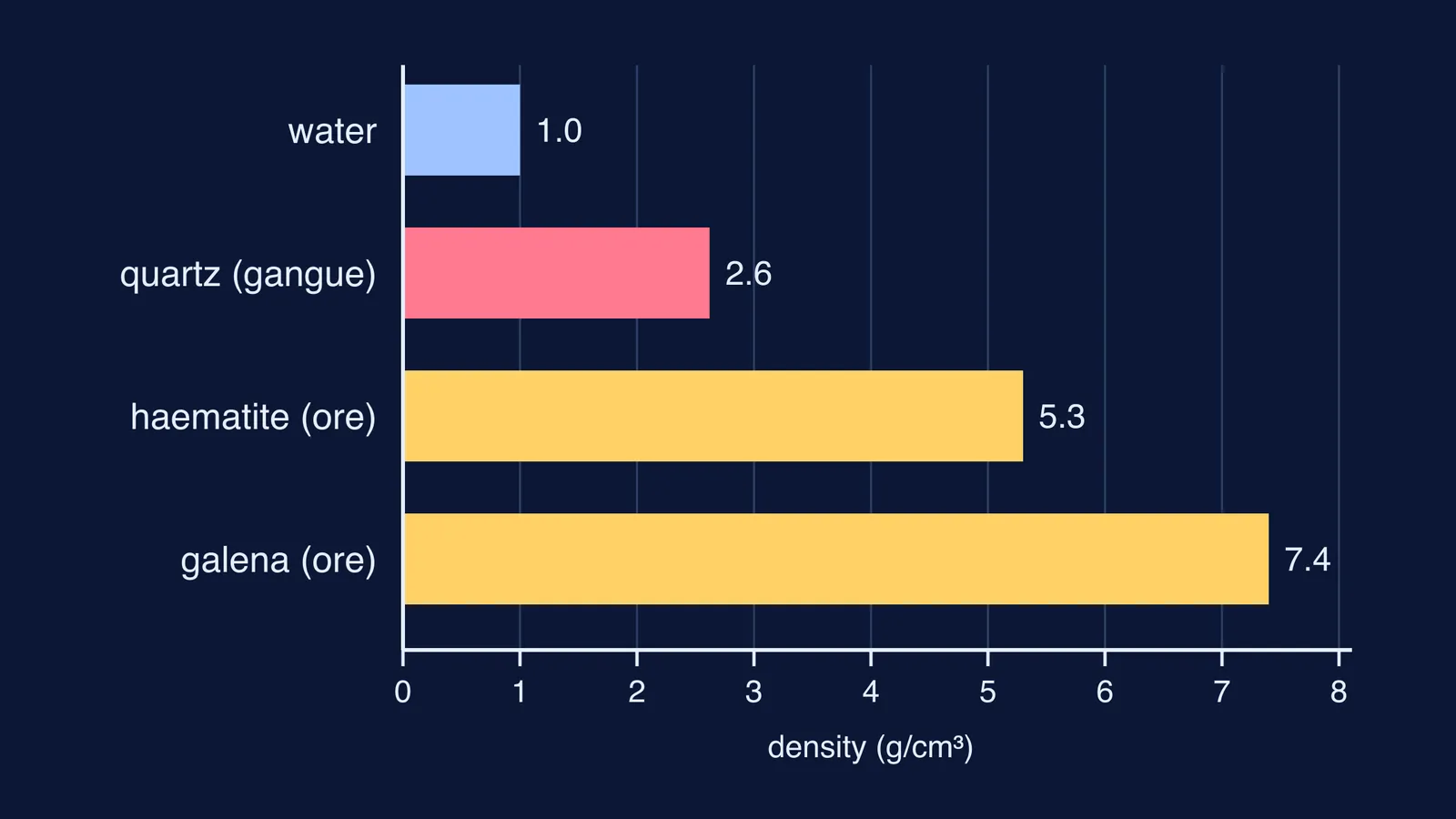
A worked check: Webmineral lists the average density of quartz as 2.62 g/cm3, of haematite as 5.3 g/cm3 and of galena as 7.4 g/cm3. If quartz stands in for the sandy gangue, haematite is about twice as dense (5.3 / 2.62 = 2.0), so a stream of water carries the quartz off first, and gravity separation makes sense. Webmineral lists haematite as magnetic only after heating, and NIOS places it under gravity separation, not magnetic separation.
Galena is denser still, about 2.8 times quartz (7.4 / 2.62). But it is a sulphide, so question 1 wins: NIOS lists it under froth flotation. For the idea behind comparing densities, see how to find density by weighing in air and water.
How do you write a "which method" answer?
A full answer to "name and explain a method of concentrating ore X" has five parts:
One line defining gangue (soil, sand and rock mixed with the ore).
The method's name.
The property it uses: density, magnetism, wetting by oil or solubility.
One or two lines on how it works.
The example ore, with its formula.
For example: "Galena (PbS) is a sulphide ore, so it is concentrated by froth flotation. Oil wets the ore particles, which rise with the froth, while the gangue is wetted by water and sinks."
What happens after concentration?
The NCERT flowchart puts concentration first for every ore. Then the path splits by reactivity: very reactive metals go to electrolysis of the molten ore. Middle-reactivity metals have their carbonate ores calcined or their sulphide ores roasted to an oxide, which is then reduced and purified (NCERT Chapter 3). The next steps are covered in extracting metals for Class 10: roasting, calcination and reduction.
To test yourself with questions that need the reasoning written out, try the Fermi Problem Library. Its step-by-step solver explains the reasoning rather than printing an answer.


