On this page
John Hasbrouck Van Vleck, an American theoretical physicist, spent half a century working out why materials are magnetic. His Nobel autobiography records that he was born in Middletown, Connecticut, on 13 March 1899, took his PhD at Harvard in 1922, and taught at Minnesota and Wisconsin before returning to Harvard from 1934 to 1969. His crystal field theory explains why the spin-only formula you use in chemistry works.
Why is Van Vleck called the father of modern magnetism?
The Royal Swedish Academy of Sciences repeated the label when it announced his prize. Its press release of 11 October 1977 says “Van Vleck has been called ‘the father of modern magnetism’”. The prize was shared equally by Philip W. Anderson, his former student, Sir Nevill F. Mott and Van Vleck “for their fundamental theoretical investigations of the electronic structure of magnetic and disordered systems.”
The release credits him as the first to develop crystal field and ligand field theory, which describe how an ion behaves inside a crystal, and says his ideas “played a central role for the development of the laser.”
What could classical physics not explain about magnets?
Van Vleck told the story in his Nobel lecture, Quantum Mechanics: The Key to Understanding Magnetism. In 1905 Paul Langevin gave each molecule a fixed magnetic moment and recovered Curie's law. But consistent classical physics predicts no magnetism at all, as Niels Bohr's 1911 dissertation first pointed out: “perhaps the most deflationary publication of all time in physics,” Van Vleck called it.
In χ = CNμ²/kT, classical theory gave C = 1/3, the old quantum theory gave 1.54 with whole quanta and 4.57 with half quanta, his lecture shows. Quantum mechanics in 1926 brought C back to 1/3, and Van Vleck was one of four researchers who calculated this independently. For Curie's law itself, see why paramagnetic susceptibility falls as 1/T.
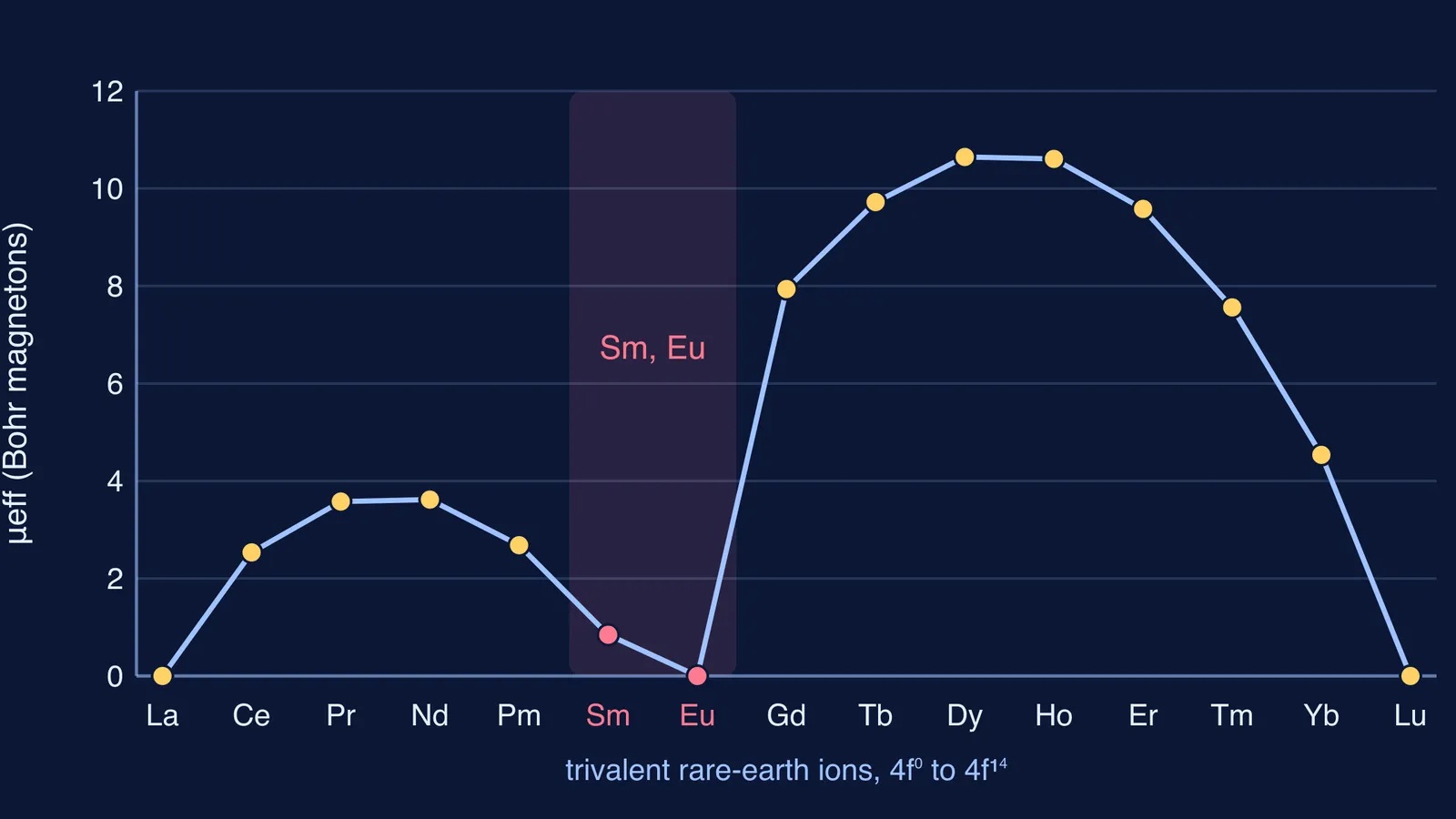
The chart at the top of this post shows another test. Hund's 1925 formula matched measurements on rare-earth compounds except those containing samarium or europium. Van Vleck and his collaborator Frank added the second-order energy term that had been left out, and theory then agreed with experiment. His 1932 book, The Theory of Electric and Magnetic Susceptibilities, followed.
How did crystal field theory explain iron, cobalt and nickel?
A magnetic ion in a crystal feels the applied magnetic field and also a static electric field from neighbouring atoms, the lecture explains. For rare earths that field is weak, because the 4f electrons sit deep inside the atom. For the iron group it is strong enough to quench a large part of the orbital magnetic moment even at room temperature. Hans Bethe supplied the group theory; see how Hans Bethe's crystal field splits d orbitals.
The theory explained why most nickel salts are nearly isotropic while cobalt salts are strongly anisotropic (direction-dependent). A calculation by Gorter then predicted that four-coordinated cobalt(II) salts should be much less anisotropic than six-coordinated ones. K. S. Krishnan and Asutosh Mookherji confirmed it in a 1937 Physical Review paper.
In a 1935 paper Van Vleck generalised the theory towards what is now called ligand field theory, and noted that a strong enough field can break Hund's rule, so electrons pair up: the high-spin and low-spin cases you meet in Class 12. His lecture adds an example from Pauling and Coryell's 1936 work on blood: the ferro-haemoglobin ion has spin 2 with water attached and spin 0 with oxygen.
How do you use Van Vleck's idea in a magnetic moment question?
Because the crystal field quenches most of the orbital moment in iron-group ions, spin alone gives a good estimate. The spin-only formula is μ = √(n(n+2)) Bohr magnetons, where n is the number of unpaired electrons (LibreTexts Chemistry/Crystal_Field_Theory/Magnetic_Moments_of_Transition_Metals)).
Worked example, using the haemoglobin case from his lecture (Fe²⁺, d⁶):
Count d electrons. Iron is [Ar]3d⁶4s², so Fe²⁺ is 3d⁶.
Read the spin. With water, S = 2, so n = 2S = 4 unpaired electrons (high spin). With oxygen, S = 0, so n = 0 (low spin).
Apply the formula. High spin: μ = √(4 × 6) = √24 ≈ 4.90 BM. Low spin: μ = 0, so it is diamagnetic.
Compare with measurement. LibreTexts lists observed values of 5.1 to 5.7 BM for high-spin octahedral Fe(II).
To go from a measured moment to geometry, read how to find a complex's hybridisation from its magnetic moment. If d-orbital splitting is the shaky step, the Fermi Concept Library gives each concept its own lesson and its place in the map. For practice, the Fermi Problem Library has worked problems with a step-by-step solver that explains the reasoning rather than printing an answer.
What can students learn from how he worked?
He checked theory against data. When his calculation for nitric oxide gas predicted departures from Curie's law, three laboratories tested it in 1929, and he called the agreement “gratifying” in his Nobel lecture. And he stayed with one question: “My last paper dealing with magnetism was published fifty years after my first one,” he wrote in his autobiography. He died on 27 October 1980.
Try the four steps on one magnetic moment question today.