On this page
In the early 1880s, one key step in making a shoe was still done entirely by hand. Lasting, where the leather upper is stretched over a foot-shaped wooden block called a last and fixed to the sole, had no machine that could do the whole job, according to the National Inventors Hall of Fame. Jan Ernst Matzeliger, a young immigrant working in a shoe factory, built the machine that did it.
What did Jan Matzeliger's lasting machine do?
Matzeliger's patent, US 274,207 "Lasting Machine", was filed on 24 January 1882 and granted on 20 March 1883. The patent describes a sequence that copies what a skilled laster's hands did:
A jack holds the shoe on its last, turns it, and a feeding spur moves it forward in small, regular steps.
Pinchers grip the edge of the upper, rise to stretch it, move forward to draw it over the edge of the last, then press down to hold it.
Guiding jaws with small rollers press the wrinkles out of the leather.
A distributor sends tacks one by one down a polished-steel channel, and a spring-driven driver strikes each one just after the pinchers have drawn the leather over the last.
At the heel and toe, the pinchers turn left or right to fold (plait) the extra leather.
The patent notes that earlier devices held the last and drew the leather over it while the nailing was still done by hand. Matzeliger's machine did all of it automatically, "requiring only the service of a boy or girl or other unskilled labor to attend the machine."
Who was Jan Matzeliger?
Matzeliger was born on 15 September 1852 in Paramaribo, Suriname, then a Dutch colony, and died on 24 August 1889 (National Inventors Hall of Fame). His Dutch father ran a shipworks that had been in the family for three generations, and his mother was an enslaved woman of African descent (Wikipedia). He was in Massachusetts by 1877 and went to work at the Harney Brothers shoe factory in Lynn, a shoemaking town.
He died of tuberculosis in Lynn at 36. According to the Lemelson-MIT Program, the Consolidated Lasting Machine Company was formed to manufacture his machines, and he was given a large amount of its stock. A US postage stamp was issued in his honour on 15 September 1991, and he was inducted into the National Inventors Hall of Fame in 2006.
How much faster was the machine than hand lasting?
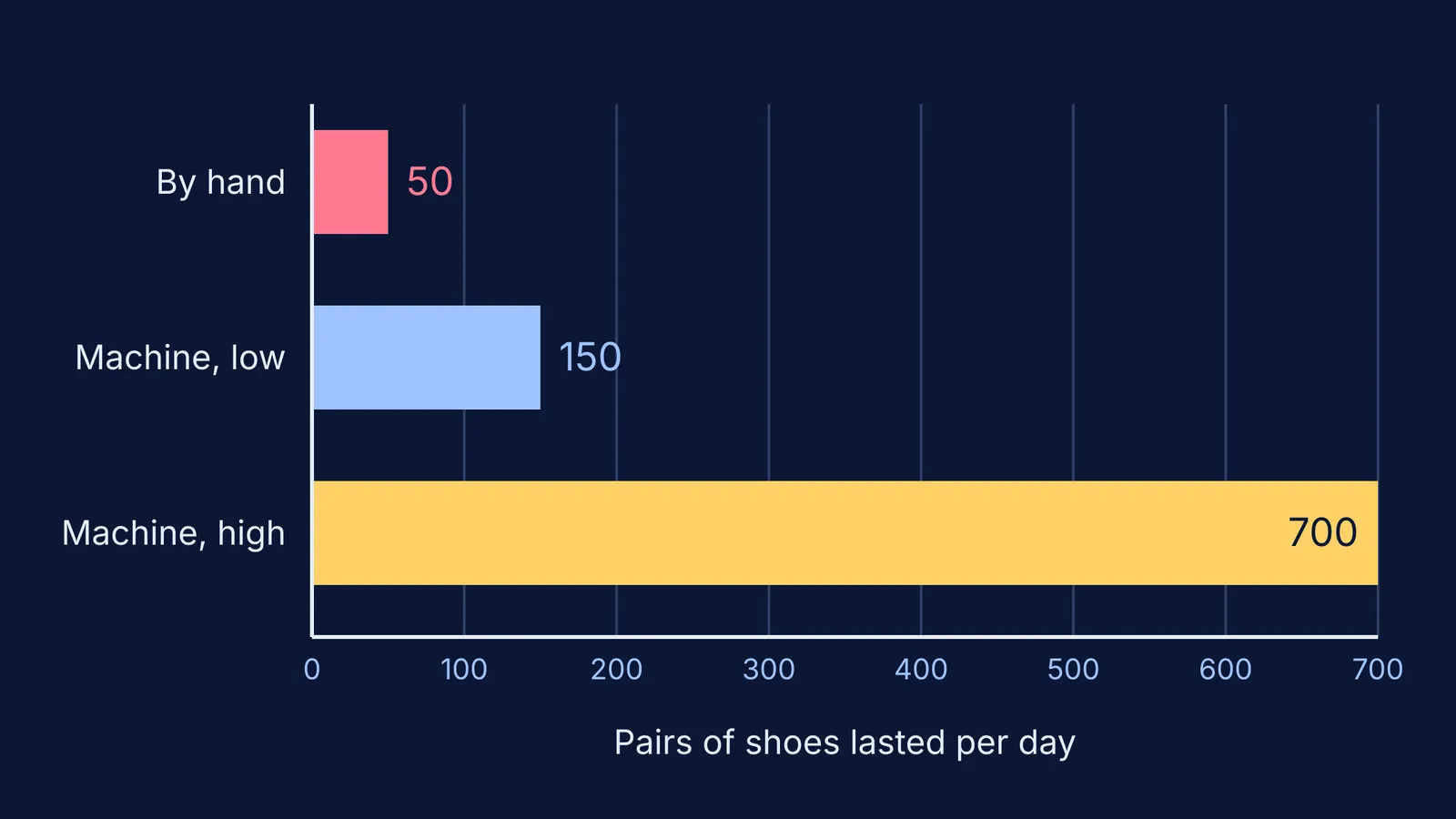
A skilled hand laster could make about 50 pairs of shoes a day, while Matzeliger's machine could produce 700 pairs a day, according to the National Inventors Hall of Fame. The Lemelson-MIT Program gives a range of 150 to 700 pairs a day for the machine.
Here is a worked example using those numbers. Say a factory wants to last 1,400 pairs a day.
By hand: 1,400 ÷ 50 = 28 skilled lasters.
With machines at the low figure: 1,400 ÷ 150 ≈ 9.3, so 10 machines.
With machines at the high figure: 1,400 ÷ 700 = 2 machines.
At the top rate, one machine does the work of 700 ÷ 50 = 14 lasters. Even at the low figure it does the work of 3.
Why did shoe prices fall?
Lasting needed skilled hands, and the machine needed only an unskilled attendant while turning out many times more pairs, according to the patent and the output figures above. Factories could make many more shoes for less. The National Inventors Hall of Fame says shoe prices dropped by nearly half, making quality shoes affordable to many more people for the first time.
You can see related ideas in Elias Howe's sewing machine, Henry Ford's moving assembly line and Elijah McCoy's automatic lubricator.
What can a student learn from Matzeliger's bottleneck?
Matzeliger didn't try to mechanise the whole factory. He worked on the one step that was still done by hand. You can use the same idea when you plan your studying.
List the steps between you and a solved problem: reading the question, recalling the concept, setting up the equation, doing the algebra, checking the units.
Look at your last ten mistakes and mark which step each one broke at.
Pick the step with the most marks. That is your bottleneck.
Practise that step on its own for a week, the way the machine copied one job very well.
Count again. Once one bottleneck clears, the next slowest step becomes the new limit.
If the bottleneck turns out to be setup, the Fermi Problem Library has worked problems with a step-by-step solver that explains the reasoning rather than printing an answer. If you can't tell where to start, Fermi's AI tutor works out what you already know and builds a plan for the session.
Next time you put on a pair of shoes, look at where the upper meets the sole. Matzeliger worked out how to make that joint by machine.