On this page
Around 1300, a teacher in Marrakesh wrote a maths textbook short enough to learn by heart. Scholars went on explaining it for about three hundred years. Its square-root rule still works, and you can try it with a pencil.
Who was Ibn al-Banna of Marrakesh?
Ibn al-Banna was born in Marrakesh, Morocco, on 29 December 1256 and died there on 13 July 1321, according to the MacTutor History of Mathematics biography. He taught arithmetic, algebra, geometry and astronomy in Fez.
His full name ends in al-Marrakushi, "of Marrakesh". Historians Mahdi Abdeljaouad and Jeffrey Oaks write that he is known to have written nearly 120 works, from mathematics and astronomy to law and medicine (Abdeljaouad and Oaks, introduction).
What is in Ibn al-Banna's arithmetic book?
The book is the *Talkhis a'mal al-hisab*, or "Summary of arithmetical operations": a brief introduction to calculating with Indian (that is, Arabic) numerals, including methods for finding unknown numbers (Abdeljaouad and Oaks). Its contents run in two parts:
Part I, known numbers: whole numbers (addition, subtraction, multiplication, division), then fractions (naming them, adding, multiplying, dividing, converting), then roots (taking, adding, multiplying and dividing them).
Part II, unknown numbers: proportion, the "method of scales" (double false position) and algebra, including six standard types of equation.
Students then were often expected to memorise textbooks, and the *Talkhis* gave no numerical examples and no proofs (Abdeljaouad and Oaks). His student al-Hawari began a commentary of worked examples while attending his lectures in Marrakesh in 1305. Beyond that and Ibn al-Banna's own commentary, ten more people wrote commentaries on the book between the fourteenth and sixteenth centuries, and four authors turned it into verse.
How did Ibn al-Banna approximate square roots?
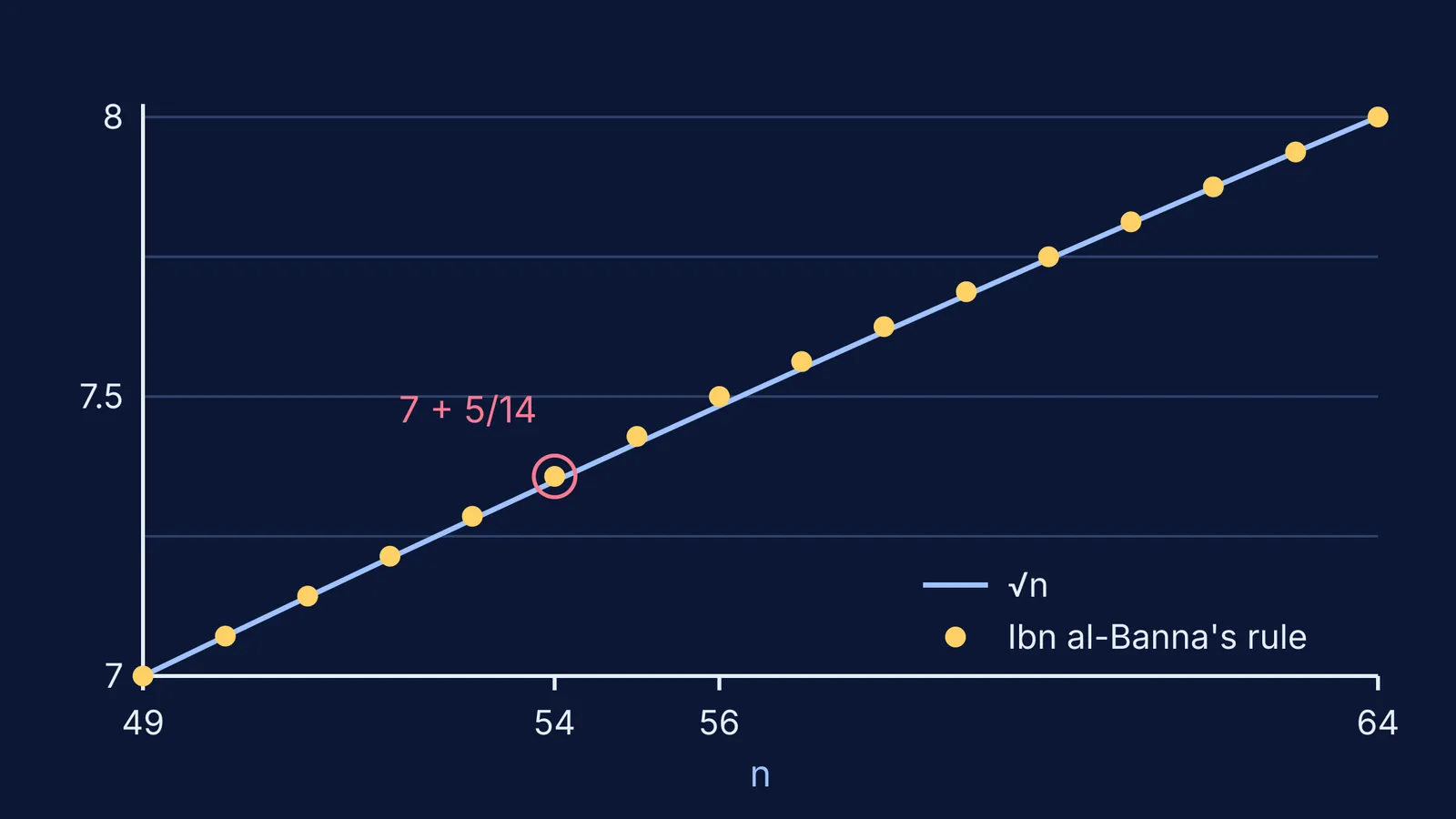
Here is his rule, from the English translation (paragraph 166.9), put into modern words. Find the largest whole number *a* whose square fits inside your number. Call the leftover *r*.
If *r* is no bigger than *a*, the root is about *a* + *r*/(2*a*).
If *r* is bigger than *a*, add one to *r* and two to 2*a*: the root is about *a* + (*r* + 1)/(2*a* + 2).
To get closer, square your answer, take the excess over the original number, divide it by twice your answer, and subtract.
The translation works examples. Take 54. The square below it is 49, so *a* = 7 and *r* = 5. Since 5 is less than 7, the root is about 7 + 5/14, which the text writes as "seven and two sevenths and half a seventh". That is 7.357; your calculator says 7.348.
Now 92. Here *a* = 9 and *r* = 11, which is bigger than 9, so the root is about 9 + 12/20 = 9.6. The text checks it: 9.6 squared is 92.16, "ninety-two and four fifths of a fifth". The refining step takes 0.16 ÷ 19.2 = 1/120 off, giving 9.59167. The true value is 9.59166.
Why does rule 1 work? Our explanation, not Ibn al-Banna's: (*a* + *x*)² = *a*² + 2*ax* + *x*². If *x* is small, *x*² hardly matters, so *x* ≈ *r*/(2*a*). It is the binomial approximation √(1 + *h*) ≈ 1 + *h*/2 from JEE physics, and step 3 is what we now call Newton's method.
Did Ibn al-Banna invent a number notation?
Not in this book. Some accounts credit him with early algebraic symbols, a claim MacTutor argues against (MacTutor). MacTutor also says he seems to have been the first to treat a fraction as a ratio between two numbers.
Abdeljaouad and Oaks point out that Ibn al-Banna wrote every number in the *Talkhis* in words, even while teaching Indian numerals (introduction). Notation lived on the dust-board, where sums were worked before being written up, and some North African books show that board notation. Al-Hassar's late-twelfth-century book shows fractions as numerator over denominator with a horizontal bar. Ibn al-Yasamin, in the same period, marked square roots with an elongated letter *jim* above the number, much like our root sign.
For the steps before him, read about al-Uqlidisi and the earliest known decimal fractions and al-Khwarizmi's book on Hindu numerals; for what came after, how al-Qalasadi moved algebra towards symbols.
Try his method: a ten-minute practice
Cover the working, try each one on paper, then check.
√30: *a* = 5, *r* = 5. Rule 1 gives 5.5. Refine: 5.5² = 30.25, and 0.25 ÷ 11 ≈ 0.023, so about 5.477.
√40: *a* = 6, *r* = 4. Rule 1 gives 6 + 4/12 ≈ 6.333 (true value 6.325).
√45: *a* = 6, *r* = 9, bigger than 6. Rule 2 gives 6 + 10/14 ≈ 6.714 (true value 6.708).
Every first answer comes out slightly too big, which is why step 3 subtracts.
If you keep losing track of the leftover, the Fermi Problem Library has a step-by-step solver that explains the reasoning, so you can see which line went wrong. To revise surds from the start, use the Fermi Concept Library.