

On this page
For centuries, solving an algebra problem meant writing a short essay. If you wanted to state an equation, you had to write every number, operation and variable as full words. The shift towards the tight, symbolic equations we use today took place over hundreds of years. A key figure in that change was Abu'l Hasan ibn Ali al-Qalasadi (1412–1486), an Andalusian mathematician from Granada.
Why did early algebra use words instead of symbols?
In early "rhetorical algebra", a problem such as 2x² + 3x = 10 would be written out in sentences. A mathematician would write: "Two squares and three things equal ten." This made working through long calculations slow and hard to read at a glance. As mathematics grew more complex, scholars needed a shorthand.
According to the MacTutor History of Mathematics Archive, the 19th-century historian Franz Woepcke described Al-Qalasadi's work as taking the "first steps toward the introduction of algebraic symbolism." While earlier North African mathematicians used similar ideas, Al-Qalasadi popularised and standardised them in his widely read textbook, *al-Tabsira fi'lm al-hisab* (Clarification of the Science of Arithmetic).
What symbols did Al-Qalasadi use?
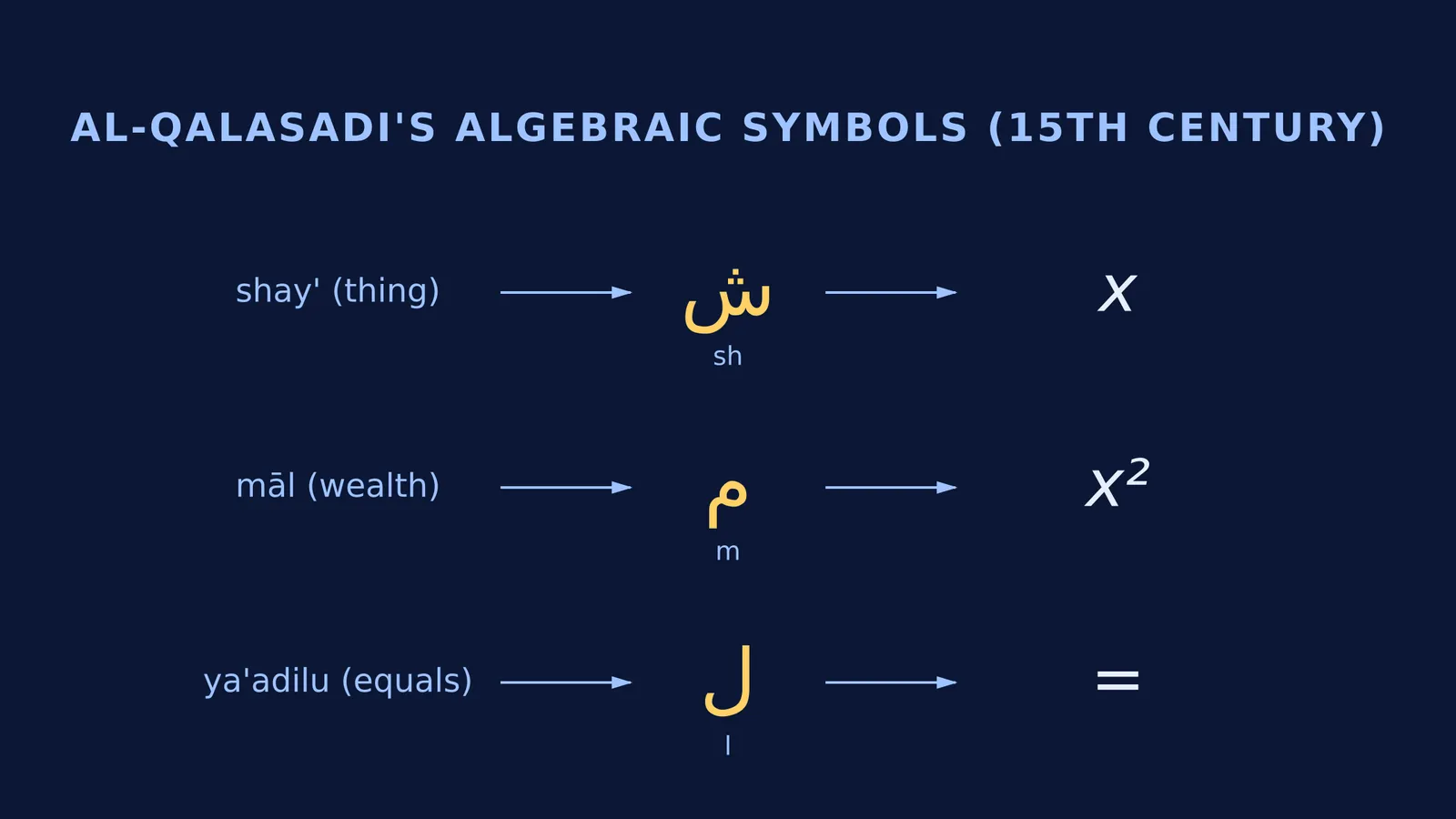
Instead of making up entirely new shapes, Al-Qalasadi took the first letters of Arabic mathematical terms and used them as single-character symbols. His system mapped directly to the parts of an equation:
The unknown (x): He used the letter ﺵ (sh), short for *shay'*, which means "thing" (MacTutor).
The square (x²): He used ﻡ (m), short for *māl*, meaning "wealth" or "property" (MacTutor).
The cube (x³): He used ﻙ (k), short for *ka'b*, meaning "cube" (MacTutor).
Equality (=): He used ﻝ (l), short for *ya'adilu*, meaning "it equals" (MacTutor).
Square root (√x): He used ﺝ (j), short for *jadhr*, meaning "root" (MacTutor).
He also used short words or letters for operations: ﻭ (wa, "and") for addition, and إلا (illa, "except") for subtraction.
If you are trying to master equations today, the Fermi Concept Library covers every concept in mathematics, each with its own lesson, so you can see how each piece fits together.
How did symbolic algebra change mathematics?
By shrinking words to single letters, Al-Qalasadi made it possible to write a polynomial in a fraction of the space. His textbooks remained the standard in North Africa for more than a century.
The shift to symbols changed how we think about mathematics. It turned algebra from a process of reading sentences into a system of manipulating objects on a page. Today, if you get stuck on a long polynomial, the Fermi Problem Library has a step-by-step solver that explains the reasoning rather than printing an answer.
You can see a similar evolution in how other mathematicians formalised logic; for example, how George Boole and the Laws of Thought of 1854 brought algebra to human reasoning. The mathematical tradition in the Islamic world was rich, with scholars previously working on Al-Karaji, the binomial table and an early form of induction and pushing the boundaries of algebra.
How can you learn algebra today using the "translation" method?
Students often struggle with algebra because they see equations as meaningless shapes rather than sentences. You can use Al-Qalasadi's approach to make algebra click:
Translate symbols back to words: When you see an equation like 3x − 5 = 10, read it aloud as "Three times a certain number, minus five, equals ten." This reminds you that *x* is just a placeholder for a quantity.
Track the physical meaning: Just as Al-Qalasadi used *māl* (property) for squares, remember what your variables represent. Are they metres, seconds, or rupees? Keeping the physical meaning in mind stops you from making abstract errors.
Write out your steps: Do not try to hold the entire manipulation in your head. Write each step on a new line, keeping the equals sign aligned, to see the logical flow of the argument.
Define your unknowns clearly: Before you write an equation for a word problem, explicitly state "Let *x* be the speed of the car." This simple step prevents confusion later.
To build confidence in algebra, do not just memorise the final formulas. Understand what the symbols stand for and the story they are telling.


