On this page
Most people who change how a country learns maths never become famous for a theorem. Grace Alele-Williams is one of them. She earned a doctorate at a time when no Nigerian woman had one, then spent the next two decades on a harder problem: what actually happens in a maths classroom, and how to make it better.
Who was Grace Alele-Williams?
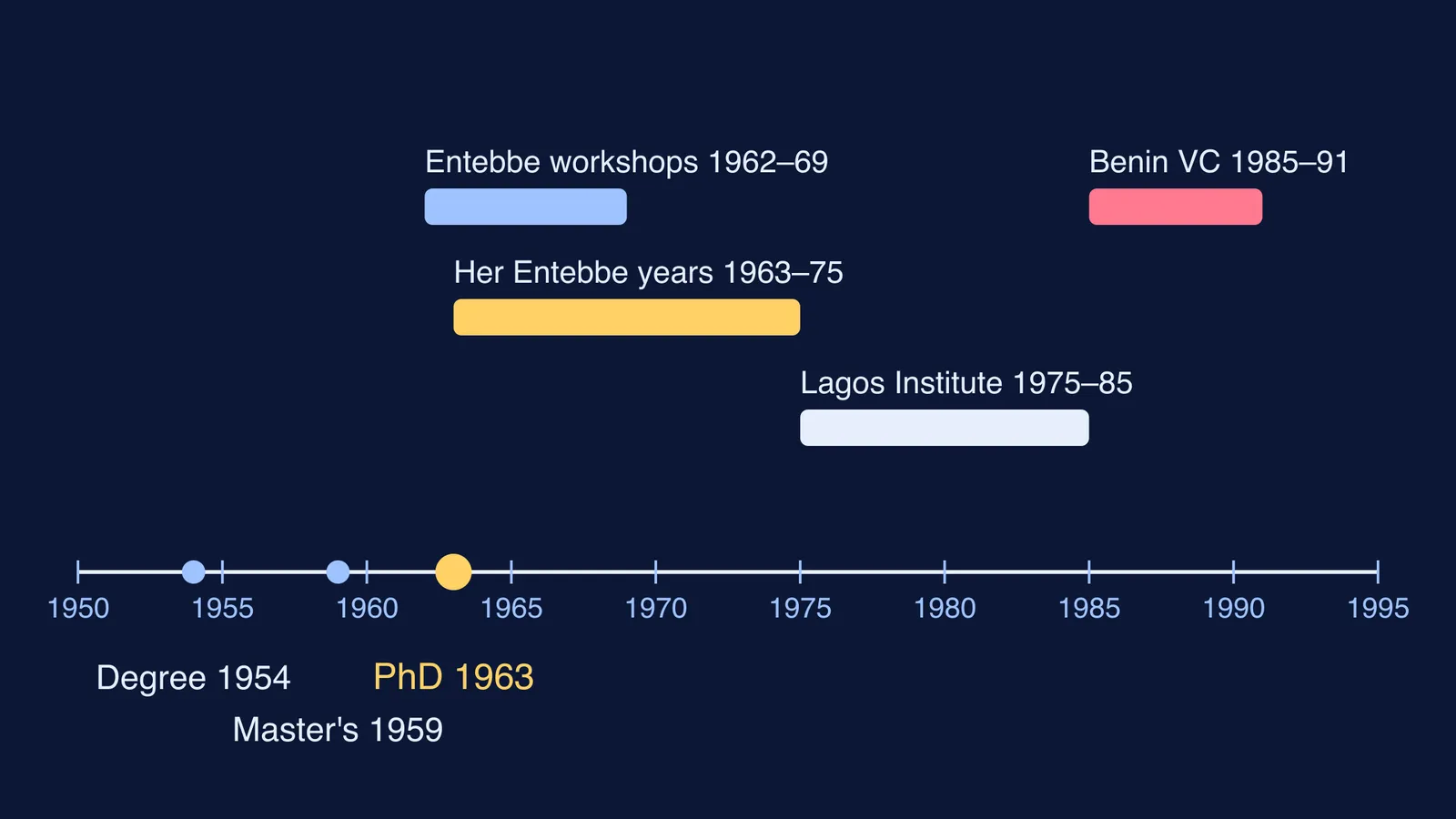
She was born Grace Awani Alele on 16 December 1932 in Warri, Nigeria, and studied at Queen's College, Lagos, according to her MacTutor History of Mathematics biography. She took an honours degree in mathematics at University College Ibadan in 1954, then taught maths at Queen's School, Ede, from 1954 to 1957.
She went to the University of Vermont as a graduate assistant, earned a master's in education in 1959, and moved to the University of Chicago. Her doctoral dissertation was titled "Dynamics of Education in the Birth of a New Nation: Case Study Of Nigeria". She died in Lagos on 25 March 2022.
Was she the first Nigerian woman with a maths PhD?
Yes, and more than that. When she was awarded her doctorate in March 1963, she became the first Nigerian woman ever to be awarded a doctorate in any subject, as the MacTutor archive records. Her PhD was in mathematics education: the study of how maths is taught and learned, rather than new results in pure maths.
What was the Entebbe Mathematics Project?
The African Mathematics Programme grew out of a six-week meeting at Dedham, Massachusetts, in the summer of 1961 that set up the African Education Program, whose steering committee was chaired by the MIT mathematician William Ted Martin, according to MacTutor. In her own 1976 description, it "brought together Africans, Americans, and British educators in English-speaking African countries to consider changes in mathematics education in Africa."
Between 1962 and 1969, the programme ran annual eight-week writing workshops in Entebbe and Mombasa and produced over 80 volumes of teaching material for primary school, teacher training, secondary and sixth form. Alele-Williams took part in these workshops from 1963 to 1975.
In a 1971 report in the International Review of Education, she described the finished Entebbe Mathematics Series as 67 volumes covering every level from primary to sixth form. She pushed back on the idea that the books were simply American: "Africans, working with Europeans and Americans, have produced mathematics texts good enough for use anywhere in the world."
If you like stories of teachers who rebuilt a subject from the classroom up, read about the Hoshangabad Science Teaching Programme in Madhya Pradesh and Mary Everest Boole's hands-on maths teaching.
How did she change maths teaching in Nigeria?
She joined the University of Lagos in 1965 to teach the teaching of mathematics, and published a Modern Mathematics Handbook for Teachers in 1974, as her MacTutor biography notes. She chaired the Bendel State Curriculum Review Committee from 1973 to 1979, then the Lagos State Curriculum Review Committee and Lagos State Examinations Boards from 1979 to 1985.
As Director of the University of Lagos Institute of Education from 1975 to 1985, she introduced certificate courses that were especially important for training older women as primary school teachers.
In a 1976 paper in The Arithmetic Teacher, she wrote that in Lagos State the Entebbe programme's good results led to "the total acceptance of the project", but that much work with teachers remained.
In 1985 she became Vice-Chancellor of the University of Benin, the first woman to lead a Nigerian university, and served until 1991.
What can you take from her approach?
Her 1976 point applies to students too. Knowing a formula is the easy part. Changing how you practise is the hard part, and it is where marks come from. Here is a four-week plan for one maths chapter where you "know it" but still lose marks.
Week 1, diagnose. Redo ten questions you got wrong in tests. Label each mistake: concept (did not understand the idea), method (wrong approach), or slip (arithmetic or copying).
Week 2, fix concepts. For every "concept" label, explain the idea aloud in your own words without notes, then check against your textbook.
Week 3, fix method. Solve five new questions, writing one line before each step that says why you are doing it.
Week 4, test practice. Do a timed mixed set and count mistake types. If slips dominate, check each answer before moving on.
Parents can help with one question: "Show me one problem you got wrong this week and how you fixed it." It rewards the habit, not just the score.
If week 2 shows a gap in an idea, the Fermi Concept Library has a lesson for every concept in mathematics, physics, chemistry, biology and computing. If week 3 shows method mistakes, the Fermi Problem Library has worked problems with a step-by-step solver that explains the reasoning rather than printing an answer.
For another Nigerian scientist who built a career at home, read how Francisca Okeke studies the ionosphere over the magnetic equator.