

On this page
In 1971 Anil Sadgopal, a biochemist with a PhD from Caltech, left the molecular biology department of the Tata Institute of Fundamental Research in Bombay to work in villages, according to his Jamnalal Bajaj Award biography. He founded Kishore Bharati, based at Palia Piparia, a village in Hoshangabad district, Madhya Pradesh. One of its first projects changed how government schools there taught science from 1972 until 2002.
What was the Hoshangabad Science Teaching Programme?
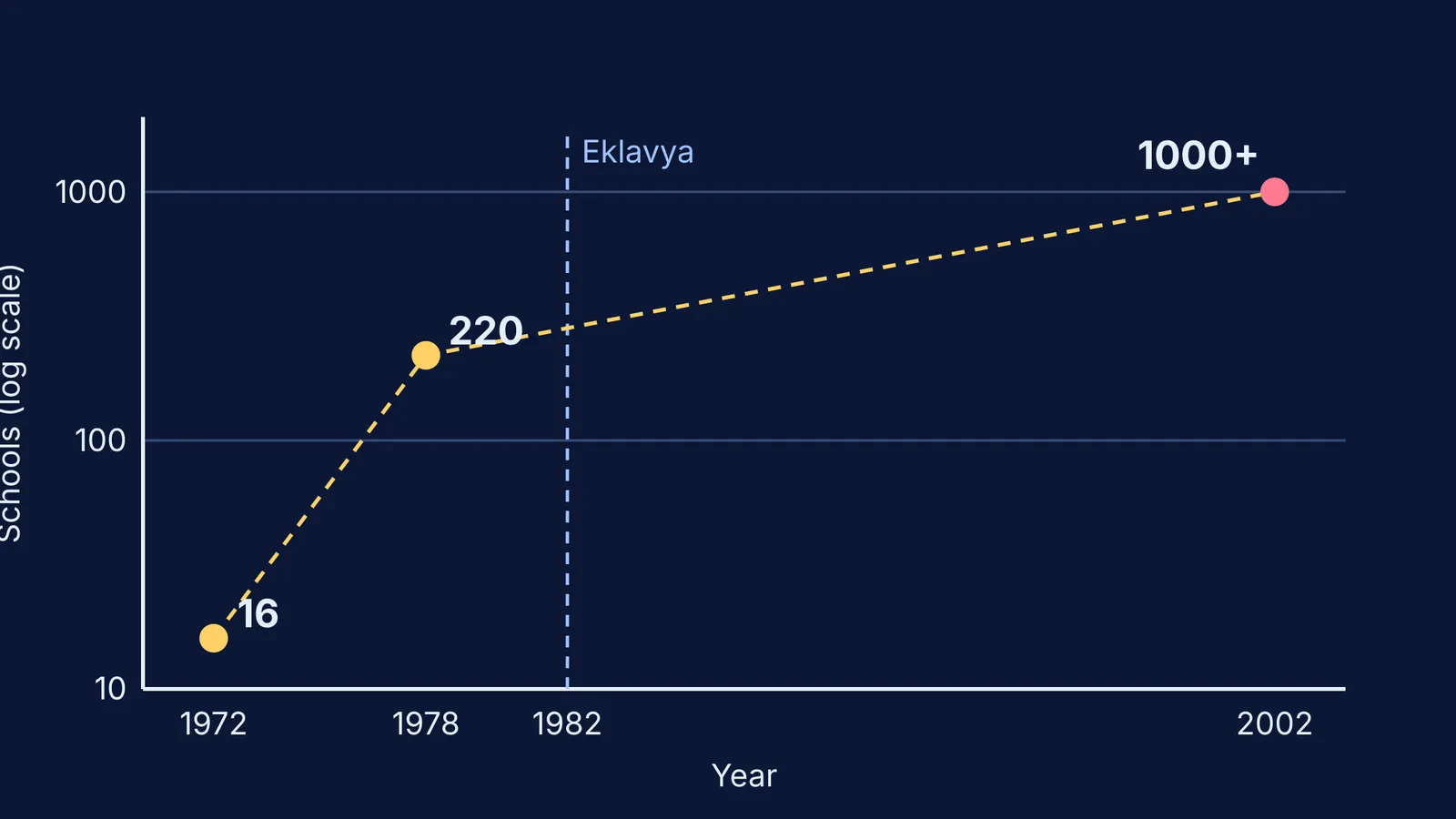
HSTP was a science curriculum for government middle schools in which children performed experiments themselves instead of learning by rote, an approach the Jamnalal Bajaj Foundation biography calls the "discovery approach" and "activity-based learning". The same source says the Madhya Pradesh government allowed it as a pilot in 16 village middle schools, launched in 1972 by Kishore Bharati with the Friends Rural Centre, Rasulia.
Eklavya's history of HSTP adds detail: the pilot began in May 1972 in 16 middle schools across two blocks of Hoshangabad district. Groups from the All India Science Teachers Association and TIFR gave the initial impetus; a University of Delhi group joined in 1973 and later took over academic responsibility.
How did children learn science in HSTP?
The programme worked on four things together, according to the Jamnalal Bajaj Foundation and Eklavya:
A kit: a simple, inexpensive, multipurpose science kit, with teaching materials.
Books: the Bal Vaigyanik books, whose first edition came out between 1978 and 1980.
Teachers: existing teachers took a reorientation course in the new method, so none had to be replaced.
Exams: examinations were revised to test students' intelligence and ability.
Writing in Manushi in 2002/3.A%20Black%20day.pdf), University of Delhi linguist Ramakant Agnihotri described children working in small groups with a locally designed kit, recording and analysing what they saw in tables and graphs, with the teacher as a partner. In his words, the idea was "to encourage children to ask questions rather than treat them as empty receptacles ready to assimilate received knowledge."
How big did HSTP grow?
In 1978 the Madhya Pradesh government, with help from NCERT, decided to extend HSTP to all 220 middle schools in Hoshangabad district, says the Jamnalal Bajaj Foundation.
A new organisation, Eklavya, took over the programme in 1982 and was registered on 26 October that year. By 2002 HSTP was running in over 1000 schools in 15 districts of Madhya Pradesh, according to Agnihotri's Manushi article/3.A%20Black%20day.pdf). He reports that over 2000 teachers had been trained, about 200 of them as resource teachers for its training camps, and that the programme reached around 100,000 students directly.
Why did HSTP end in 2002?
Down To Earth reported the sequence: on 7 February 2002 the Hoshangabad district planning committee recommended closing the programme in the district; after a 3 July state order, an 8 August order told 15 districts to follow a uniform curriculum, textbooks and exams, with HSTP only as a supplement. The administration's review said HSTP children did not fare all that well in exams such as the Class 10 board exam, and the state wanted common textbooks for children facing a common evaluation.
Agnihotri, a supporter, disputed this in Manushi/3.A%20Black%20day.pdf). The government report ranked Hoshangabad 16th of 45 districts for Class 10 students scoring above 60% in science. He questioned judging a Class 6 to 8 programme by a Class 10 exam built on significantly different assumptions, and noted that Eklavya's own comparisons showed no significant difference in exam results between HSTP and non-HSTP children.
How can you learn science the HSTP way at home?
One photo in the Manushi article shows Class 8 children doing an experiment on how things float. You can run a similar investigation with a bucket of water and ten kitchen objects:
Ask one question. Which of these objects will float?
Predict first. Make four columns in your notebook: object, prediction, result, reason. Fill in every prediction before testing.
Test and record. Write down what actually happens, even when it surprises you.
Look for a pattern. Weight? Size? Material? Shape? Write one rule in a sentence.
Try to break your rule. A steel bowl and a steel spoon are a good test. Revise the rule.
Parents can help by asking "what do you think will happen, and why?" before each test, without giving the answer. The same habit works for a torch cell, a small bulb and wires. Use only cells, never a wall socket.
When an idea is hard to set up at home, Fermi's Simulation Lab has interactive simulations for ideas that are easier to see than to read, and you can still predict first and test second.
For more on learning by doing, read about Carl Wieman's move beyond the lecture, what the 2014 Freeman active learning meta-analysis found, and an earlier Indian example, Gijubhai Badheka's classroom experiment in Divaswapna.
Start with the bucket and ten objects this weekend, and write your predictions down before you test anything.


