On this page
Born in Anambra State, Francisca Nneka Okeke became the first female professor of physics in the eastern part of Nigeria. She earned her degrees at the University of Nigeria and completed postdoctoral work at the University of Tokyo, dedicating her career to understanding the ionosphere—a layer of the Earth's upper atmosphere filled with ions and free electrons. Her research earned her the Laureate for Africa and Arab States at the 2013 L'Oréal-UNESCO For Women in Science Awards.
What is the magnetic equator?
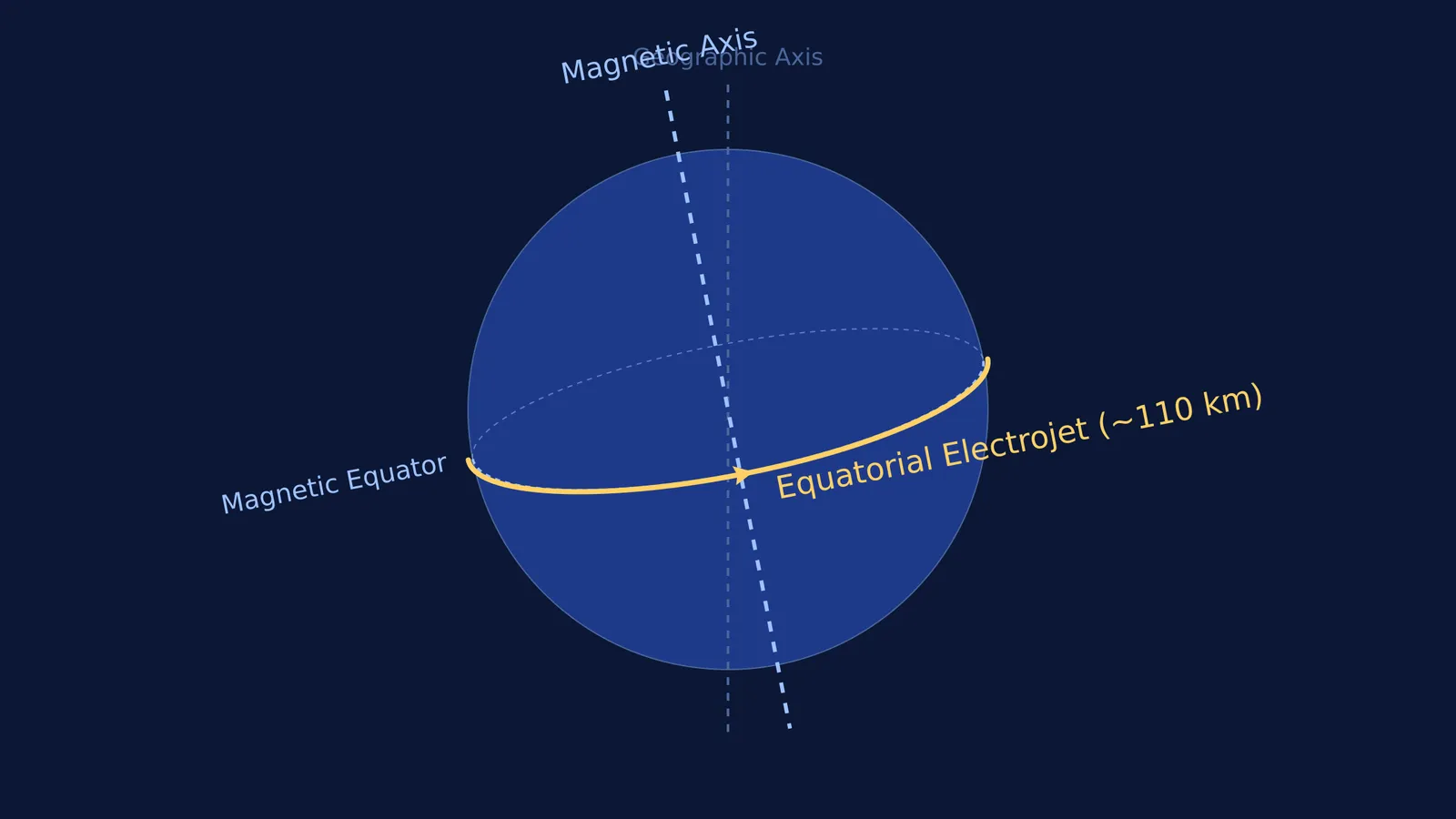
The Earth acts like a giant bar magnet, but its magnetic poles do not perfectly align with the geographic North and South poles. The magnetic equator is an imaginary line where the Earth's magnetic field is perfectly horizontal, with a magnetic dip of zero degrees.
Because the magnetic axis is tilted, this equator shifts over time and crosses the geographic equator. It passes through central Nigeria and cuts across the southern tip of India. In fact, the Thumba Equatorial Rocket Launching Station in Kerala was established in 1963 specifically because of its proximity to the magnetic equator, making it an ideal place to study atmospheric physics.
What is the equatorial electrojet?
High above the magnetic equator, strong solar radiation ionises the thin atmosphere, stripping electrons from atoms to create a sea of charged particles. During the day, the unique horizontal geometry of the Earth's magnetic field at the equator interacts with these charges.
This creates the equatorial electrojet (EEJ): a narrow ribbon of electric current flowing eastward in the daytime ionosphere, at an altitude of 100 to 130 kilometres. Because the magnetic field is perfectly horizontal here, a complex feedback loop of electric fields drives a strong eastward current, reaching peak strengths of about 100 kiloamperes.
How did Francisca Okeke study the ionosphere?
Okeke studied the daily variations of these large ion currents to see how they change the Earth's magnetic field. Her research mapped how fluctuations in solar activity alter the electrojet, and she proved that studying these variations could lead to a better understanding of climate change.
Furthermore, studying the electrojet helps scientists pinpoint the sources of natural phenomena like tsunamis and earthquakes. In August 2025, the International Astronomical Union named Asteroid 149831 Okeke in her honour for her contributions to space science.
How to visualise Earth's magnetic currents?
Physics problems involving moving charges in Chapter 4 and Chapter 5 of the Class 12 syllabus often feel abstract until you build a mental model of the fields. As discussed in our guide on Why memorising physics formulas fails, and what to do instead, relying purely on the formula F = q(v × B) without a picture often leads to sign errors.
To understand the forces in the ionosphere, use this three-step visualisation framework inspired by How to learn physics from first principles, not formulas:
Identify the field direction: At the magnetic equator, the magnetic field (B) is completely horizontal, pointing straight towards the magnetic North. Picture this as flat arrows hovering over the ground.
Find the velocity vector: The Sun's radiation ionises particles. Under complex cross-field drifts in the ionosphere, these ions acquire a net drift velocity (v).
Apply the right-hand rule: The magnetic force on a moving charge (q) is F = q(v × B). Point the fingers of your right hand in the direction of velocity, curl them towards the North-pointing magnetic field, and your thumb gives the force direction. This cross-product of fields is what drives the eastward electrojet.
If you find it hard to picture how moving charges interact with magnetic fields in three dimensions, the Fermi Simulation Lab lets you launch charged particles into a magnetic field and watch how they deflect. If you get stuck applying the right-hand rule to a new problem, Fermi's AI tutor can work out what you already know and build a plan for the session, guiding you step by step.