

On this page
Mary Everest Boole (1832–1916) was a progressive educator and self-taught mathematician who believed that learning should begin with the body and the "unconscious mind." Long before the formalisation of modern educational psychology, she sought to make mathematics a tactile, joyful discovery rather than a rigid, fear-inducing chore. Her most famous invention is curve stitching—a technique that remains a staple of both classroom geometry and modern string art (Wikipedia). By treating mathematical structures as patterns to be observed and felt, she opened the door for generations of children to grasp abstract ideas with confidence.
What is curve stitching?
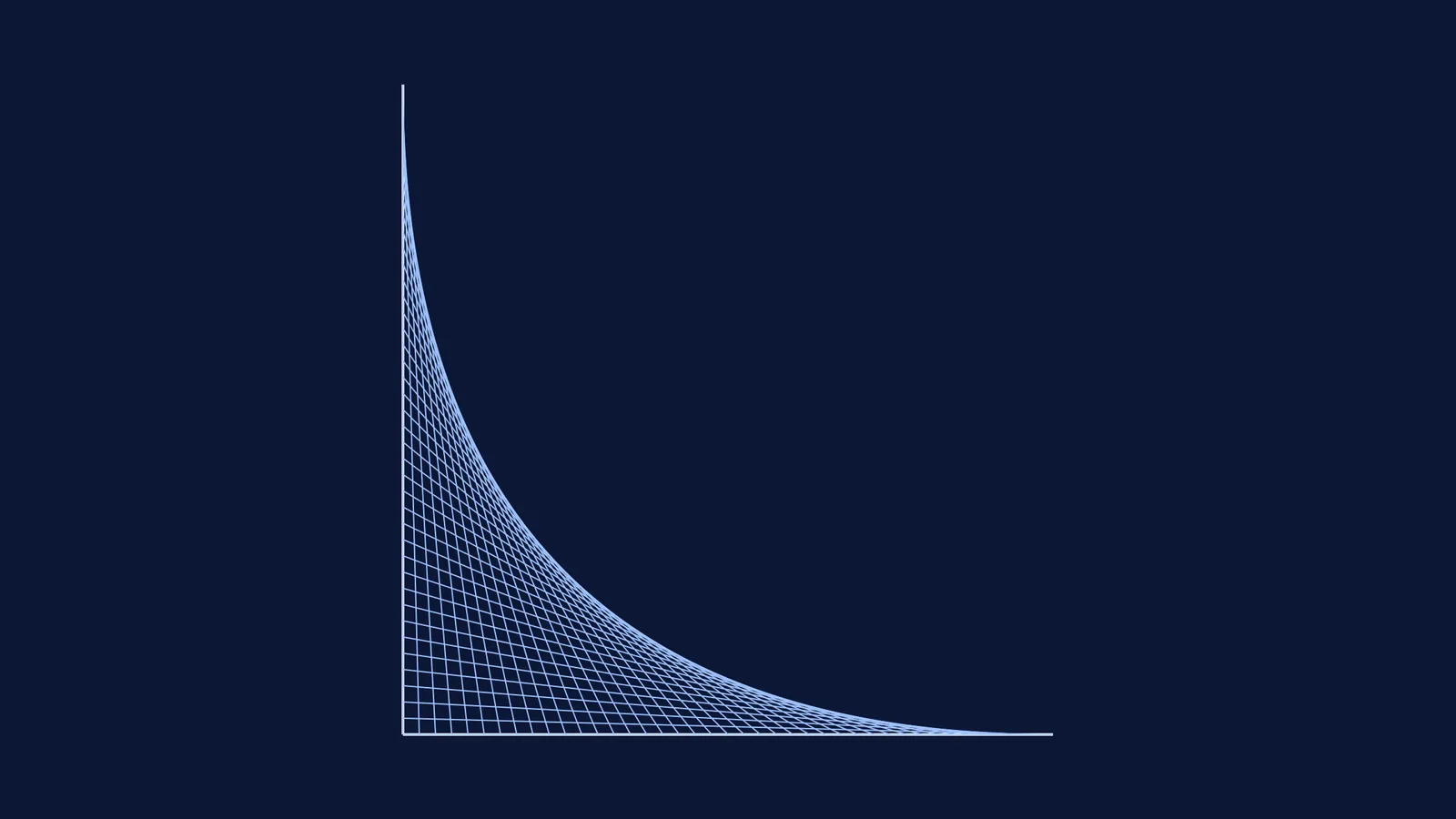
Curve stitching, also known as string geometry, is a method of generating smooth curves using only straight lines. As detailed in her 1904 book *The Preparation of the Child for Science*, children sew coloured threads through holes pricked in cardboard along two intersecting axes. By connecting specific pairs of points (for instance, linking a point high on the y-axis to one far out on the x-axis), the straight threads cross each other in a dense, overlapping pattern.
The result is a mathematical envelope—the straight lines visually define the boundary of a smooth curve, most commonly a parabola (whose dimensions can be described by latus rectum lengths: 4a for a parabola, 2b²/a for an ellipse). Boole designed this activity to give children a physical intuition for coordinate geometry and calculus concepts before they ever encountered a formal equation. She believed that playing with these shapes would embed an intuitive understanding of how straight dimensions interact to form complex, sweeping paths.
For ideas that are easier to see than read, modern tools use the same principle of visual discovery. The Simulation Lab allows students to interact with moving physical systems, building an intuitive grasp of forces and shapes before moving on to the maths.
How did she teach the fun of algebra?
Mary Everest Boole was the wife of the pioneering logician George Boole—famous for the Boolean logic detailed in George Boole and the Laws of Thought of 1854—but she was a profound, influential thinker in her own right. She fiercely opposed the rote memorisation common in Victorian schools, arguing that demanding children memorise disconnected facts caused unnecessary mental fatigue and crushed their natural curiosity.
In her 1909 book *Philosophy and Fun of Algebra*, she defined algebra not as a set of mechanical rules, but as a "method of solving problems by honest confession of one's ignorance." To her, the variable *x* was a psychological tool. By writing down an *x* for an unknown quantity, a student clears their mind of anxiety, marking the exact limits of their knowledge so they can systematically uncover the rest. It was an exercise in intellectual honesty, proving that it is perfectly safe to not know the answer immediately.
What is the "Sabbatical rhythm" in learning?
Boole theorised that robust learning requires a natural cycle of intense focus followed by unconscious processing. She urged parents and teachers to establish a "Sabbatical rhythm in science." This meant maintaining a strict boundary between times of structured instruction and times when the child was completely free to experiment, observe, and even make mistakes without correction.
She believed that adults frequently interfere too much in a child’s discovery process, trying to explain things prematurely. She advised that guides must, at the proper times, "keep silence even from good words," leaving the child to absorb the raw impressions of nature without a running, overbearing commentary. Furthermore, she warned against using early competition to motivate students, calling it "injurious both to nerve-power and to scientific insight". By removing the pressure to perform, students could develop a genuine, lifelong scientific temperament.
Her philosophy of guided independence aligns closely with how Fermi's AI tutor interacts with a student today. Rather than jumping straight to the answer or overwhelming the learner with facts, it works out what you already know, asks targeted questions, and holds a line of reasoning—allowing you to do the thinking and discover the logic for yourself.
Try it yourself: A curve stitching plan
You can recreate Boole's string geometry at home to see how straight lines build a parabola.
Draw a large L-shape (an x and y axis) on a piece of thick card or cardboard.
Mark 10 evenly spaced points along both the vertical and horizontal lines.
Number the vertical points 1 to 10 from top to bottom (with 10 at the corner).
Number the horizontal points 1 to 10 from the corner moving outwards.
Using a needle and thread, stitch a line connecting vertical point 1 to horizontal point 1, then vertical 2 to horizontal 2, and so on.
The resulting web of straight threads will form a perfect parabolic envelope.


