On this page
Frederic Stanley Kipping was an English chemist who spent decades making compounds in which silicon is bonded to carbon, and he gave silicones their name. Kipping himself treated his silicones as a side issue, and he doubted the field would lead anywhere soon.
Who discovered silicones?
Kipping was born on 16 August 1863 and became professor of chemistry at University College, Nottingham, in 1897, staying until he retired in 1936 (Wikipedia biography of Frederic Kipping).
Over some 45 years (1899–1944), Kipping and his coworkers at Nottingham published a series of 57 scientific papers on organosilicon compounds, according to a history of silicones by Dow Corning chemist Donald Liles (CoatingsTech, April 2012).
In 1901 Victor Grignard reported the synthetic uses of organomagnesium compounds, and Kipping soon realised these reagents were ideal for organosilicon synthesis (EBSCO Research Starters). If that reaction is hazy for you, our post on how Victor Grignard's reagent joins carbon chains walks through it.
"Discovered" needs care. EBSCO calls Kipping probably the first to prepare a silicone and certainly the first to use the term. Liles notes that Friedel and Crafts made the first organosilicon compound, tetraethylsilane, in 1863, and that Wöhler used the word silicone earlier for a different substance (Liles, CoatingsTech). Kipping's claim is the long, systematic study and the name as we use it now.
Why did Kipping call them silicones?
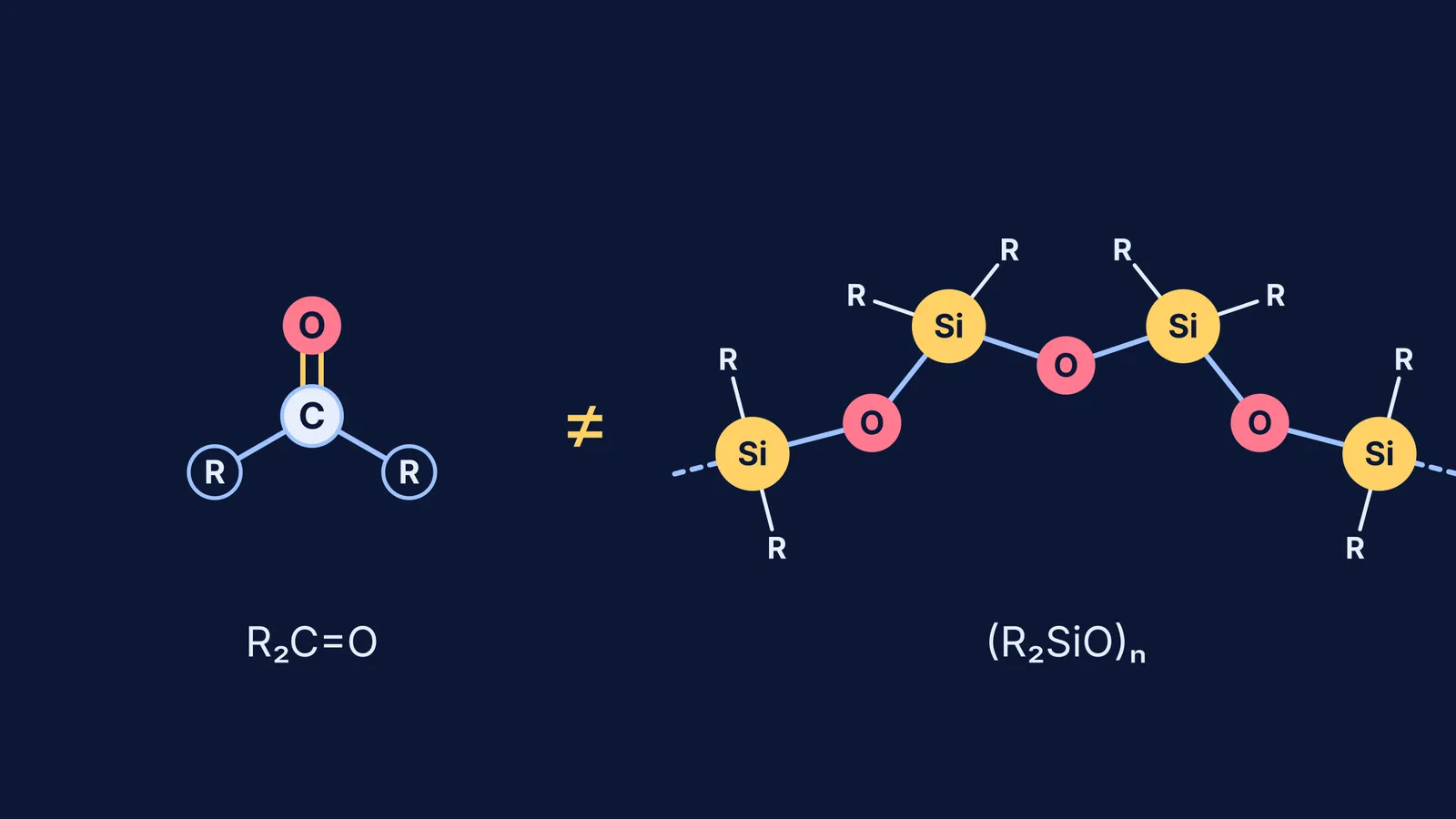
When Kipping hydrolysed silicon chlorides carrying two organic groups, the product had the empirical formula R₂SiO, which looked like a ketone, R₂CO, so he called it a silicone (Liles, CoatingsTech). His first term was "silicoketone", for Ph₂SiO, by analogy with the ketone benzophenone, Ph₂CO (Wikipedia: Silicone).
Sources disagree on the year: the Wikipedia silicone article gives 1901, Liles gives 1905, and EBSCO places Kipping's key discoveries between 1901 and 1904. The safe answer is the early 1900s.
The formula was the only real match. Kipping knew that his diphenyl silicone was polymeric while benzophenone is a single small molecule, and chemists now prefer the name siloxane for the Si–O–Si backbone (Wikipedia: Silicone).
Why did silicones take so long to become useful?
Kipping regarded silicones as a side issue and did not pursue their commercial possibilities (EBSCO Research Starters). His Bakerian Lecture, "Organic Derivatives of Silicon", was published by the Royal Society in 1937 (Proceedings of the Royal Society A). Liles quotes its conclusion: "the prospect of any immediate and important advances in this section of organic chemistry does not seem to be hopeful" (CoatingsTech).
Industry was already moving, and the commercial silicone industry started in 1943, as Liles's history describes:
In 1930 Corning Glass Works hired J. Franklin Hyde, who picked up Kipping's work and made silicone polymers by Kipping's Grignard route.
On 10 May 1940 Eugene Rochow at General Electric found a direct synthesis of methyl chlorosilanes from methyl chloride and silicon, with copper.
Dow Corning was formed on 9 February 1943; the first commercial silicone product, a grease, protected aircraft ignition wiring in the Second World War.
How can you test a chemical analogy like Kipping's?
Kipping's name shows how far a formula can mislead. Use three checks when two compounds "look the same" on paper.
Formula: do the atom ratios match? Ph₂CO and Ph₂SiO: yes.
Bonding: can both central atoms make the same bonds? Carbon forms C=O easily; silicon does not readily form multiple bonds, according to Liles, so each silicon links to oxygens by single bonds instead.
Size: is it one molecule or a chain? Single Si–O bonds can repeat, Si–O–Si–O, so the silicone becomes a polymer.
The numbers back this up. In the comparison table Liles gives, an Si–O bond is about 445 kJ/mol against 358 kJ/mol for C–O, and the Si–O–Si angle is 143° (CoatingsTech). Liles says this high bond energy gives the siloxane bond strong resistance to homolytic cleavage, and he credits silicones' usefulness partly to their resistance to weather and to wide temperature extremes.
If you want to practise reading structures from formulas, our post on silicate and silicone structures from the formula works through chains, rings and sheets. And if the step from bond type to properties is where you lose the thread, the Fermi Concept Library has every concept in chemistry, each with its own lesson and its place in the map, so you can trace a gap back to its source.
What can students take from Kipping's career?
Kipping's story is decades of careful papers on a topic he did not expect to pay off, which others built an industry on. The same pattern runs through polymer chemistry; read how Hermann Staudinger fought to prove polymers are molecules.
For your own long topics, the habit to copy is the record: write down what you tried and what happened, even when the result looks useless. When a chapter feels too big to start, Fermi's AI tutor can work out what you already know and build a plan for the session, so you sit down to a clear next step.
Next time you see "silicone" on a label, try the three checks above on R₂SiO yourself.