On this page
In CBSE Class 8 Science, the chapter on "Coal and Petroleum" explains how crude oil is separated into useful fractions like petrol, kerosene and diesel. But there is a problem with simple fractional distillation: a barrel of crude oil contains mostly heavy, long-chain molecules that are too thick and viscous to burn efficiently in a car engine. In contrast, it contains very little of the light, short-chain molecules that make good petrol.
Early refineries tried to solve this imbalance with thermal cracking. This process used intense heat and high pressure to physically force the long hydrocarbon chains to break apart, a method pioneered by engineers like Vladimir Shukhov (read about Vladimir Shukhov, Hyperboloid Towers and Thermal Cracking). However, thermal cracking was highly inefficient, yielding only about 25 percent petrol. It also left behind large amounts of solid carbon, known as coke, which clogged the machinery. In the 1930s, a French mechanical engineer named Eugene Houdry transformed the petroleum industry by introducing a catalyst to the process.
How does Eugene Houdry's catalytic cracking work?
Eugene Houdry began his research in 1922, originally trying to make petrol from lignite (a soft brown coal). When that demonstration plant proved too expensive to run, he shifted his focus to the heavy, low-value fractions of crude oil left over from distillation.
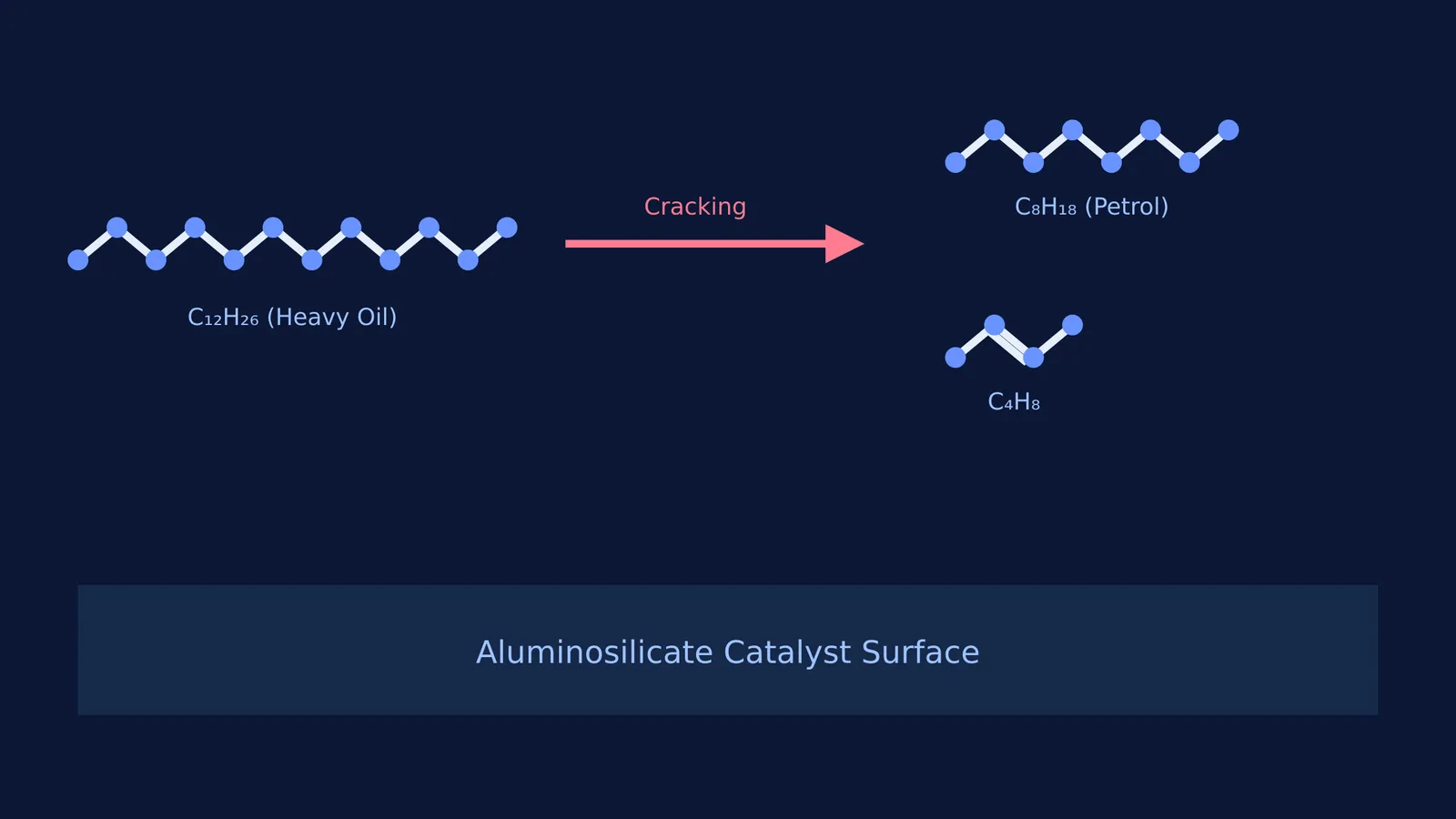
He discovered that an aluminosilicate clay—a highly porous material made of aluminium, silicon and oxygen—acted as an excellent catalyst. When the heavy oil was vaporised and passed over a bed of this clay, the catalyst provided a surface for the molecules to attach to. This lowered the activation energy needed to break the strong carbon-carbon bonds, snapping the long chains into smaller pieces much faster than heat alone could.
In March 1937, the first full-scale commercial Houdry unit began operating at a Sun Oil refinery in Pennsylvania, USA, processing 15,000 barrels of petroleum a day. The results were clear: the process produced almost 50 percent petrol from the crude oil, doubling the yield of older thermal methods. It also naturally produced highly branched molecules (isoparaffins) and aromatic hydrocarbons, which burn much more smoothly in high-compression engines.
If you are learning about reaction rates and equilibrium in chemistry, you can use the Fermi Concept Library to explore how a catalyst lowers activation energy without being consumed in the reaction. (You can also read more about why a catalyst does not change the equilibrium constant.)
Why was 100-octane petrol critical in World War II?
Houdry’s process did not just make more petrol; it made better petrol. The fuel produced by his catalytic cracking had an octane rating of 100, meaning it could withstand high compression in an engine without "knocking" or detonating prematurely (read more about what the octane number of petrol actually means).
This high-octane fuel became a decisive advantage during World War II. During the first two years of the war, Houdry plants produced 90 percent of the catalytically cracked aviation gasoline used by the Allies. In the first six months of 1940 alone, 1.1 million barrels of 100-octane fuel were shipped to the Allies every month. This fuel gave British Spitfires and American Mustangs a 15 to 30 percent power advantage in take-off and climbing compared to Axis planes, allowing them to carry heavier payloads and fly at higher altitudes.
What are the fractions of crude oil?
When studying petroleum refining, it helps to know what happens to the crude oil before it even reaches a cracking unit. Here is the standard order of fractions separated by boiling point in a refinery:
Petroleum Gas (below 25 °C): The lightest molecules (1 to 4 carbon atoms), used for LPG in homes.
Petrol / Gasoline (25 °C to 60 °C): Molecules with 5 to 12 carbon atoms, used as motor fuel. This is the fraction Houdry's process aimed to maximise.
Naphtha (60 °C to 180 °C): Used to make chemicals and petrochemicals.
Kerosene (180 °C to 250 °C): Molecules with 10 to 16 carbon atoms, used as aviation turbine fuel and in stoves.
Diesel (250 °C to 300 °C): Molecules with 14 to 20 carbon atoms, used for heavy vehicles and generators.
Lubricating Oil (300 °C to 350 °C): Thick oils used to reduce friction in machinery.
Fuel Oil and Bitumen (above 350 °C): The heaviest residues, used for ships, power plants and surfacing roads.
Catalytic cracking takes the fractions from step 5, 6 and 7, and breaks them down to create more of the high-value petrol in step 2.