

Vladimir Shukhov was a polymath whose theoretical work reshaped two completely different industries: structural engineering and oil refining. At a time when architects relied on massive stone or heavy iron frameworks, he discovered a way to build taller and stronger structures using far less material. Simultaneously, his understanding of thermodynamics and fluid mechanics allowed him to invent a chemical process that would eventually fuel the global automobile revolution.
How do straight lines form a curved tower?
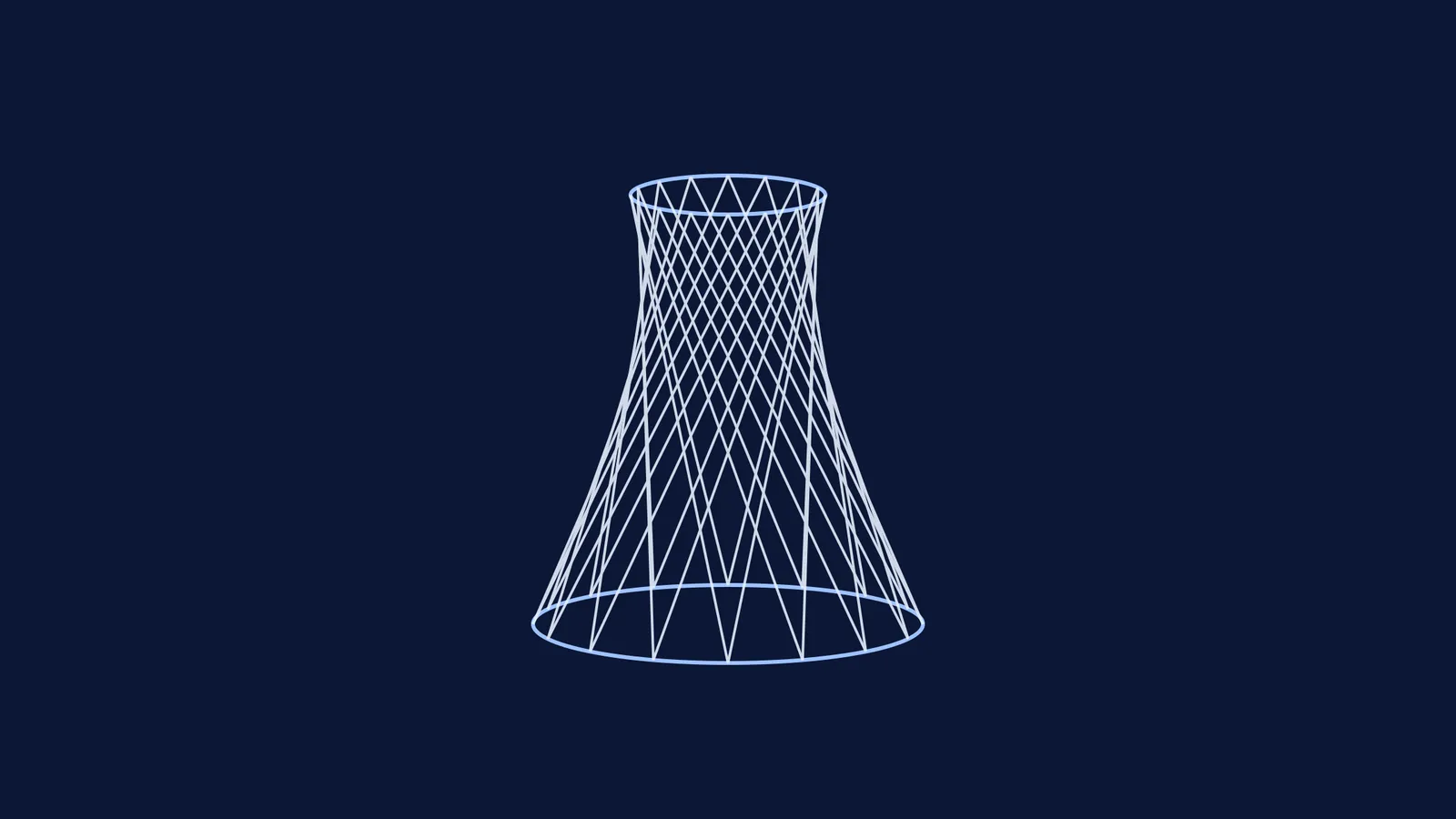
The secret to Shukhov's famous towers is a mathematical surface known as a hyperboloid of one sheet. While it looks from afar like a smoothly curving hourglass, the entire structure is constructed from straight, intersecting steel bars.
This design is a "ruled surface". You can trace the shape yourself using a simple mental model:
Imagine a flat ring of points at the top of a tower, and a wider ring of points at the base.
If you drop a straight plumb line from point 1 on the top ring to point 1 on the bottom ring, you get a simple cylinder or cone.
But if you connect point 1 on the top ring to point 6 on the bottom ring, the straight line must angle across the empty space.
When you repeat this angular shift for every point, the straight lines cross over one another, naturally pinching inwards in the middle to form a "waist" before flaring out again.
Because every individual piece of the lattice is a straight steel beam under tension or compression, the overall structure is highly resistant to buckling. Furthermore, the open diagonal grid (diagrid) lets wind pass straight through. This eliminates the massive lateral wind loads that solid structures, like conventional walls or chimneys, have to endure. If picturing how a doubly curved surface emerges from straight lines is difficult, the Fermi Simulation Lab has interactive simulations for the ideas that are easier to see than to read.
Shukhov's first such structure, a 37-meter water tower built for an 1896 exhibition in Nizhny Novgorod, proved the concept to the world. It paved the way for his masterpiece, the Shukhov Tower (also known as the Shabolovka Tower) in Moscow. During the Russian Civil War, steel was in desperately short supply. Shukhov had originally designed a 350-meter tower that would have surpassed the Eiffel Tower in height while using only a fraction of the metal. Due to the steel shortages, the final structure, completed in 1922, was scaled back to a height of 160 meters. It still stands today as a highly efficient structure. Decades later, engineers applied similar structural logic to skyscrapers, much like the work of Fazlur Rahman Khan and the tube design of skyscrapers.
What was the Shukhov cracking process?
Before his towers changed the Moscow skyline, Shukhov reshaped the chemical industry. In the late 19th century, refining crude oil by simple distillation largely yielded heavy products like fuel oil and lubricants. Lighter, more volatile components like kerosene (used for lighting) and gasoline were harder to extract in large volumes because crude oil naturally contains long, heavy hydrocarbon chains.
In 1891, Shukhov and his colleague Sergei Gavrilov patented the world's first industrial thermal cracking process (Russian Empire Patent No. 12926). They realized that if you applied intense heat to heavy oil, the thermal energy would overcome the activation energy of the carbon-carbon bonds, snapping the long hydrocarbon chains into shorter ones.
Their crucial innovation was a continuous tubular installation. Instead of heating a large, dangerous batch of oil in a single vat, Shukhov pumped the heavy oil through a coiled network of heated pipes under constant, high pressure. Maintaining high pressure was essential; it prevented the oil from simply boiling away as a gas before the chemical bonds had a chance to break.
This process successfully "cracked" heavy oil into lighter, more valuable fuels. For a breakdown of how large alkane chains differ structurally from shorter ones, you can read about structural isomers in Class 10: butane and pentane drawn out. If you are struggling to picture the reaction mechanisms of hydrocarbons, the Fermi Concept Library covers every concept in chemistry, each with its own lesson.
Although gasoline was not in high demand in 1891, the Shukhov cracking process laid the technical groundwork for the petrochemical industry. Years later, when the mass production of automobiles caused a spike in gasoline demand, American companies patented similar cracking methods (such as the Burton process in 1913). However, Shukhov's earlier patent was successfully cited in international patent disputes to prove that the fundamental engineering of continuous thermal cracking had already been solved in Russia.


