On this page
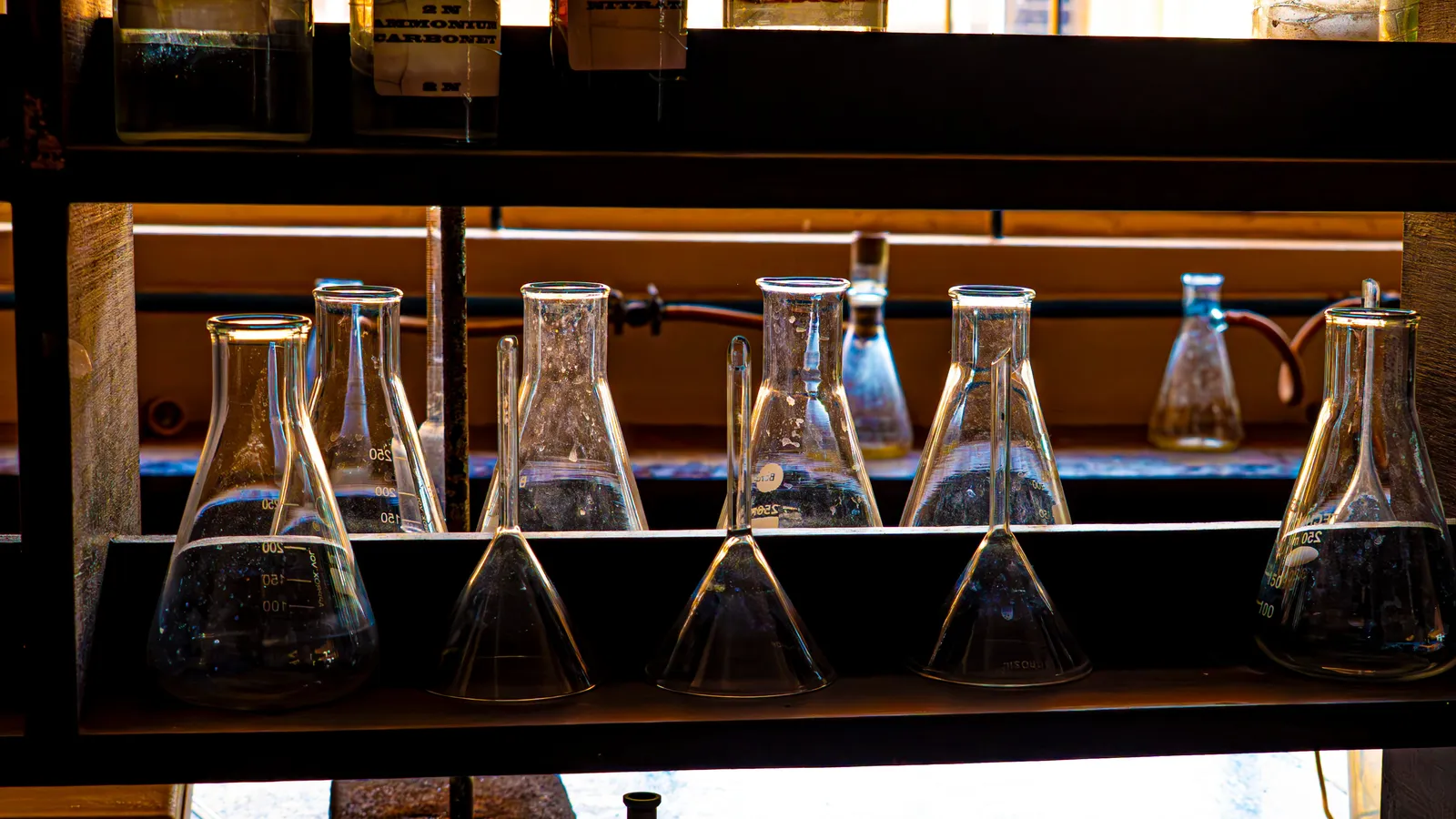
A Class 11 acid-base titration uses a burette above, a white tile below and a conical flask in your hand. That flask is the Erlenmeyer flask, and its design was first published in 1860.
Who invented the Erlenmeyer conical flask?
The conical flask was invented by the German chemist Emil Erlenmeyer (1825–1909), according to the Wikipedia entry on the Erlenmeyer flask, which cites his original paper. He described it in an article called "Zur chemischen und pharmazeutischen Technik" in the *Zeitschrift für Chemie und Pharmacie*, volume 3, January 1860, pages 21–22.
The same article says he had already shown the new flask at a pharmaceutical conference in Heidelberg in 1857, and had arranged for local glassware makers to produce and sell it. Compound Interest puts it the same way: he designed the flask in the late 1850s and first described it in a paper published at the beginning of 1860.
You may see 1861 in some reference works, such as the EBSCO Research Starter on Erlenmeyer. The January 1860 journal citation is the safer date to write in an answer. EBSCO also notes that Erlenmeyer took over editing the *Zeitschrift* in 1859, when August Kekulé left to become chair of chemistry at Ghent, so the flask appeared in a journal he was editing.
Why is a conical flask shaped the way it is?
Compound Interest and the Wikipedia article describe three of them:
Flat base: the flask stands on the bench and does not tip over easily, unlike a round-bottomed flask.
Sloping sides and narrow neck: you can swirl the liquid to mix it with little risk of it spilling out of the top.
Narrow upper section: hot vapour condenses on the upper walls, so less solvent is lost when you heat it.
A beaker's mouth is as wide as its base, so a hard swirl can throw liquid over the rim. In a titration, any liquid that splashes out takes some of the substance you are measuring with it.
How do you swirl a conical flask during a titration?
The NCERT Class 11 chemistry laboratory manual, Unit 6 (Titrimetric Analysis) lists a 100 mL conical flask, a 50 mL burette, a 10 mL pipette and a white glazed tile for its oxalic acid versus sodium hydroxide experiment. It says to pipette 10 mL of oxalic acid into a washed and dried conical flask and add 1–2 drops of phenolphthalein. Then you titrate until a very faint permanent pink appears. Its note is short: "Swirl the liquid during the titration." Its figure shows one hand controlling the stopcock while the other swirls the flask on the tile.
Here is that routine turned into steps you can practise:
Hold the flask near its neck with one hand while the other works the stopcock. NCERT's figure shows it done either way round.
Keep the flask over the white glazed tile, as NCERT says, so the colour change is easy to see.
Swirl from the wrist in small, steady circles. The liquid should form a gentle whirl, not climb to the neck.
Add the titrant in small amounts at first, then drop by drop as the pink starts to linger. NCERT gives this order too.
Near the end, swirl after every single drop and wait a moment. A pink that fades means you have not reached the end point yet.
Repeat the titration until you have three concordant readings, as NCERT asks.
If your readings refuse to agree, our guide to taking concordant readings in a titration practical goes through the usual causes. Rinsing is the other common slip, and why burettes are rinsed with solution but flasks only with water explains the logic.
After the practical, the marks depend on the calculation. If you are unsure where the basicity of oxalic acid goes in the formula, the Fermi Problem Library has worked problems with a step-by-step solver that explains the reasoning rather than printing an answer.
What else did Erlenmeyer do besides the flask?
EBSCO records that he became a full professor at the new Munich Polytechnic School in 1868. In 1880 he set out what is now called the Erlenmeyer rule: an alcohol with its OH group attached directly to a double-bonded carbon is not stable, and it rearranges into an aldehyde or ketone. You will meet the same idea as keto-enol tautomerism. Compound Interest adds that he was the first to suggest that two carbon atoms could be joined by double and triple bonds.
Historian Alan Rocke's paper "Theory versus Practice in German Chemistry: Erlenmeyer beyond the Flask" (*Isis*, 2018) is a good place to start if you want the fuller story.
For another piece of lab equipment named after its inventor, read about Robert Bunsen, his burner and the discovery of caesium.