On this page
Most people know Albert Einstein for relativity. Fewer know that he and his former student Leo Szilard spent years designing fridges, and that one of their designs makes cold from heat without a single moving part. The idea behind it is one you already meet in Class 11 chemistry: partial pressure.
What did Einstein and Szilard invent?
According to APS News, the project began in 1926, when newspapers reported that a whole family in Berlin had died from toxic gas leaking out of a broken refrigerator seal. APS News says the pair went on to file more than 45 patent applications in six countries.
One of them is US patent 1,781,541, titled simply "Refrigeration". Google Patents lists it as filed on 16 December 1927 and granted on 11 November 1930. The same APS article says that a new non-toxic refrigerant, Freon, arrived in 1930 and spelled doom for their fridge. (For Szilard's bigger idea, read how Leo Szilard got the idea of the nuclear chain reaction.)
How does an absorption fridge work with no moving parts?
An ordinary kitchen fridge uses a motor-driven compressor to squeeze the refrigerant, as explained in how a refrigerator makes things cold. The Einstein-Szilard machine has no compressor. The patent says the pressure in its parts is uniform, apart from the small differences that liquid columns create to make the fluids flow. It uses three fluids: butane as the refrigerant, ammonia gas, and water. Here is the cycle as the patent describes it:
Evaporator (the cold box). Liquid butane meets ammonia gas. The ammonia lowers butane's partial pressure, so butane evaporates at a low temperature and takes heat from the food space.
Condenser. The butane-ammonia gas mix flows into a vessel cooled by a water jacket. Water absorbs the ammonia, which dissolves easily, but not the butane. Butane now holds nearly the whole pressure, which is enough to liquefy it at the cooling-water temperature.
Back to the cold box. Liquid butane is lighter than the ammonia solution, so it floats on top and runs back to the evaporator.
Generator. The ammonia solution flows down by gravity to a heated chamber. Heat drives the ammonia out as gas, which returns to the evaporator. Vapour bubbles then lift the weak solution back up so it can flow to the condenser and absorb more.
Heat and gravity do all the moving.
Why does butane boil cold in one place and condense in another?
Dalton's law states that the total pressure of a gas mixture is the sum of the partial pressures of its gases, and each gas's partial pressure equals its mole fraction times the total (LibreTexts/10%3A_Gases/10.06%3A_Gas_Mixtures_and_Partial_Pressures)).
Liquid butane keeps evaporating while its vapour pressure is higher than butane's partial pressure in the gas above it, and butane vapour condenses when its partial pressure is higher. Butane boils at -0.5 °C at normal atmospheric pressure (PubChem). Lower its share of the pressure and it boils colder, the same reason water boils below 100 °C on a mountain (why water boils at a lower temperature in the mountains).
Worked example: how much ammonia does the cold box need?
The total pressure of 3 bar below is our own illustrative choice, not a figure from the patent. Butane vapour pressures come from the Antoine equation parameters on the NIST Chemistry WebBook.
Pick the total pressure: 3 bar everywhere in the machine.
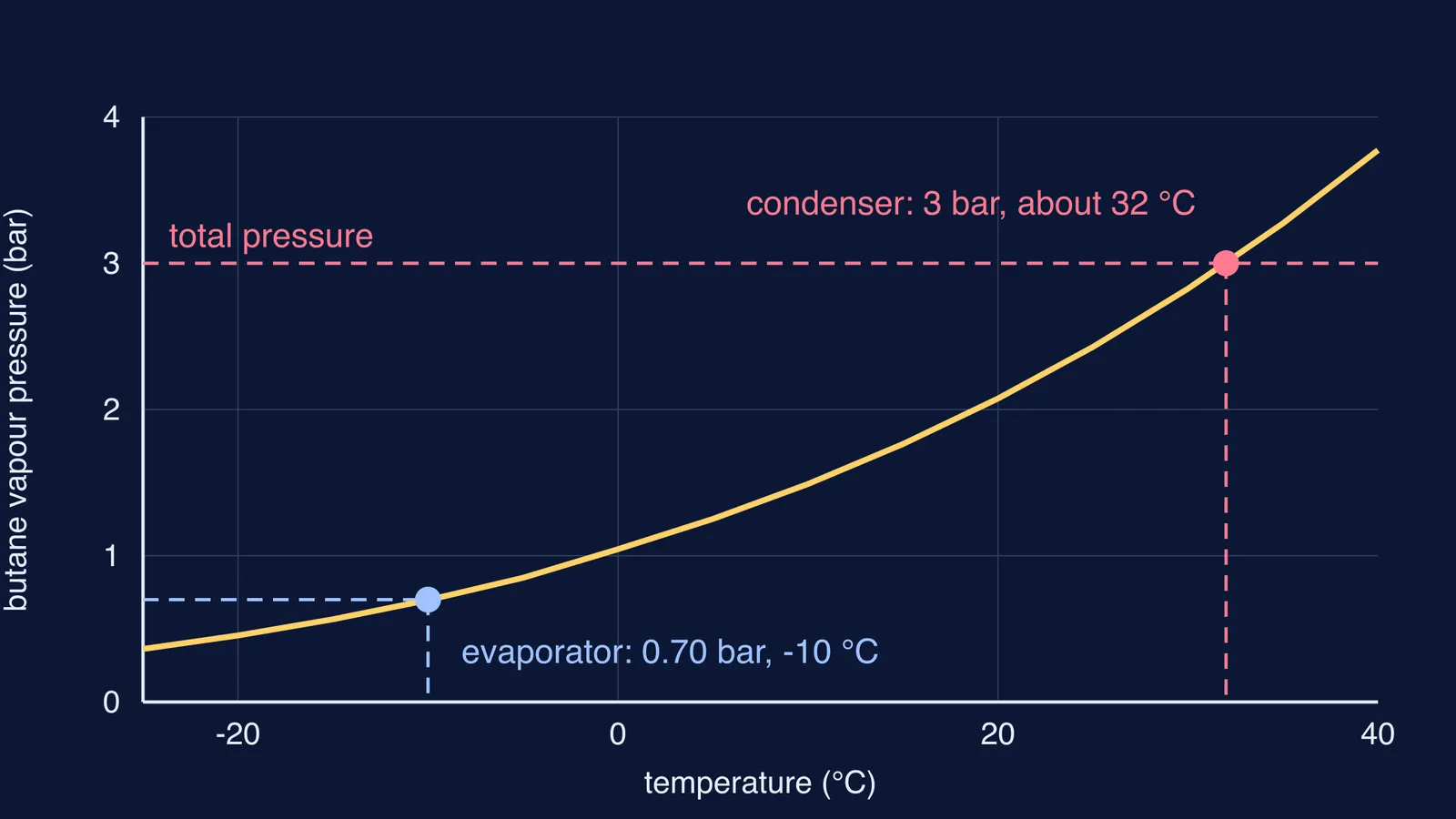
Check the condenser. Say the cooling water is at 30 °C, a warm Indian afternoon. NIST's parameters give butane a vapour pressure of about 2.83 bar at 30 °C. Once the water has absorbed the ammonia, butane holds almost the full 3 bar, which is more than 2.83 bar, so it condenses.
Set the cold-box target: -10 °C. NIST's parameters give butane a vapour pressure of about 0.70 bar at -10 °C. For butane to boil there, its partial pressure must be 0.70 bar or less.
Find the ammonia share. Ammonia must supply the rest: 3 - 0.70 = 2.30 bar. By Dalton's law its mole fraction is 2.30 / 3, about 77%.
So butane sees about 0.7 bar in the cold box and about 3 bar in the condenser, roughly a fourfold change, with no compressor at all. Check yourself: if the cooling water were at 35 °C, where butane's vapour pressure is about 3.27 bar by the same NIST data, would 3 bar still work? (No. You would need a higher total pressure.)
Did the Einstein fridge ever come back?
In 2008, Phys.org reported that the team of Malcolm McCulloch, an electrical engineer at the University of Oxford, had built a prototype of the design as part of a three-year project on appliances for places without electricity. He predicted that using different gases could quadruple its efficiency, and said its lack of moving parts would mean minimal maintenance, useful in rural areas.
Partial pressure is easier to see than to read. The Fermi Simulation Lab has interactive simulations for ideas like this, and the Fermi Concept Library gives Dalton's law and vapour pressure their own lessons if step 4 felt shaky.