On this page
In 1940 a Berkeley physicist, Edwin McMillan, chased a radioactivity that would not behave and found element 93, the first one past uranium. The physics fits on two lines of Class 12 nuclear equations.
Who discovered neptunium?
Neptunium was discovered by Edwin McMillan and Philip Abelson, who reported it in the paper Radioactive Element 93, published in Physical Review, volume 57, in June 1940.
McMillan, born in California in 1907, took his PhD at Princeton in 1932 and moved to Berkeley the same year. There he joined Ernest Lawrence's Radiation Laboratory, studying nuclear reactions and helping build cyclotrons, says his Nobel Prize biography.
The Berkeley Lab history page puts the discovery in one line: McMillan and Abelson "used the 60-inch cyclotron to bombard uranium with neutrons, creating element 93, which McMillan named neptunium." Because uranium was named for Uranus, neptunium was named for Neptune, the next planet out, notes Los Alamos National Laboratory. For the start of that naming story, read how Martin Klaproth discovered uranium.
How did hitting uranium with neutrons make a new element?
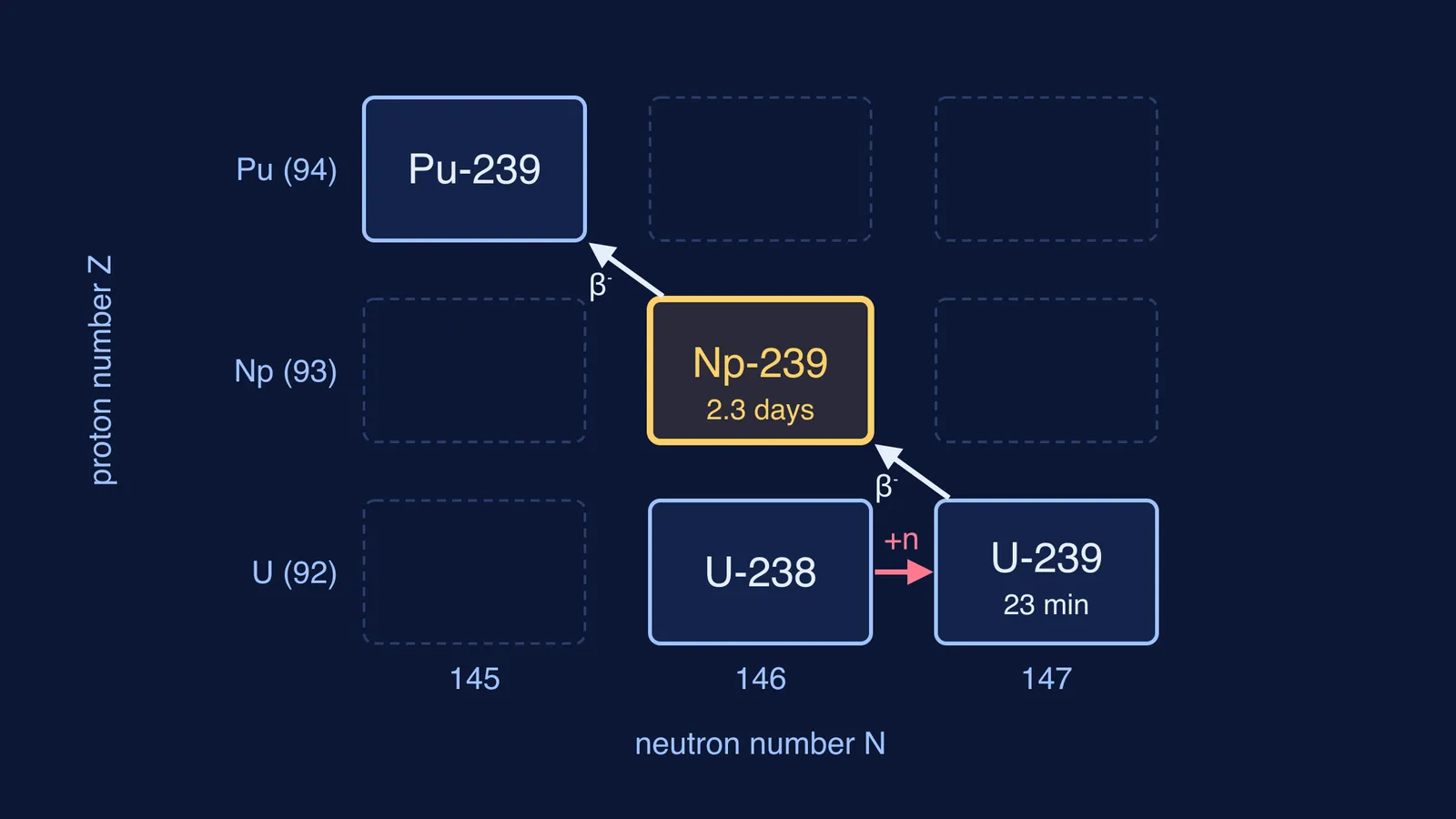
According to the Linda Hall Library, McMillan found two new radioactive materials in his irradiated uranium: one with a half-life of 23 minutes and one with a half-life of 2.3 days. Here is the reasoning as a worked example.
Neutron capture. Uranium-238 (Z = 92, A = 238) absorbs a neutron (Z = 0, A = 1). A rises by one, Z stays: U-238 + n gives U-239, the 23-minute activity.
Beta-minus decay. In U-239 a neutron becomes a proton and an electron shoots out. A stays 239, Z rises to 93: U-239 gives Np-239, an electron and an antineutrino.
Check the bookkeeping. Left: A = 239, Z = 92. Right: 239 + 0 = 239, and 93 + (-1) = 92. Both balance.
Predict the next step. Np-239, the 2.3-day emitter, should beta-decay into element 94 (Pu-239).
The proof was the timing. As the paper put it (quoted in a 2012 review of transuranium isotope discoveries), "The final proof that the 2.3-day substance is the daughter of the 23-minute uranium is the demonstration of its growth from the latter." The same review says the 2.3-day figure agrees with today's adopted Np-239 half-life of 2.356 days.
Check the logic yourself. After 2 hours, U-239 has gone through about 5.2 half-lives (120 / 23), so roughly (1/2)^5.2, about 3%, is left. Nearly all of it is now neptunium, which has barely begun to decay, so an afternoon's chemistry can catch element 93. If the electron's energy in step 2 puzzles you, read why the beta decay energy spectrum is continuous.
Why did earlier searches for element 93 fail?
The 2012 review notes that in 1934 Enrico Fermi's group reported the "possible production of elements of atomic number higher than 92" by bombarding uranium with neutrons. Then Otto Hahn and Fritz Strassmann found barium among the products, showing that uranium can split in two. Fission meant that many of the supposed new elements might really be fragments of split uranium.
McMillan's new activities stayed in the uranium target instead of flying out the way fission fragments did, as the history of neptunium explains, which pointed to something other than a fragment. His paper also suggested that "there may be a second 'rare earth' group of similar elements starting with uranium." That hunch points towards the actinide series in your periodic table today, although the series as drawn now begins at actinium rather than uranium. For why heavy nuclei like these carry so many extra neutrons, see why heavy nuclei have more neutrons than protons.
What happened after neptunium?
By February 1941, Glenn Seaborg, J.W. Kennedy and Arthur Wahl, "continuing McMillan's work", had made and purified element 94, later named plutonium, records the Berkeley Lab history. McMillan left for wartime research in November 1940, and in 1945 had the idea of "phase stability" that led to the synchrotron. He shared the 1951 Nobel Prize in Chemistry with Seaborg "for their discoveries in the chemistry of the transuranium elements", per his Nobel biography.
How can you use this story to learn nuclear reactions?
Next time you meet a nuclear equation, run this checklist:
Write A and Z for every particle, including the neutron (1, 0) and the electron (0, -1).
Add the top numbers on each side, then the bottom numbers. They must match.
Name the process from what changed: A up by 1 means capture; Z up by 1 with A fixed means beta-minus.
Ask what the product does next, and use half-lives to estimate how much is left.
If decay chains still feel abstract, the Fermi Simulation Lab has interactive simulations for ideas that are easier to see than to read. If you get stuck balancing one, the Fermi Problem Library has a step-by-step solver that explains the reasoning rather than printing an answer.