On this page
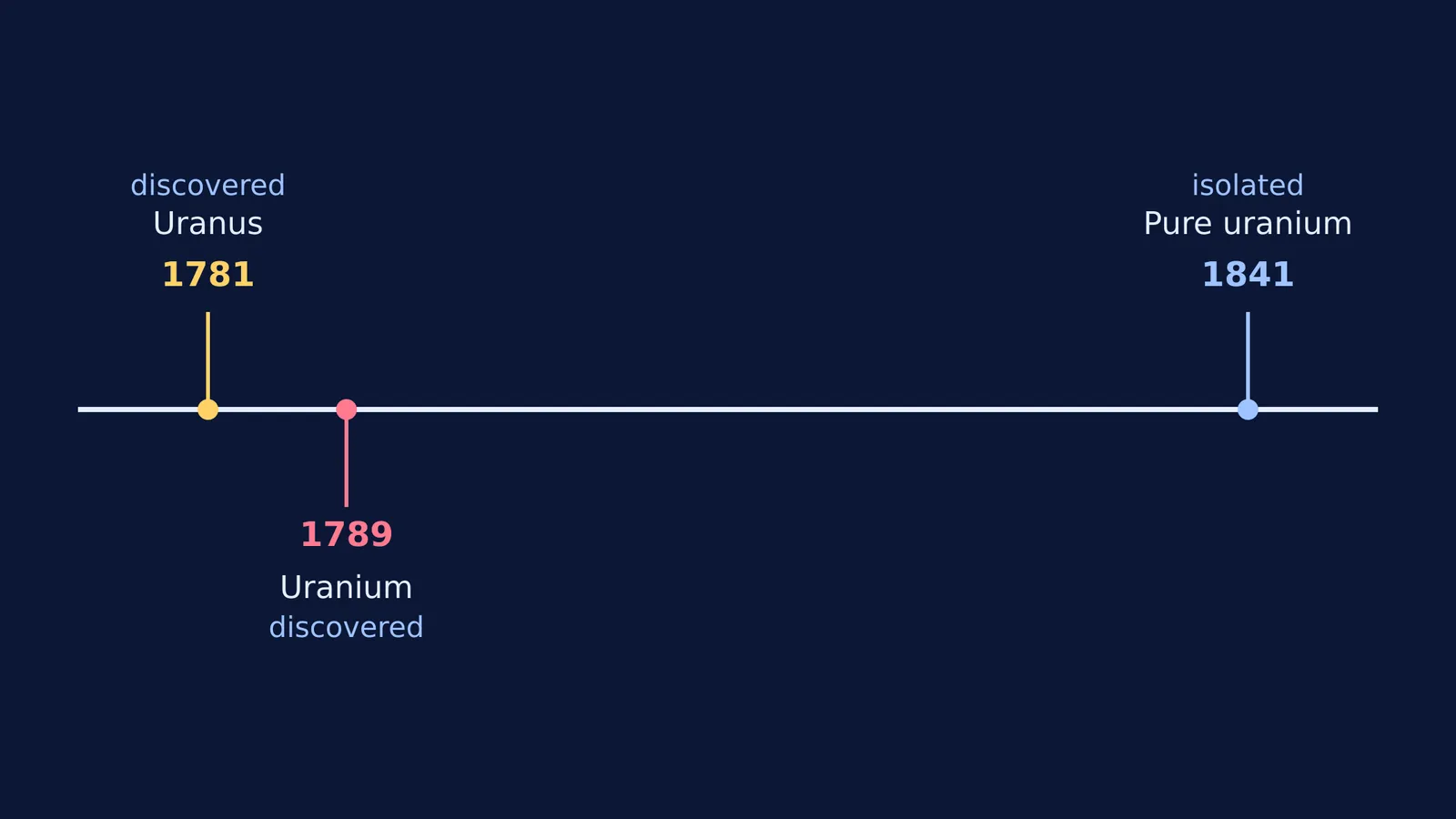
In 1789, the German chemist Martin Heinrich Klaproth discovered uranium while analysing the mineral pitchblende. He named his new element after Uranus, a planet that had been found just eight years earlier by the astronomer William Herschel.
When a chemist finds a new element, they get to name it. Before the late 1700s, finding an element was a rare event, but the tools of analytical chemistry were steadily improving. Klaproth was an apothecary and chemist in Berlin who refused to ignore tiny discrepancies in his experimental results. His intense attention to detail and rigorous quantitative approach made his laboratory one of Europe's most productive chemical research centres, setting a new and exacting standard for the field of analytical chemistry.
How did Klaproth discover uranium?
Klaproth was studying pitchblende, a heavy, dark mineral that miners knew well but chemists did not fully understand. At the time, some scientists believed it was an ore of zinc, iron, or tungsten.
He dissolved the pitchblende in nitric acid and then neutralised the solution with sodium hydroxide. By carefully precipitating the compounds, he separated a yellow powder. He heated this yellow powder with charcoal, expecting to extract a known metal. Instead, he found a black, metallic-looking powder that behaved differently from any known substance, leading him to conclude that he had found an entirely new element. On 24 September 1789, he announced his momentous discovery to the Royal Prussian Academy of Sciences.
Although Klaproth genuinely thought he had isolated pure uranium metal, he had actually produced an oxide of uranium, UO₂. It would take another half-century for the French chemist Eugène-Melchior Péligot to isolate the first actual sample of pure uranium metal in 1841.
Why did Klaproth name it uranium?
In 1781, William Herschel had discovered a new planet beyond Saturn, which was eventually named Uranus. It was the first planet ever discovered with a telescope, and the news had completely thrilled the scientific world across Europe.
Klaproth decided to honour this astronomical milestone. He took the name Uranus and adapted it into "uranium" for his newly discovered metal. This started a lasting tradition. When scientists later discovered the next two elements in the actinide series, they named them neptunium and plutonium, directly after the newly found planets Neptune and Pluto.
What can we learn from careful observation?
Klaproth's great success came from his absolute refusal to accept rough answers. When the mass of the products in a reaction did not perfectly match the mass of the starting materials, he looked for exactly what was missing. This relentless habit of chasing down discrepancies is what sets great experimental science apart from ordinary work, much like how Clemens Winkler found germanium in a missing part of a mineral's mass.
When you study chemistry today, it is easy to focus only on getting the right answer and moving on. But the real learning happens when you stop to investigate why an answer is wrong or why a chemical reaction did not go exactly as expected. If you find yourself stuck on a difficult concept or a tricky calculation, Fermi's AI tutor can help. Instead of just giving you the final number, it holds a line of reasoning across a session, notices where you are stuck, and decides whether to explain, ask, or show.
Just as Klaproth used precise tools to break down complex minerals, breaking down a hard chemistry problem into smaller, understandable parts makes it significantly easier to solve. For worked examples in electrochemistry and beyond, you can explore topics like the E° values of 3d metals.
How can you learn from discrepancies?
When you check your work and find your answer does not match the expected result, do not just cross it out and start over blindly. Use this structured method to find out exactly why:
Check the units: Did you use grams when the formula required kilograms, or Celsius instead of Kelvin?
Track the mass: If a chemical equation does not balance, write down the mass of every reactant and product to see what is missing.
Question the assumptions: Did you mistakenly assume a gas behaves ideally at high pressure?
Isolate the error: Redo the entire problem step by step until you find the exact line where your result drifts from the expected one.
Paying close attention to the details will always serve you well, both in exams and in a real laboratory.