On this page
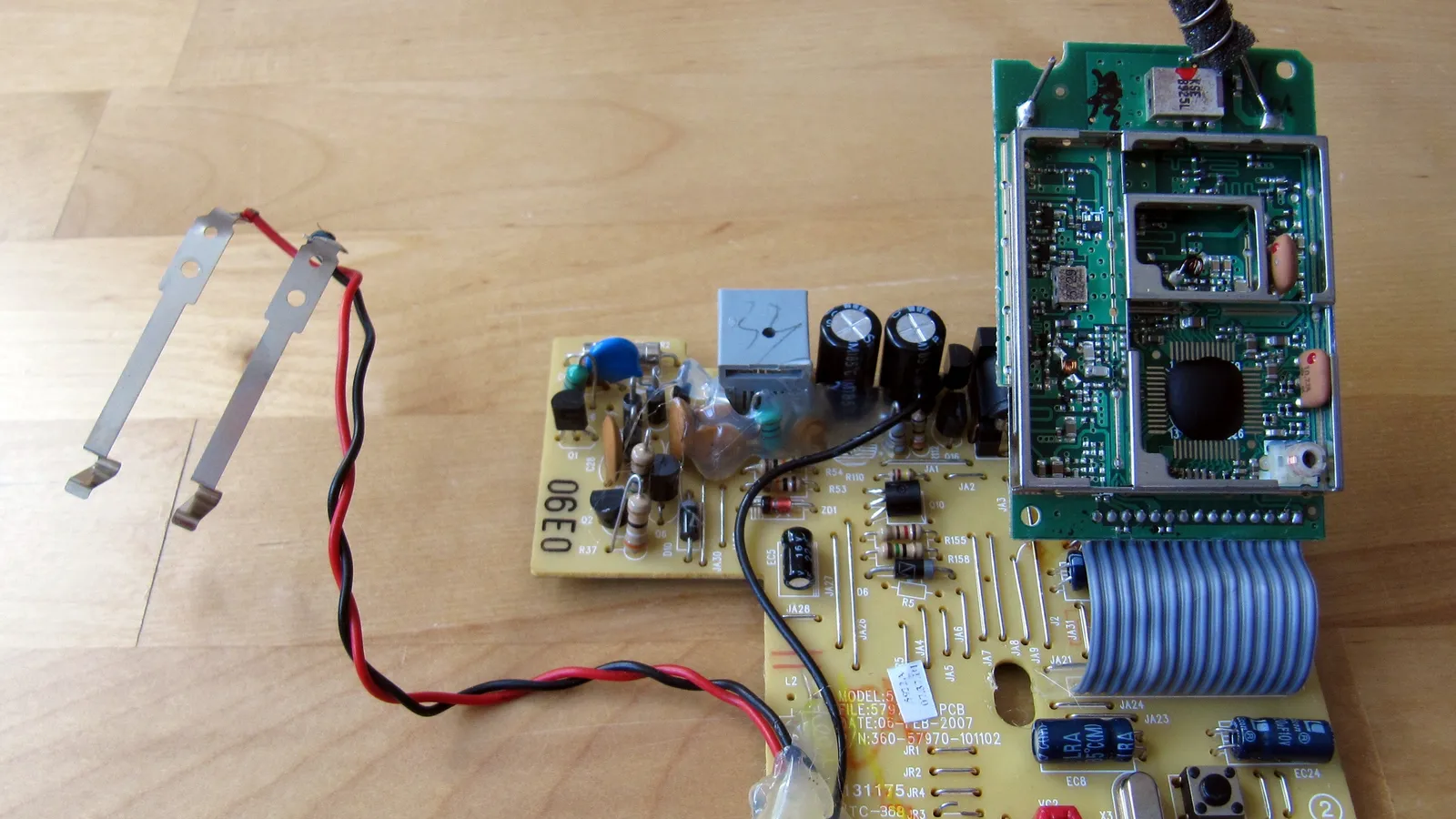
On 24 November 1890, in a lab at the Institut Catholique de Paris, the physicist Édouard Branly saw something odd. A pinch of metal filings that barely conducted electricity suddenly let a current through when a spark was made nearby. The IEEE milestone record for the discovery gives that date and says he "observed that an electromagnetic wave changes the ability of metal filings to conduct electricity." His tube of filings, later called the coherer, became the ear of the first radio receivers.
What did Branly actually observe?
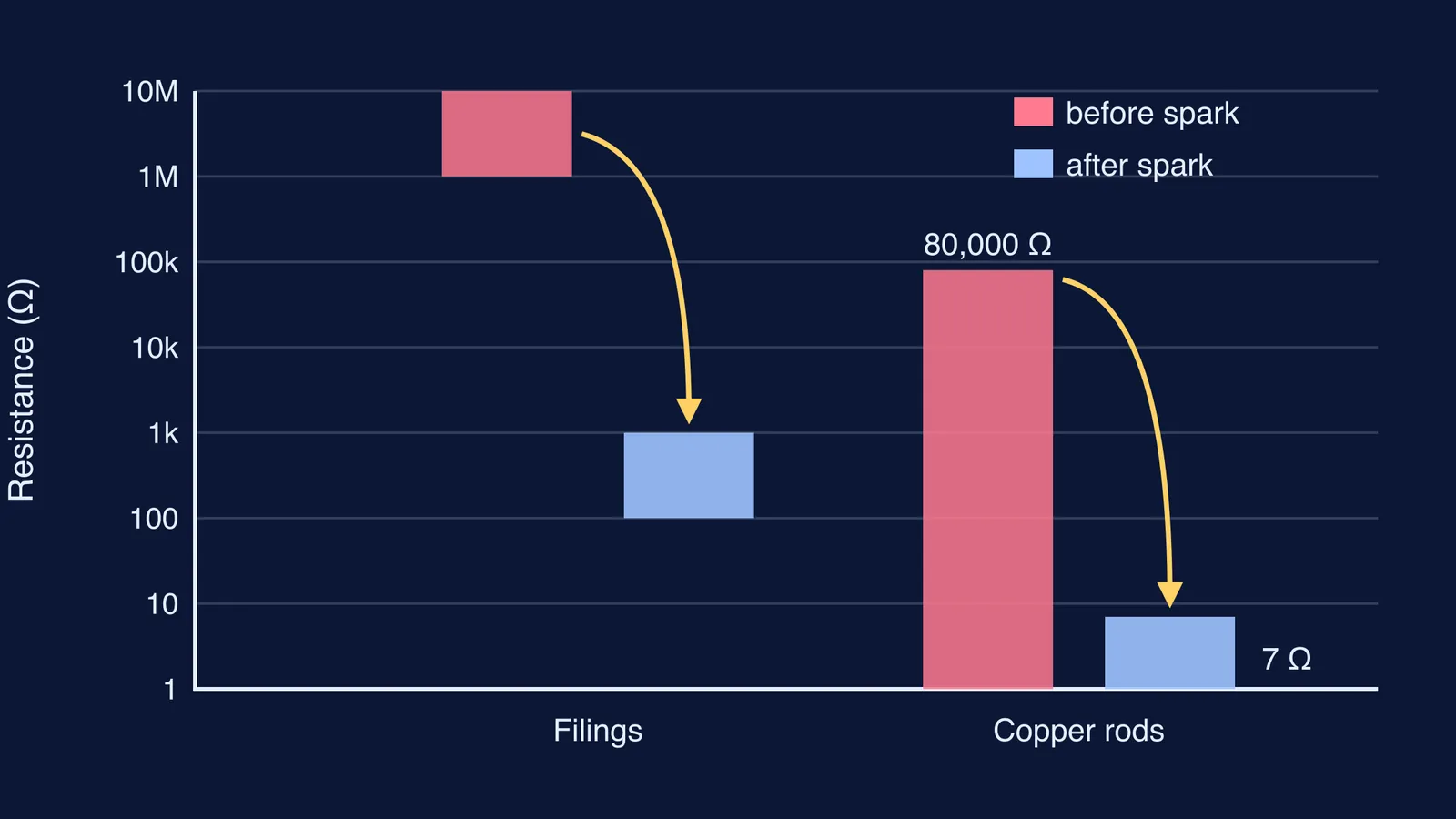
Branly built a circuit with a battery, a galvanometer and a small tube or cup of fine metal powder. An English version of his report, printed in J. J. Fahie's 1901 History of Wireless Telegraphy, records what he measured. Loose powder had a resistance "of the order of millions of ohms", he wrote, though the same metal as a solid piece would offer only a fraction of an ohm. After a spark, "the resistance of the metal is no longer to be measured in millions of ohms, but in hundreds."
The spark never touched the circuit. Discharging a Leyden jar "at some little distance off" made the galvanometer needle jump, and the effect was "observable several metres away from the powder, even with a small Wimshurst machine" (Fahie, 1901). In one case, two crossed, oxidised copper rods fell from 80,000 ohms to 7 ohms.
The low resistance stayed after the spark was over. The reset was mechanical: "On smartly tapping the table supporting the ebonite cup in which the sensitive substance is contained, the original condition is completely restored." Branly reported the work in 1890 in the Comptes rendus of the French Academy of Sciences (Wikipedia: Édouard Branly).
Worked example: how big is that change?
Take Branly's copper-rod numbers (Fahie, 1901) and put them in a circuit with one 1.5 V cell. The cell is our choice for the example, not his.
Before the spark: I = V/R = 1.5 V / 80,000 Ω ≈ 0.000019 A, about 19 microamperes. Far too little to ring a bell.
After the spark: I = 1.5 V / 7 Ω ≈ 0.21 A.
Ratio: 80,000 / 7 ≈ 11,400. The same cell now drives over ten thousand times more current.
That is the trick: the weak radio wave powers nothing. It only flips a switch, and the local battery does the work.
How does a coherer work as a radio detector?
Here is the path of one signal through an early coherer receiver, as described in Wikipedia's coherer article:
A spark transmitter far away sends out a burst of electromagnetic waves (to see why a spark radiates, read why accelerated charges produce electromagnetic waves).
The antenna picks up a tiny oscillating voltage across the coherer.
The filings cling together, or "cohere", and the resistance drops.
Battery current now flows through a relay, which rings a bell or marks a dot or dash.
A tapper strikes the tube, the filings loosen, and the coherer is ready for the next pulse.
Branly called his device a "radio-conductor"; the English physicist Oliver Lodge named it the coherer (Wikipedia: Édouard Branly). Lodge also added a device that shook the filings between signals, resetting them automatically (IEEE ETHW: Coherer). Guglielmo Marconi demonstrated wireless telegraphy using a coherer in 1895 (Wikipedia: Coherer). That same year Alexander Popov built a coherer-based lightning detector in Russia: here is how Popov built a radio receiver in 1895. The waves themselves had been shown to exist only a few years earlier by Heinrich Hertz, whose spark-gap experiments set the stage.
Why was the coherer replaced?
Coherers stayed in wide use until about 1907, when more sensitive electrolytic and crystal detectors replaced them (Wikipedia: Coherer). Jagadish Chandra Bose had already described an iron-mercury version in 1899, and that type resets itself without any tapping, according to the same article.
Branly was nominated for a Nobel Prize three times but never won (Wikipedia: Édouard Branly).
What can you take from Branly into physics class?
Branly's tube is a neat way to remember a receiver's job: turn a weak, fast oscillation into a change something else can use. Check yourself:
What changes in a coherer (its resistance), and what causes the change (an electromagnetic wave)?
Can you redo the Ohm's law calculation above with 3 V and Branly's "millions" and "hundreds" of ohms?
Why can a weak wave control a much stronger current?
Which step resets the detector, and what would go wrong without it?
If a wave travelling from a spark to a distant tube is hard to picture, the Fermi Simulation Lab has interactive simulations for ideas that are easier to see than to read. And if Ohm's law or electromagnetic waves still feel shaky, the Fermi Concept Library gives each concept its own lesson.
The first radio receivers listened through a tube of metal dust.