

On this page
In short On May 7, 1895, Russian physicist Alexander Popov demonstrated a radio receiver designed to detect electromagnetic waves from lightning strikes. His use of a vertical antenna and an automatic resetting mechanism made it a foundational invention in the history of wireless communication.
Russian physicist Alexander Stepanovich Popov is widely celebrated in his home country as the inventor of radio. While Guglielmo Marconi is most often credited globally for commercialising wireless telegraphy, Popov's independent work represents a major milestone in physics and engineering.
On May 7, 1895, Popov presented his "lightning detector" to the Russian Physical and Chemical Society in St. Petersburg (Linda Hall Library), proving that electromagnetic waves could be captured and recorded from a distance.
How did Popov's radio receiver work?
Popov built his receiver on the discoveries of Heinrich Hertz, who first proved the existence of electromagnetic waves, and Oliver Lodge, who had experimented with early detectors. Popov's genius lay in combining an antenna with an ingenious feedback loop to make the device practical.
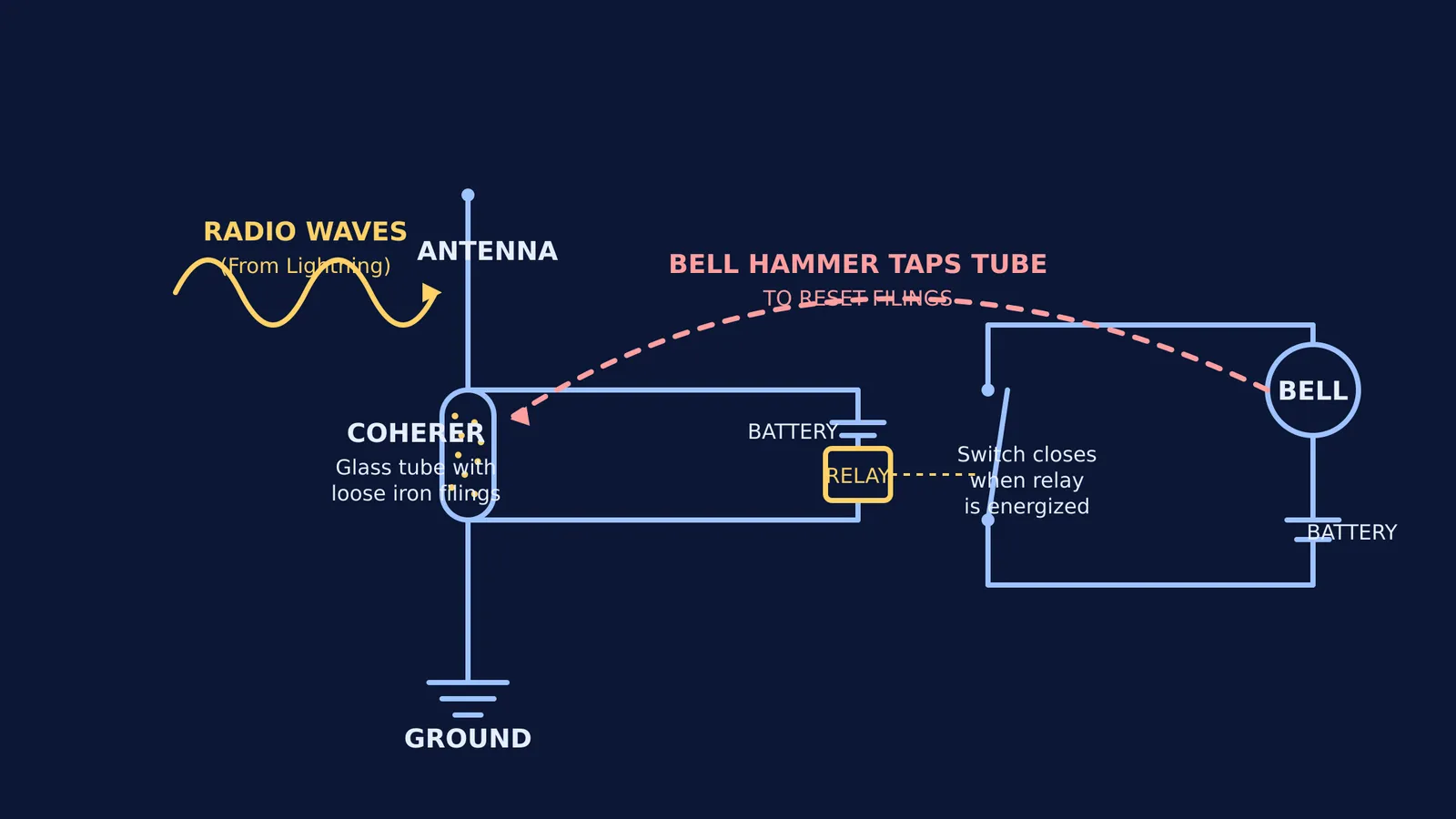
The core of the receiver was a coherer. A coherer is a glass tube filled with loose iron filings placed between two metal electrodes. Normally, the loose filings have a very high electrical resistance, so almost no current flows through the tube.
When a lightning strike occurs, it acts as a massive spark gap, broadcasting a burst of radio waves. Popov used a long vertical wire—an early antenna—to intercept these waves. The wave induces a brief voltage spike across the coherer, causing the filings to stick together, or "cohere". This drastically lowers the resistance of the tube, allowing a battery-powered current to flow through the circuit.
To process this weak current, Popov used a relay. The relay acted as a switch to close a secondary, higher-power circuit that rang an electric bell.
How did the automatic resetting mechanism work?
The most important part of Popov's design was how it prepared for the next signal. Once the iron filings cohered, they would stay stuck together, meaning the bell would ring endlessly and the device would be deaf to new waves.
Popov positioned the bell's hammer so that every time it struck the bell to announce a signal, it would bounce back and tap the glass coherer tube. This mechanical vibration shook the filings apart, immediately restoring their high resistance. The receiver was instantly reset and ready for the next lightning strike.
Early radio circuits rely on concepts that are easier to see than to read. You can explore how electromagnetic waves and circuits behave in the Fermi Simulation Lab.
Did Alexander Popov or Guglielmo Marconi invent radio?
The debate over who invented radio first stems from the secrecy of Popov's work. Because Popov worked extensively with the Russian Navy, much of his research was kept confidential.
In March 1896, Popov successfully transmitted the words "Heinrich Hertz" in Morse code between two buildings in St. Petersburg (Linda Hall Library). However, Marconi had already begun filing patents in the West and actively commercialising his systems. Today, historians recognise both men—alongside Nikola Tesla and Oliver Lodge—as independent pioneers who solved the wireless communication problem at nearly the same time.
In 1945, the Soviet Union officially established May 7 as Radio Day to mark the 50th anniversary of Popov's demonstration, a date still celebrated in Russia today (Linda Hall Library).
How do you explain the coherer circuit in an exam?
Understanding how a coherer circuit works is an excellent exercise in tracing logic through an electronic system. If you are asked to explain early radio detection or feedback loops, use this five-step framework:
Initial state: The loose iron filings in the coherer have high resistance; no current flows in the primary circuit.
The trigger: An electromagnetic wave hits the antenna, inducing a voltage spike across the coherer.
The change: The filings cohere, resistance drops, and a primary current energises the relay coil.
The output: The relay closes the secondary circuit, ringing the electric bell.
The reset: The bell's hammer physically taps the coherer, breaking the filings apart and returning the circuit to its initial state.
If you are stuck on how an antenna picks up electromagnetic waves or how relays function, Fermi's AI tutor can help. It works out what you already know and builds a plan for the session, teaching you the underlying physics rather than just giving you an answer.


