

On this page
In 1887, the German physicist Heinrich Hertz first observed the photoelectric effect while testing electromagnetic waves with a spark gap generator (Wikipedia). He was searching for the radio waves that James Clerk Maxwell's equations had predicted, but he accidentally uncovered a phenomenon that would eventually rewrite the laws of physics.
How did Hertz use the spark gap experiment?
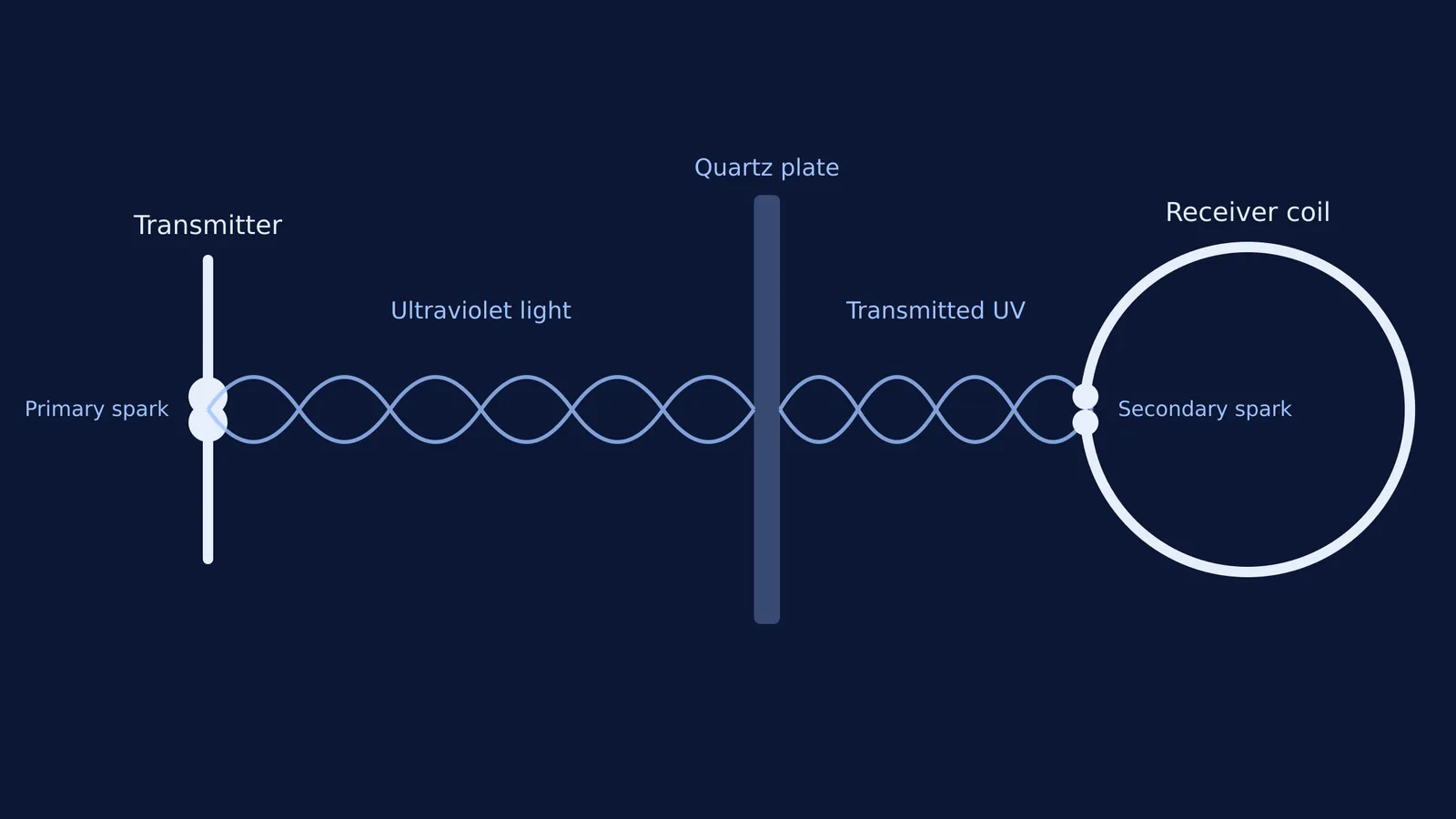
Hertz built a transmitter (a dipole oscillator) and a receiver (a simple wire coil with its own tiny gap). When the transmitter fired high-voltage pulses, the receiver produced a secondary spark. To see this faint receiver spark more clearly, Hertz enclosed the receiver in a dark box.
Surprisingly, the spark in the receiver gap became much weaker when it was in the dark. It grew to its maximum length only when it was exposed to the light coming from the primary spark of the transmitter.
Hertz decided to test what part of the light caused this effect. He placed a sheet of glass between the two sparks and saw the effect vanish. When he used a piece of quartz instead, the receiver spark remained strong. Since quartz allows ultraviolet (UV) radiation to pass but glass absorbs it, Hertz realised UV light was helping the spark jump the gap.
Why did classical physics fail to explain the photoelectric effect?
Hertz had found the first sign of the photoelectric effect: the emission of electrons from a material caused by electromagnetic radiation. However, the classical wave theory of light could not explain it.
According to the classical wave theory, light is a continuous wave. If light waves hit a metal surface, the energy should build up over time. A brighter or more intense light should give the emitted electrons more kinetic energy, and even dim light should eventually eject an electron if left shining long enough.
But experiments by Philipp Lenard and others between 1900 and 1902 showed a completely different reality. The kinetic energy of the ejected electrons depended only on the frequency (or colour) of the light, regardless of its brightness. A bright, low-frequency light would never eject any electrons, while a dim, high-frequency light (like UV) would eject them instantly.
If a student struggles to picture how electrons respond to different frequencies of light, the Fermi Simulation Lab has interactive simulations for the ideas that are easier to see than to read.
How did Einstein explain the photoelectric effect in 1905?
Hertz meticulously recorded his findings in *Annalen der Physik* in 1887, but he did not pursue a theoretical explanation for the effect. He was focused on proving the existence of radio waves, and left the puzzle of the UV light for others to solve.
In 1905, Albert Einstein provided the explanation by proposing that light is not a continuous wave, but a stream of discrete energy packets (later called photons) (Wikipedia). For a photon to eject an electron, its frequency must be above a certain threshold for that material.
Einstein's equation showed that a photon's energy is proportional to its frequency (E = hν), finally explaining why the high-frequency ultraviolet light, but not lower-frequency visible light, worked in Hertz's experiment. This discovery earned Einstein the Nobel Prize in Physics and laid the foundation for quantum mechanics.


