On this page
Edmond Halley is remembered for his comet. In 1693 he also published a paper in the Royal Society's *Philosophical Transactions* showing how a town's birth and burial records could be turned into a fair price for a lifetime income (Halley, Phil. Trans. 17: 596-610). His method combined two ideas that actuarial maths still uses: a life table and interest.
Why did Halley use records from Breslau?
The records came from Caspar Neumann, who examined the registers of Breslau and sent his observations to Leibniz. Leibniz told Justel at the Royal Society, who asked Neumann for the data; Neumann sent the figures for 1687 to 1691, and the Royal Society asked Halley to analyse them (notes on Halley by Richard Pulskamp).
Over those five years Breslau recorded 6,193 births and 5,869 burials, about 1,238 births and 1,174 burials a year (OCR text of Halley's paper).
What made the data useful was that deaths were recorded with ages. Halley's method needs no general census, only the numbers of births and deaths and the ages at which people died over a few years (HistData notes on Halley's table).
What is a life table?
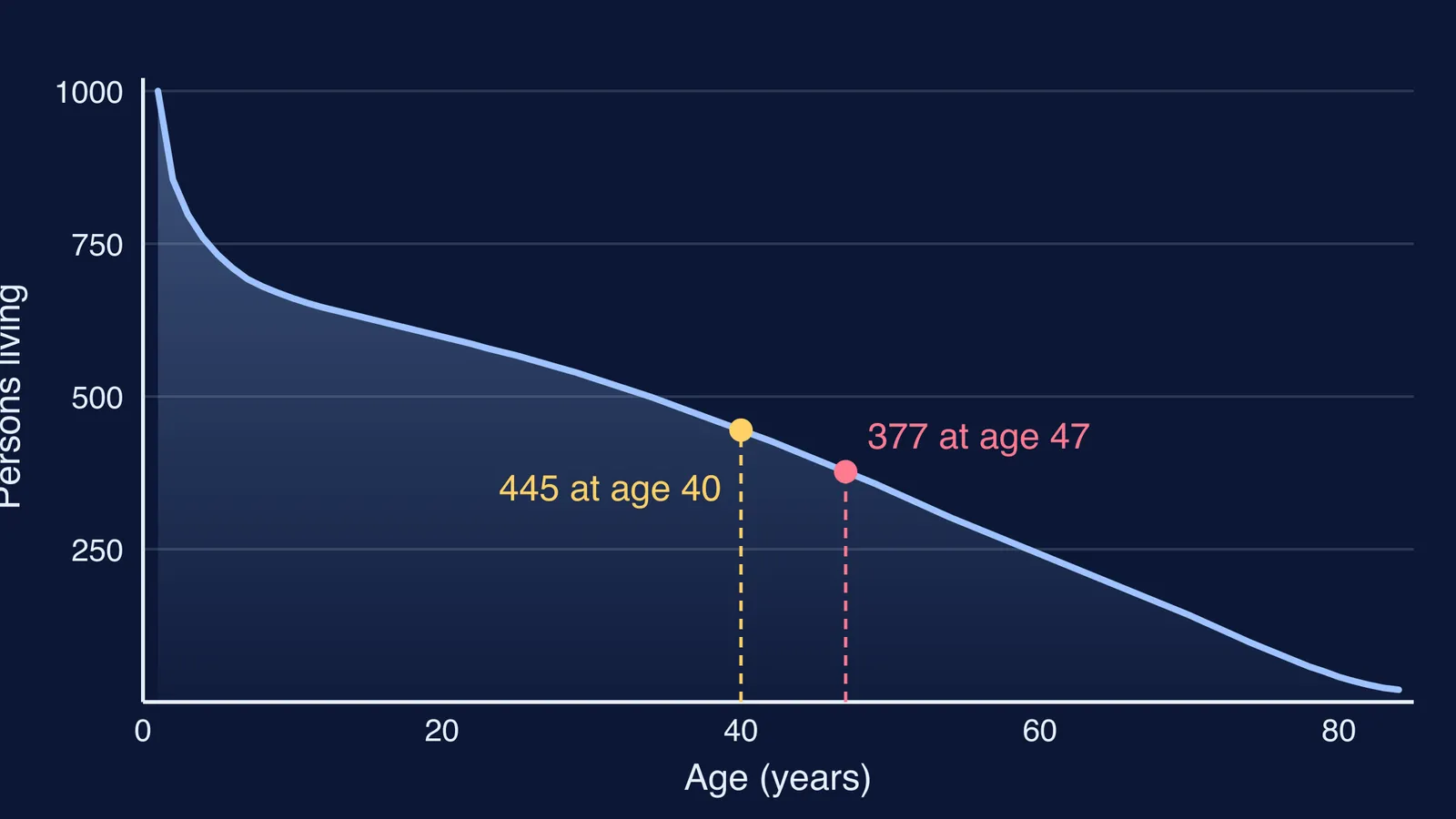
A life table follows a group of people born in the same year and shows how many are still alive at each age (HistData).
The rule is simple: the number alive at the next age equals the number alive now minus the deaths at this age (HistData).
Starting from 1,000 people at age 1, Halley's table has 692 alive at age 7, 598 at 20, 445 at 40, 242 at 60 and 142 at 70 (table values, Rdatasets). From it Halley put the whole population of Breslau at 34,000 people (Halley's text).
The statistician David Bellhouse calls it arguably the first life table in the world based on population data, and notes that Halley rounded his numbers and smoothed out outliers to make the table easier to use (Bellhouse, JRSS A, 2011).
How did Halley turn the table into odds?
Halley read odds straight off the table (Halley's text). At age 25 there are 567 people and at 26 there are 560, so 7 die during the year. That gives odds of 560 to 7, or 80 to 1, that a 25-year-old does not die within a year.
Of 445 people at 40, 377 reach 47, so the odds are 377 to 68, about 5.5 to 1, that a 40-year-old lives 7 more years. In today's notation the probability is 377 ÷ 445, about 0.85.
How did Halley price an annuity?
An annuity on a life pays a fixed sum every year for as long as the buyer is alive. Halley's rule was to value each year's payment separately, allowing for interest and for the chance the buyer is still alive, then add: "the Sum of all those yearly Values being added together, will amount to the value of the Annuity" (Halley's text).
Here is a worked example with his numbers (table values). A 40-year-old buys ₹100 a year for 3 years, paid only while alive, with interest at 6%.
Year 1: chance alive is 436 ÷ 445 = 0.9798. ₹100 due in one year is worth 100 ÷ 1.06 = ₹94.34 today. Value: 0.9798 × 94.34 = ₹92.43.
Year 2: chance alive is 427 ÷ 445 = 0.9596. Present value is 100 ÷ 1.06² = ₹89.00. Value: ₹85.40.
Year 3: chance alive is 417 ÷ 445 = 0.9371. Present value is 100 ÷ 1.06³ = ₹83.96. Value: ₹78.68.
Add them: ₹256.51. Certain payments would cost ₹267.30; the gap is the chance the buyer dies.
Halley carried this to the end of the table. With interest at 6%, the rate in his paper's tables, he valued a life annuity at 13.44 years' purchase at age 10, 10.57 at age 40 and 5.32 at age 70, meaning the price was that many times the yearly payment (Halley's text). He pointed out that a government fund lately granted to William and Mary paid 14% a year, or 7 years' purchase for a life, when young lives at the usual interest were worth above 13.
Why does Halley's table still matter?
Life insurance and pensions still use the same two ingredients: the chance of being alive, and money discounted for time. Read how actuaries and data scientists differ as careers, how Daniel Bernoulli used a life table to weigh smallpox inoculation, and how William Farr turned causes of death into vital statistics.
To practise, try this plan:
Pick an age from the table and find the one-year survival chance.
Write it as odds and as a probability, and check they agree.
Price a 2-year annuity for a 60-year-old at 6%, step by step as above.
Compare it with the certain price and explain the gap in one sentence.
If compound interest or conditional probability is the shaky part, the Fermi Concept Library gives every concept in mathematics its own lesson. To check your working, the Fermi Problem Library has worked problems with a step-by-step solver that explains the reasoning rather than printing an answer.