On this page
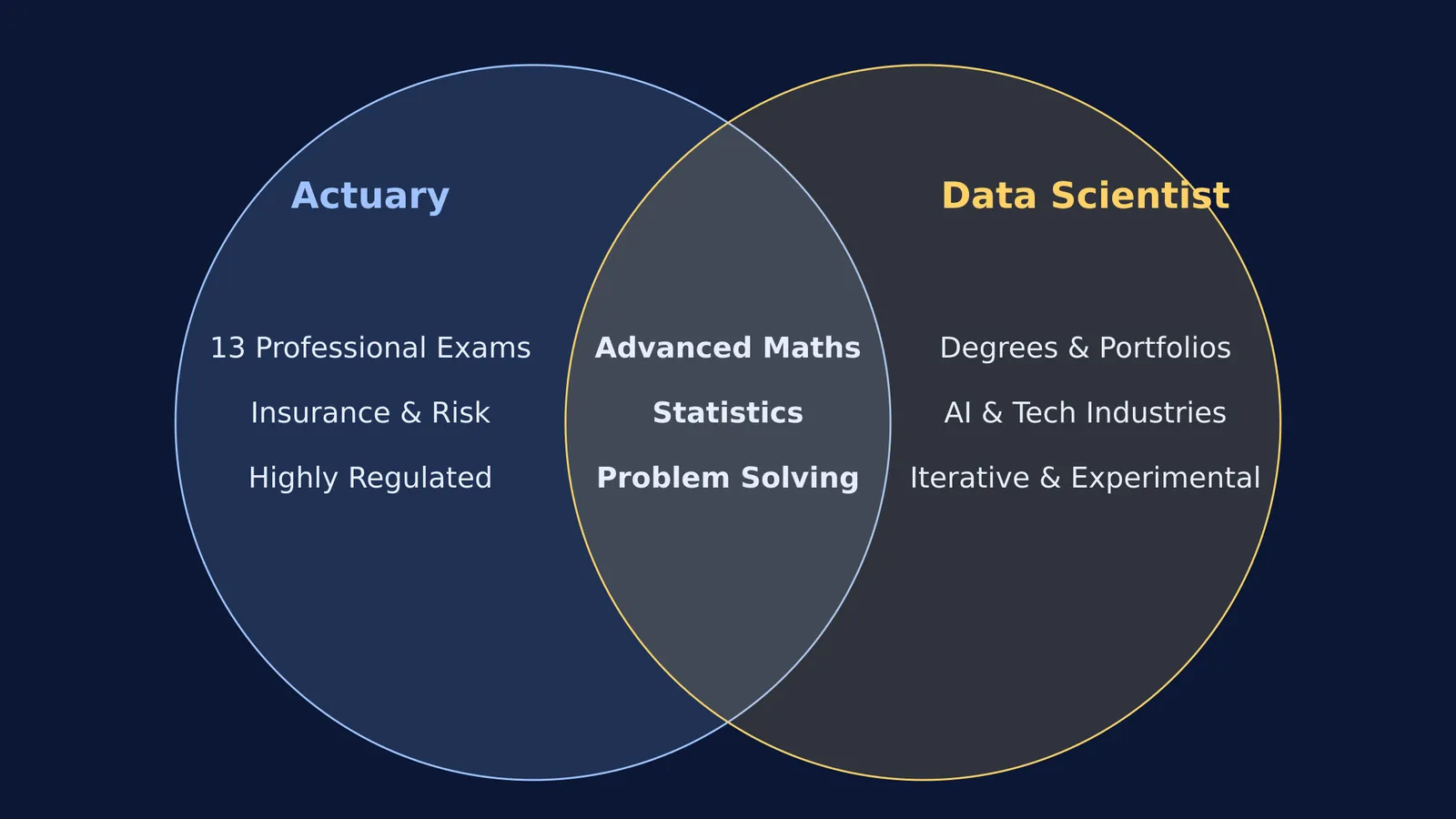
Both actuaries and data scientists use advanced mathematics and statistics to solve complex problems, but their daily tools, industries, and qualification paths are entirely different. If you enjoy numbers but are torn between finance and tech, understanding how these roles operate in the real world will help you make the right choice.
What do they actually do all day?
Actuaries are risk specialists. They work primarily in insurance, pensions, and banking to calculate the financial impact of uncertain future events, such as accidents, natural disasters, or life expectancy changes. Their work heavily relies on probability, financial mathematics, and a deep domain knowledge of legal and regulatory frameworks.
Data scientists, on the other hand, are insight architects. They write code to parse massive, unstructured datasets—such as user clicks, text, or sensor data—and build predictive machine learning models. You will find data scientists in nearly every industry, from tech giants and e-commerce to healthcare, retail, and manufacturing.
While an actuary might spend their day building financial models in Excel, SAS, or R to ensure an insurance company remains profitable, a data scientist is more likely to be writing algorithms in Python, querying databases with SQL, and deploying models to cloud servers. The actuary's role is heavily regulated and structured, whereas the data scientist's role is highly experimental and iterative.
Exams vs Degrees: How do you qualify?
The most defining difference between the two careers is the qualification path.
To become a fully qualified actuary in India, you must clear a long series of professional exams conducted by the Institute of Actuaries of India (IAI). You start by passing the Actuarial Common Entrance Test (ACET), followed by 13 core and specialist papers. These exams are notoriously difficult; recent pass rates for the core professional exams often sit between 10% and 45%. Many students study for these exams over 5 to 8 years while working full-time, often receiving paid "study days" from their employers.
Data science does not have a central licensing body or standardized exams. Qualification usually comes from a strong degree in a quantitative field, such as the B.S. in Statistics and Data Science at IIT Kanpur or a B.Stat from the Indian Statistical Institute. Securing a job relies heavily on demonstrating your skills through coding portfolios and real-world projects.
Which pays better for freshers in India?
According to salary data from AmbitionBox, entry-level roles for both careers in India typically start between ₹3.5 Lakhs and ₹7.0 Lakhs per annum. However, their long-term trajectories scale very differently.
Actuarial salaries are strictly tied to your exam progress. Companies often have a "study policy" that guarantees a salary hike—sometimes ₹40,000 to ₹1,00,000 per year—for every professional paper you clear. A fully qualified Fellow can command ₹25.0 Lakhs to ₹50.0 Lakhs or more, with extreme job security because qualified actuaries are exceptionally rare in India.
Data scientist salaries are skill-linked and can be much more volatile. Your earning potential depends on your tech stack mastery, project impact, and the tier of your graduating college. While top-tier graduates can start at ₹15.0 Lakhs or more, the field requires continuous upskilling to stay relevant as artificial intelligence tools evolve rapidly. If you want to see how these algorithms start, you can build linear regression with Class 11 maths.
The decision framework: Which is right for you?
Choosing between the two depends entirely on your working style and interests. Here is a quick way to decide:
Choose Actuarial Science if: You love finance and risk, prefer a structured and highly secure career path, and have the discipline to study for grueling exams for several years after graduation.
Choose Data Science if: You love coding, prefer building software and AI models, want the flexibility to work across diverse industries, and enjoy continuous self-learning over standardized testing.
Both careers require a very strong grasp of probability, statistics, and calculus. If you struggle with the core maths, you can practice with the Fermi Problem Library, where Fermi's AI tutor breaks down complex problems into step-by-step reasoning instead of just printing an answer. This helps you understand the "why" behind the equations, which is essential whether you are pricing a life insurance policy or training a neural network.