On this page
In 1760, the Swiss mathematician Daniel Bernoulli presented the first epidemiological model to the Royal Academy of Sciences in Paris, published in the Mémoires de l'Académie Royale des Sciences. Facing a fierce European debate over variolation—an early form of smallpox inoculation carrying a 1% risk of death—Bernoulli used calculus and demographic data to prove that universal inoculation would raise average human life expectancy at birth by over three years.
Why did Daniel Bernoulli model smallpox in 1760?
In the eighteenth century, smallpox caused 8% to 10% of all European deaths and killed roughly 1 in 7 to 1 in 8 people who caught it, as documented in Reviews in Medical Virology. Variolation gave lifelong immunity by transferring infectious material from a mild smallpox lesion to a healthy person, but roughly 1 in 100 to 200 inoculated patients died from the induced infection. Parents and magistrates debated whether exposing a healthy child to an immediate 1% risk was justified.
Bernoulli recognized that individual anecdotes could not resolve the debate. Proving the value of inoculation required answering a population-level question: how long would humans live if smallpox were completely eliminated? This required solving what actuaries now call competing risks, analyzed in Mathematical Biosciences00122-0). If smallpox vanished, people would still die from fevers, consumption, and other hazards. Bernoulli set out to separate smallpox from all other causes of death.
How did Bernoulli's differential equations calculate life expectancy?
Bernoulli divided the population at age x into susceptibles s(x) and immunes who survived infection, as detailed in Mathematical Biosciences00122-0). He assumed a constant annual infection risk of q = 1/n = 1/8 among susceptibles and a case fatality rate of p = 1/m = 1/8 among the infected. With ξ(x) as total survivors and m(x) as non-smallpox background mortality, he wrote:
ds/dx = −(m(x) + q) s
dξ/dx = −m(x) ξ − p q s
To eliminate the unknown non-smallpox mortality m(x), Bernoulli introduced the susceptibility ratio u(x) = s(x) / ξ(x), a step highlighted in Nature. This yielded a single solvable differential equation:
du/dx = −q u (1 − p u)
Integrating with the condition that all newborns are susceptible (u(0) = 1) gives:
u(x) = m / ((m − 1) e^(x/n) + 1)
Bernoulli then derived the counterfactual survival curve ξ*(x) for a smallpox-free population:
ξ*(x) = ξ(x) × m / ((m − 1) + e^(−x/n))
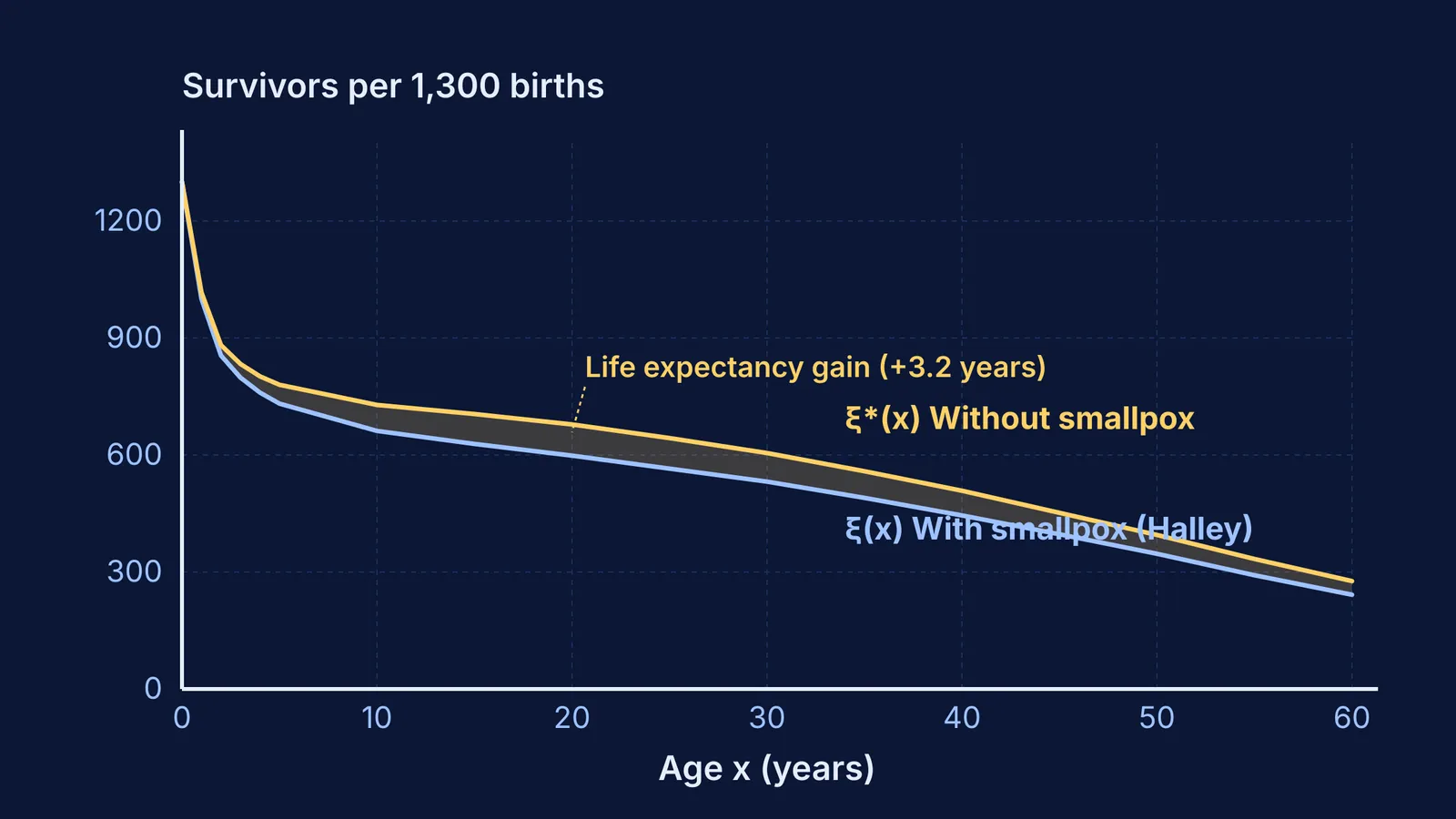
Using Edmond Halley's Breslau life table from the Philosophical Transactions of the Royal Society, where 1,000 out of 1,300 newborns survived to age 1 with a life expectancy of 26 years and 7 months, Bernoulli proved that eliminating smallpox would increase life expectancy at birth to 29 years and 9 months—a gain of 3 years and 2 months.
Worked example: how much does removing smallpox increase survival at age 10?
To see how Bernoulli's formula works, calculate the counterfactual survivors at age 10 using the parameters verified in Mathematical Biosciences00122-0):
Parameters: n = 8 (annual infection rate 1/8) and m = 8 (case fatality 1/8).
Decay factor: e^(−x/n) = e^(−10/8) = e^(−1.25) ≈ 0.2865.
Multiplier: m / ((m − 1) + e^(−x/n)) = 8 / (7 + 0.2865) = 8 / 7.2865 ≈ 1.0979.
Survival gain: Halley's table records 661 survivors at age 10 per 1,300 births. Without smallpox, survivors increase to ξ*(10) = 661 × 1.0979 ≈ 725.7 (Bernoulli's discrete table gives 728.4), preserving over 65 additional children.
As age advances, e^(−x/n) vanishes and the multiplier approaches m / (m − 1) = 8/7 ≈ 1.1429, raising the adult population by 14.3%. For students learning how biological rate laws become differential equations, the Fermi Concept Library covers every concept in mathematics and biology, each with its own lesson and its place in the map.
Why did d'Alembert challenge Bernoulli's public health model?
In November 1760, Jean le Rond d'Alembert challenged Bernoulli's conclusions before the Academy, as recounted in the Journal of the Royal Society of Medicine. D'Alembert agreed with the calculus but rejected the assumption that maximizing average life expectancy is always rational for an individual.
D'Alembert argued that an individual faces an immediate 1% probability of death from inoculation today to gain extra years only in late adulthood. Discussed in Nature, this debate laid the groundwork for modern utility theory and medical ethics by distinguishing population-wide public health benefits from individual risk choices.
What does Bernoulli's model teach modern students of mathematics?
Bernoulli's paper anticipated modern compartmental epidemiology, including the basic reproduction number R₀ and the SIR framework, as shown in Mathematical Biosciences00122-0). His mathematical principles connect directly to demographic models such as Pierre Verhulst and the logistic curve of population growth and modern vaccine trial analysis demonstrated by Gagandeep Kang and rotavirus.
For exam preparation, Bernoulli's substitution illustrates how recognizing structure simplifies nonlinear differential equations. When practising step-by-step solutions, students can work through problems in the Fermi Problem Library, where worked problems feature a step-by-step solver that explains the reasoning rather than printing an answer. To strengthen your integration technique, explore our guide on differential equations for JEE.